“The Junior Who Learns by Getting Chewed Out by Seniors? They’re Gone Now”—Even Practical Work Know-How Is Being Learned from AI [AI Sapiens—Asking About Intellectual Sovereignty, Part 4]
- Input
- 2026-09-02 06:00:00
- Updated
- 2026-09-02 06:00:00

AI is being used for workplace document tasks such as drafting reports, organizing meeting minutes, and searching market data. While processing has become faster, the time available to read source materials, establish standards for judgment, and learn how to do the work may be shrinking. In Part 4, we examine how AI is changing the way companies work, how employees develop expertise, and the workplace environment.
[Financial News] #. Employee A, who is in the second year of his career, enters internal company materials into artificial intelligence (AI) whenever he prepares a market research report. After asking AI to organize the materials by category and produce tables and conclusions, he has a draft report within minutes.
A has become accustomed to revising sentences and checking figures against the original text. However, when his team leader recently asked at a meeting, “What judgment did you make based on this figure?” he could not answer immediately. He had to look again for the materials used to produce the conclusion generated by AI.
“The time I spend writing reports has decreased, but so has the time I spend learning the work by reading the materials from the beginning,” he admitted. “I realized that finding problems in a draft and understanding the work from the ground up are two different things.”
More office workers are using AI for tasks such as drafting reports, translating, organizing meeting minutes, and searching market data. After entering the materials, they ask AI to provide the key points, anticipated questions, and even the direction of the conclusion all at once. Once a draft is produced, the user polishes the wording or revises it to fit the company’s format.
Although document quality may improve, the way newcomers, including newly hired employees, learn their jobs is changing. In the past, they learned the structure of a report by reading materials and asking senior colleagues questions. Now, they are increasingly introduced to the work by revising results generated by AI.
B, an office worker in his 30s, uses AI to organize customer inquiries. When multiple inquiries are entered, AI categorizes the types of complaints and assigns processing priorities. B once inserted the table directly into materials shared with his team, only to discover later that one customer’s repeated complaints had been classified as a routine inquiry.
The draft produced by AI and final responsibility for the work remain separate. Even when AI summarizes materials, a person must decide which sources to trust, check whether anything is missing, and determine whether the conclusion serves the purpose of the work. This review process is also necessary for newcomers, but their experience of reading source materials and formulating questions may diminish.

The impact of AI on the workplace cannot be explained solely by asking whether jobs will disappear. In practice, change emerges first in specific tasks within a job rather than across entire occupations. When repetitive tasks such as drafting reports, summarizing materials, and classifying customer inquiries are handed over to AI, the order and content of the work left to people also change.
A similar analysis has emerged in South Korea’s labor market. At a seminar held last December by the Korea Labor Institute (KLI) and the Organisation for Economic Co-operation and Development (OECD), Noh Seri, a research fellow at KLI, estimated that 8.4% of entire jobs would be replaced. The analysis found that some tasks would be replaced in 56.6% of cases, while 35.1% would involve the creation of new tasks that did not previously exist.
This means AI is more likely to change the composition and order of work than to eliminate people’s jobs wholesale. While the task of organizing materials directly may decline, verifying the accuracy of AI-generated results, comparing multiple sources, and reflecting the context of customers or the field will become more important.
The meaning of the repetitive tasks traditionally learned by new employees is also changing. As simple data entry and draft writing decline, newcomers may be freed from repetitive work. At the same time, they may have fewer opportunities to learn the industry knowledge, document-writing methods, and standards of judgment they once acquired naturally through that process.
Correcting AI-generated results has also become a task in its own right. Reviewing a report draft requires checking whether the figures match the source materials, whether any conditions have been omitted, and whether the conclusion fits the company’s decision-making needs. The ability to merely polish sentences is not enough.
These changes are also reflected in the experiences of A and B. Even when AI produces a table and conclusion, A is the person who must explain them at a meeting. Even when there is a table categorizing customer inquiries, B is the person who must decide which complaint should be handled first. The more AI produces drafts, the more human work shifts toward reading, questioning, and reassessing the results in the context of the job.
However, reviewing results requires prior experience reading source materials. It is difficult to learn which figures matter, why recurring complaints are a problem, or what decision a report’s conclusion should lead to simply by revising a draft. The more AI takes over the initial stages of work, the more reason there is to create separate channels through which new employees can learn the basic structure of their jobs.
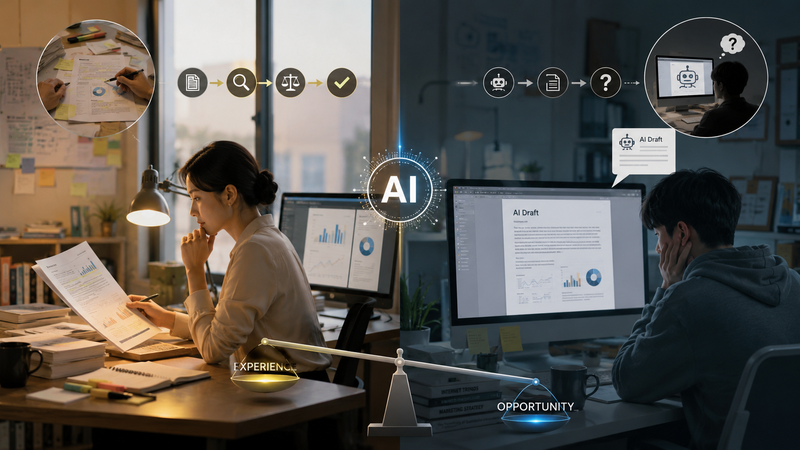
The impact of generative AI does not appear in the same way for every employee. People with extensive work experience may already have standards for comparing and revising AI-generated results. Those who are just learning their jobs, by contrast, may encounter conclusions from the outset through AI-generated drafts.
For newcomers, the important question is not simply whether they use AI. The stage at which they receive an AI-generated draft also matters. Receiving the conclusion before reading the source materials may speed up the work, but it reduces the time available to raise questions about the materials and establish standards for judgment.
In this regard, A has not stopped using AI. Instead, he changed the order of his work by first marking the key figures and issues in the source materials before receiving a draft, then comparing them with the conclusion generated by AI. “It is difficult to say that I understand the work simply because I corrected a document produced by AI,” he said. “I first try to check whether it is material I can explain at a meeting.”
[email protected] Han Seung-gon Reporter