Flood Missing in Nepal and Tibet Rise to 2,482, Death Toll Climbs to 584
- Input
- 2026-08-29 00:06:53
- Updated
- 2026-08-29 00:06:53
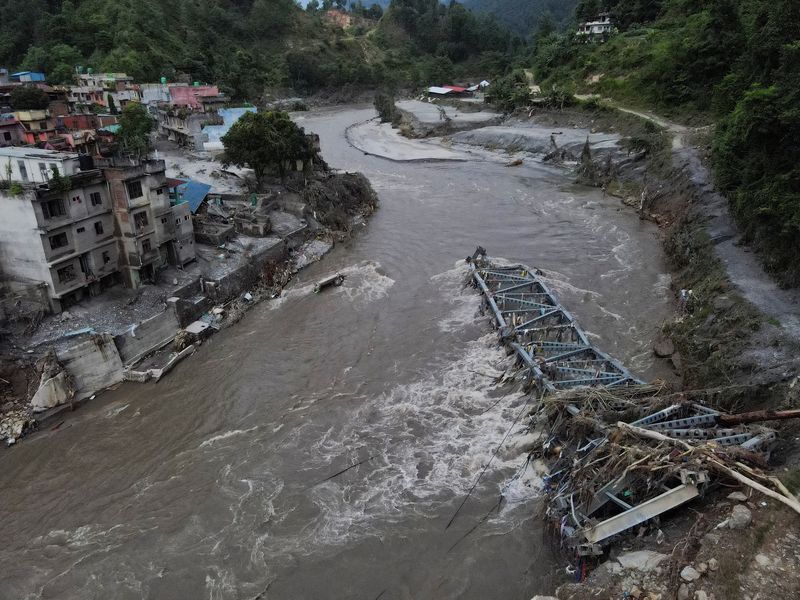
[Financial News] Three days after massive flooding and landslides hit the border region between Nepal and China, the number of missing people has climbed to nearly 2,500. The death toll has also risen to around 600.
According to foreign media outlets, including Agence France-Presse (AFP), Nepalese rescue authorities said in a statement on the 28th that at least 579 people had died in the flooding on the 26th. In a separate announcement the same day, they said 977 people were missing, including 517 foreigners. Later that day, however, the rescue authorities said the number of missing had risen to 1,924.
Around 8:37 a.m. on the 26th, a massive flood struck Bagmati Province in north-central Nepal, near the border with China. The flood also triggered large-scale landslides on the Chinese side. On the 27th, Xinhua News Agency and China Central Television reported that three people had died and 558 were missing after a landslide the previous day in Dingri County, Xigaze City, in the Tibet Autonomous Region. Among the missing, 260 were foreign nationals. Chinese authorities said on the 28th that the death toll had risen to five, but they did not change the number of missing. As a result, the combined confirmed death toll and number of missing in Nepal and China stood at 584 and 2,482, respectively.
Nepalese rescue authorities said that by the afternoon of the 28th, 14,829 security personnel had been deployed and 3,742 people had been rescued from flood-hit areas. Of those rescued, 121 were foreigners. They also evacuated 3,253 people by helicopter, and the injured were taken to hospitals in Kathmandu and other areas.
At midday on the 28th, a "natural dam lake" formed by debris flows in the upper Himalayan region overflowed. As a result, both Nepal and China temporarily suspended rescue operations over fears of a second flood, then resumed them.
Local media outlet The Kathmandu Post reported that Nepal had received requests from South Korea, India, China, the United States, the United Kingdom, Japan, Sri Lanka, and Bangladesh to allow their search and rescue teams to join the operation. Lok Bahadur Chettri, spokesperson for Nepal’s Ministry of Foreign Affairs, said, "It is natural for other countries to offer help," but added, "Our security agencies are carrying out the search and rescue work, and at this point we do not need such assistance." He also said, "The Nepalese security forces have enough capability to conduct rescue operations," and added, "We will ask for professional help or expertise when needed."
That day, Nepalese military authorities worked to rescue about 100 people trapped inside a flooded tunnel at the Upper Trishuli-1 Hydropower Project (UT-1). The facility, the largest in Nepal, was under construction by missing workers from Doosan Enerbility and Korea South-East Power Co., Ltd. Nepal Army spokesperson Raja Ram Basnet said, "We deployed two helicopters, but it is difficult even to identify the tunnel entrance."
David Fisher, head of the Nepal delegation of the International Federation of Red Cross and Red Crescent Societies (IFRC), said at a press conference in Geneva, Switzerland, that at least 93,000 people had been affected. "Urgent assistance is needed, and the risk of a second flood is also a major concern," he said.
[email protected] Park Jong-won Reporter