How Far Must Endoscopic Spine Surgery Advance to Be Considered 'Skilled'? [Health Check]
- Input
- 2026-08-28 17:53:01
- Updated
- 2026-08-28 17:53:01
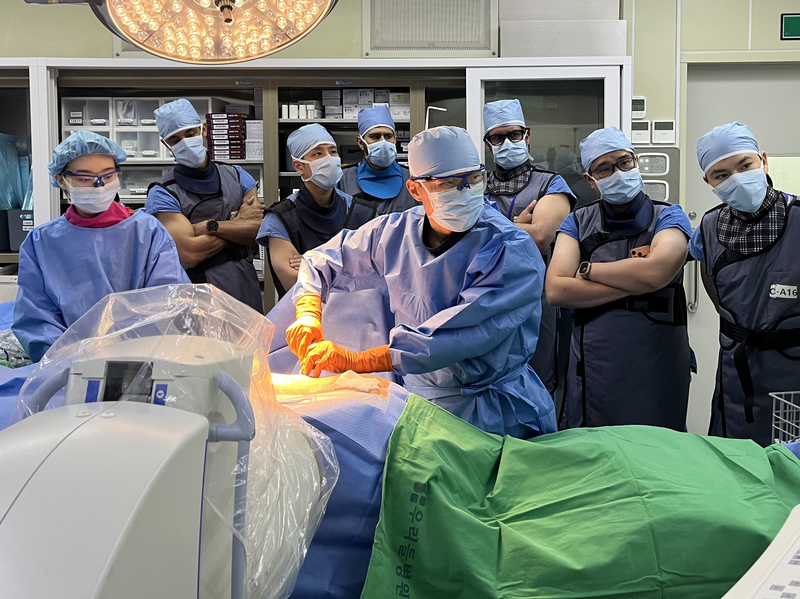
[Financial News] Endoscopic spine surgery is expanding beyond lumbar disc herniation and spinal stenosis to include cervical and thoracic conditions, but standardized criteria for evaluating medical staff proficiency remain insufficient.
A research team at Cheongdam Wooridul Hospital, a spine specialty hospital, conducted a comprehensive review of global studies on the learning curve for endoscopic spine surgery and announced findings that standardized training and objective proficiency assessments are needed to safely expand the technique.
Endoscopic spine surgery is a treatment method designed to minimize damage to healthy tissue by making only a small skin incision and approaching the lesion through an endoscope. However, surgeons must distinguish nerves from surrounding tissue in a narrow operative field while watching a monitor and precisely manipulate surgical instruments, which requires systematic training and sufficient clinical experience.
The term 'learning curve' refers to the process by which medical staff repeatedly gain experience with a new surgical technique until their operation time, accuracy, and technical performance reach a certain level. As the scope of endoscopic spine surgery expands beyond lumbar disc herniation and spinal stenosis to cervical and thoracic diseases and revision surgery, how to evaluate and train proficiency has emerged as an important research issue.
The team searched the Web of Science Core Collection for relevant papers published through March this year. After manually reviewing titles and abstracts, it selected 53 studies that specifically addressed the learning curve of endoscopic spine surgery for final analysis.
The analysis found that related research increased sharply after 2019. Major topics included 'learning curve,' 'lumbar disc herniation,' and 'percutaneous endoscopic lumbar discectomy.' By country, China produced the most papers with 26. South Korea also played a major role in the development of endoscopic spine surgery, showing strong citation impact relative to its publication volume.
The research trend has also changed. Early studies focused mainly on technical questions, such as whether endoscopy could be used to treat specific spinal diseases. More recent studies have increasingly examined how to objectively determine when surgeons reach a consistent level of proficiency.
In particular, cumulative sum analysis, or CUSUM, which tracks cumulative changes in surgical outcomes, and step-by-step methods for evaluating technical performance have drawn attention. This reflects a shift away from simply counting the number of surgeries performed and toward a more comprehensive assessment of operation time and outcomes.
So far, however, learning curve studies have focused mainly on lumbar endoscopic surgery for treating disc herniation. The team pointed out that there is relatively little research on more difficult procedures such as cervical and thoracic endoscopic surgery, revision surgery, and endoscopic fusion surgery. It said further studies are needed to establish step-by-step training programs and standardized proficiency criteria according to disease type and surgical difficulty.
Hospital Director Shin Sang-ha explained, "Endoscopic spine surgery is not a treatment that can be judged solely by its small incision size." He added, "To accurately treat lesions while protecting nerves and healthy tissue in a limited space, medical staff need sound judgment, repeated training, and a systematic education program."
He continued, "This study shows that the focus of endoscopic spine surgery research is shifting from whether the procedure is possible to how proficiency can be objectively verified." He said, "To improve patient safety, standardized training and technical evaluation systems must develop alongside treatment experience."
Patients should also not decide on treatment based only on whether endoscopic surgery is available. Even for the same lumbar disc herniation or spinal stenosis, the appropriate treatment may differ depending on the lesion's location and extent, the degree of nerve compression, spinal instability, and the patient's overall condition. Therefore, it is important to consult medical staff with sufficient experience in the disease and treatment method based on an accurate diagnosis.
The paper, titled "The Learning Curve of Endoscopic Spine Surgery: Global Research Trends, Knowledge Gaps, and Future Directions," was jointly conducted by Hospital Director Shin Sang-ha, Chairman Sang-Ho Lee, Honorary Director Bae Joon-seok, and Directors Geum Han-jung, Kim Shin-jae, and Choi Yong-su of Cheongdam Wooridul Hospital, together with researchers from Mexico. It was recently published in the international journal Asian Journal of Neurosurgery.
[email protected] Medical Reporter Jung Myung-jin Reporter