[Handongha's Boncho Yodam] Palmi-hwan Was a Famous Prescription That Strengthened Kidney Yang, Even for Physicians
- Input
- 2026-08-29 06:00:00
- Updated
- 2026-08-29 06:00:00
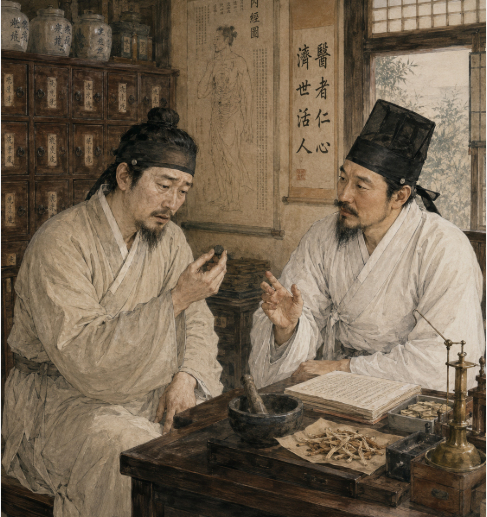
Once there was a physician. He was constitutionally frail. Since his youth, he had suffered from kidney deficiency, with ringing in the ears, lower back pain, weak legs, and cold knees. He also had a burning sensation in his palms and soles, night sweats, phlegm, and a cough.
Every morning, while he was still at the table, he would collapse as if falling over and drift into a dazed sleep. He was also sluggish in movement. In addition, he suffered terribly from severe indigestion.
He thought to himself, "This must be due to weak qi and insufficient essence." So he took medicines such as Daebo-eum-hwan and Cheongsang-boha-hwan to nourish kidney essence, but they had no effect at all.
He then reasoned, "This is probably because both the spleen and the kidneys are deficient. The cold-natured medicines and phlegm-treating remedies only addressed the symptoms and did not treat the root cause. It would be better to take Yukmijihwang-hwan to nourish the damage to all five organs."
He was concerned that cooked rehmannia would weaken the stomach and cause indigestion, so he processed it with ginger before using it. After taking about half a dose, his symptoms were reduced by more than half, and the indigestion suddenly disappeared.
He found it remarkable that he could take cooked rehmannia without developing indigestion. After that, whenever he saw patients with kidney deficiency and food stagnation, he immediately recommended this prescription. Strangely enough, although people worried that it would worsen digestion, it actually helped bowel movements and did not interfere with digestion.
He recalled a line from Huang Shangu, who said that when he took dodder seed, its digestive effect was like pouring hot water over snow. Strengthening the kidneys also improved digestion.
In fact, this experience was possible because both he and his patients had symptoms caused by kidney deficiency and were constitutionally suited to cooked rehmannia. As he had originally feared, people with weak stomachs will inevitably develop indigestion and diarrhea if they take cooked rehmannia. Processing it with ginger reduces that risk, but in most cases the problem still occurs.
After that, he would sometimes take Yukmi-hwan, adding two pieces of placenta, along with medicines such as Ophiopogon root, Schisandra chinensis, anemarrhena rhizome, and phellodendron bark. He would take about four or five doses in all. Although he did not feel that it produced any especially remarkable effect, he generally ate well, stayed healthy, and had no other illnesses.
However, after stopping the medicine for several years, his symptoms seemed to worsen again. In particular, he suffered greatly from a feeling of fullness in the upper abdomen and indigestion. He could not eat rice cakes or sweets made with honey at all.
Normally, such symptoms would be treated with a prescription focused on the stomach and intestines. But when he again took the earlier prescription containing cooked rehmannia, the symptoms would soon stop. While taking it, the color of his urine also became clearer. His usual urine had been a deep red, and immediately after urination it would quickly turn cloudy, like yellow muddy water. But after taking the prescription for a while, the urine became clear and sediment settled at the bottom.
Time passed like this. Every year, toward the end of winter, he would inevitably develop dry, burning lips. And throughout the four seasons, his palms and soles were always warm.
One day, a physician friend asked him, "You suffer from similar symptoms every year. What do you think is the cause?" He replied, "Wouldn't my symptoms be caused by a deficiency of kidney water?"
The friend asked again, "But when you urinate, you have little force and no sound in the stream. Could the cause be not only kidney water deficiency but also kidney yang deficiency?" He then said, "Now that I think about it, I sometimes feel a faint numbness inside my lower abdomen and penis. That must be due to deficiency of the kidney's true yang. My vitality also seems to have weakened."
The friend said, "Then how about trying Palmi-hwan? You are already 60, so your kidney yang must have weakened. There is probably no better medicine than Palmi-hwan for this."
Following his friend's advice, the physician prepared pills according to the original Palmi-jihwang-hwan formula, adding large aconite processed by soaking in children's urine and one nyang each of hot cinnamon bark. After taking them, the color of his urine changed to a pale yellow, and a clear sound of forceful urination appeared. His other symptoms also seemed to lessen, and his kidney qi improved greatly, to the point that it was no worse than in his youth.
He told his friend, "Seeing how much Palmi-hwan helped me, it turns out my symptoms were caused by kidney yang deficiency all along. Thank you." His friend replied, "Your symptoms looked like heat on the surface, but because the kidney yang was deficient, taking warming herbs such as cinnamon bark and aconite actually made your urine clearer."
Whenever symptoms appeared, he took Palmi-hwan, and they would disappear again. For him, Palmi-hwan was no longer a prescription that saved patients, but one that saved his own life.
Palmi-hwan is also commonly called Shinki-hwan or Geumgwe Shinki-hwan. It is used when both yin and yang of the kidneys are deficient, causing coldness and weakness in the lower back and knees, cold hands and feet, low energy, or frequent and unsatisfying urination. In particular, it is a representative prescription for older men whose bodies are weak and cold and whose urinary function has declined, as it helps strengthen kidney yang and restore kidney qi.
Source of today's Boncho Yodam story
/ Handongha, Director of Handongha Korean Medicine Clinic
[email protected] Medical reporter Jeong Myeong-jin Reporter