[Exclusive] Pay TV squeezed by OTT as government launches probe into struggling firms
- Input
- 2026-08-30 16:27:11
- Updated
- 2026-08-30 16:27:11
According to industry sources on the 30th, the KMCC recently commissioned an outside institution to examine management indicators for domestic cable system operators and other pay TV providers. The goal is to identify struggling firms early and draw up management measures as the crisis in the cable system operator sector accelerates.
The survey found three struggling firms: DLive, Ulsan Broadcasting Corporation (UBC) and Korea Cable TV Pureun Broadcasting. A struggling firm refers to a company that cannot cover interest expenses with operating profit.
DLive posted operating profit of 3.9 billion won last year, rebounding from the previous year thanks to aggressive cost-cutting. However, its total equity, calculated as assets minus liabilities, stood at minus 74.1 billion won, leaving it in complete capital impairment. UBC continued to post losses, recording an operating loss of 2 billion won last year amid falling advertising revenue and other setbacks.
JTBC’s rehabilitation filing is said to have been the decisive trigger for the probe. On June 12, JTBC declared default after failing to repay 20.6 billion won in securitized borrowings by the maturity date. On the 28th, the court ended JTBC’s autonomous restructuring support program and ordered the start of rehabilitation proceedings, effectively putting the company on a path toward sale.
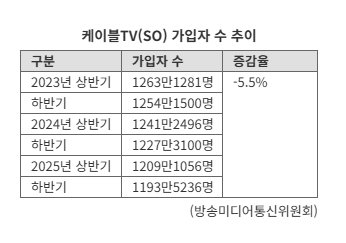
The survey also found that many cable system operators not classified as struggling firms have seen their finances deteriorate sharply. According to the Korea Cable TV Broadcasting Association, total operating profit for the cable television industry plunged from 348.6 billion won in 2017 to 14.8 billion won in 2024, a drop of 95.8%. This suggests that the problem is not limited to a few troubled companies, but reflects a broader decline in profitability across the cable television sector.
An industry source said, "Over the past few years, changes in the media environment have pushed many pay TV operators, especially in the cable television sector, to the edge financially." The source added, "The KMCC also appears to be beginning to recognize the seriousness of the structural weakness in the pay TV market."
However, it remains unclear whether the survey will lead to swift measures to revitalize pay TV, including cable television.
Industry observers say pay TV issues have effectively been pushed to the back burner among the government’s policy priorities. The KMCC held the first meeting of a public-private consultative body on pay TV revitalization on the 20th, but it reportedly produced little beyond a repetition of existing positions from operators with conflicting interests, including cable system operators and program providers (PP), without any concrete measures or direction.
An industry source said, "While measures such as regulatory easing to revitalize pay TV keep being postponed indefinitely, companies are being driven to the brink."
[email protected] Jang Min-kwon, Choi Hye-rim Reporter