"Is Samsung Electronics' stock run over?"... Why the market still says 'buy'
- Input
- 2026-08-29 08:00:00
- Updated
- 2026-08-29 08:00:00
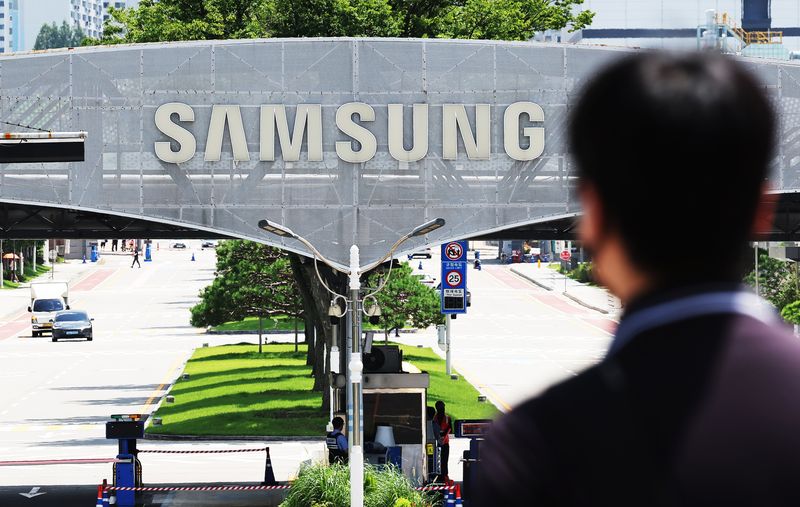
[Financial News] Why are securities firms still calling for Samsung Electronics? Although the stock is weak right now, they point to massive shareholder returns, an improving memory market, and strong competitiveness in high-bandwidth memory (HBM).
According to the Korea Exchange on the 29th, Samsung Electronics closed at 257,000 won on the 28th, down 3.38% from the previous day. SK hynix also ended at 1,653,000 won, down 4.45%. As the two leading semiconductor stocks fell together, the so-called '260,000-won Samsung' and '1.7 million-won Nix' levels were broken.
However, Mirae Asset Securities maintained its 'buy' rating on Samsung Electronics and its target price of 370,000 won. Compared with the closing price on the 28th, that implies upside of about 44%.
Kim Young-gun, an analyst at Mirae Asset Securities, said, "Despite record-level shareholder returns, the stock is reacting too strongly to concerns over macro uncertainty." He added, "Based on the current share price, the 12-month forward price-to-book ratio and price-to-earnings ratio have fallen to 1.7 times and 4.3 times, respectively, back to levels seen before the AI cycle."
Samsung Electronics announced on the 21st that it would carry out shareholder returns worth 90 trillion won to 110 trillion won this year. That is about five times larger than the previous high set in 2020. First, it plans to distribute about 30 trillion won in cash dividends in the third and fourth quarters, including regular dividends. The rest will be finalized at the board meeting in January next year, including cash dividends and treasury share purchases and cancellations.
KB Securities also said earnings improvement and shareholder returns could together drive a re-rating of the company's value. It forecast Samsung Electronics' operating profit for the third and fourth quarters at 111 trillion won. It also estimated that if total returns reach 110 trillion won, they could consist of 70 trillion won in cash dividends and 40 trillion won in treasury share purchases and cancellations. However, this is only a securities firm's projection, and the company has not yet finalized the remaining return method.
China's semiconductor growth is also seen in the market as a variable that carries both risks and opportunities. Mirae Asset Securities said Chinese companies are expected to reach self-sufficiency in HBM3 only in about two years, making it difficult for them to catch up with Samsung Electronics' technological edge in the near term. It explained that HBM consumes about four times more production capacity than conventional DRAM, so even if Chinese firms expand HBM output, it is unlikely to directly lead to oversupply in general-purpose DRAM.
Some analysts also say China's AI investment could create new memory demand. KB Securities projected that China's AI data center capacity will double from 40 GW this year to 80 GW in 2030. It also estimated that cumulative AI data center investment in the United States and China from 2026 to 2030 could reach $5 trillion. Even if China continues to localize its semiconductor industry, surging data center demand could support memory makers' growth potential.
The outlook is not entirely optimistic. Last month, securities firms issued 580 target-price downgrade reports, far outnumbering the 351 upgrade reports. Samsung Electronics' target price also varies widely by brokerage, ranging from 360,000 won to 650,000 won, showing a sharp difference in views on the durability of the industry cycle.
Kim Jae-seung, an analyst at Hyundai Motor Securities, said, "The excessive concentration was normalized through the corrections in June and July, and the environment could allow foreign investors to resume net buying." He added, "However, because the AI investment narrative has been damaged, volatility will remain even after a rebound." In the end, he noted, reaching the '370,000-won Samsung' level will require confirmation of actual HBM shipments, long-term supply contracts, and the remaining shareholder return plan, rather than just high earnings forecasts.
[email protected] Han Young-joon Reporter