Jeju 'False Closure' Police Scandal Expands Beyond One Officer to Systemic Accountability, as Both Ruling and Opposition Parties Visit the Scene
- Input
- 2026-08-28 15:39:23
- Updated
- 2026-08-28 15:39:23
[Financial News, Jeju = Reporter Jung Yong-bok] The false closure of a missing-person report in Jeju Province has grown beyond an investigation into misconduct by one police officer and into a broader question of whether the police reporting, command, and supervision system for missing-person cases actually worked. After the Democratic Party of Korea (DPK) police reform task force inspected the scene and met the Jeju Provincial Police Agency commissioner on the 28th, the People Power Party leadership also visited Jeju the same day. Political attention is now focused on one question: why was the false closure not caught internally?
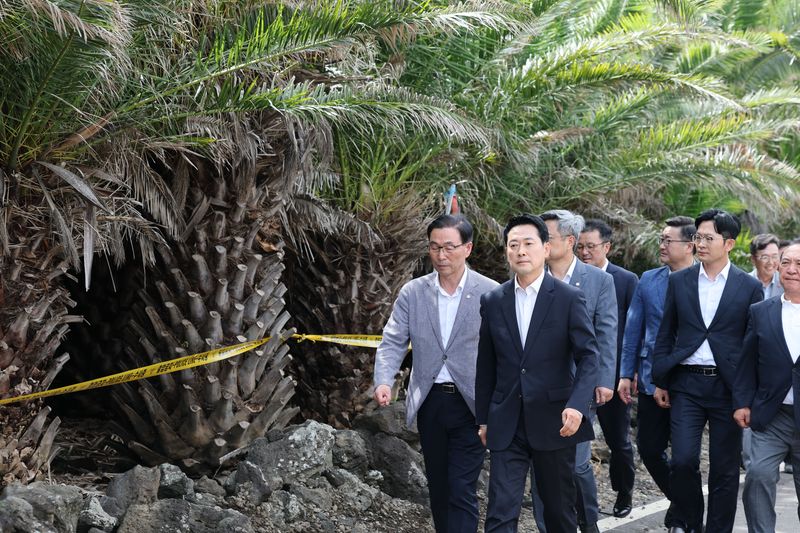
According to political and police sources on the 28th, National Assembly Security and Public Administration Committee Chair Kim Young-jin, committee member Kim Young-bae, DPK police reform task force co-heads Kim Nam-hee and Lee Hae-sik, and members Lee Joo-hee and Kim Dong-a visited the site of the missing 30-something woman's case in Hallim-eup, Jeju Province.
They examined the palm farm where the missing woman's body was found and the surrounding terrain. They also heard from police officials about the search process after the initial report and how the body was discovered.
At the scene, questions continued over why the last confirmed location of the victim's mobile phone differed from the actual discovery site, and why it took so long to find her in an area with farmland and access roads.
Police are said to have asked a telecom company to analyze the base station environment and explained that the discovery site fell within a base station boundary.
After the site inspection, the DPK task force moved to the Jeju Provincial Police Agency and met with Commissioner Ko Pyeong-gi. They focused not only on the process that led to the false closure, but also on the reporting chain after the initial report, supervisory oversight, and measures to prevent a repeat.
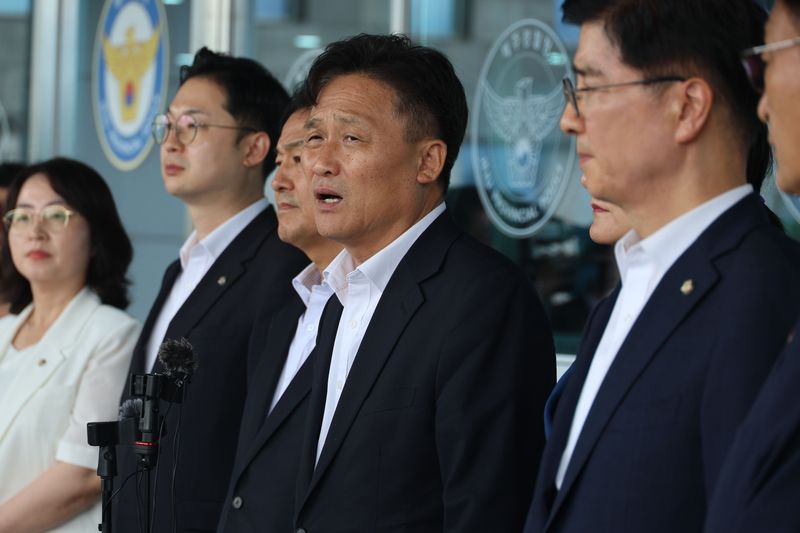
Co-head Kim Nam-hee said the case should not be seen as the misconduct of a single officer. Chair Kim Young-jin also criticized the police response, saying authorities should examine whether the case could have been resolved earlier if the situation had been properly assessed at the initial reporting stage and the search area expanded.
The visit was carried out at the direction of DPK leader Kim Min-seok. At a party Supreme Council meeting held that day on Yeongjongdo Island, Kim said he had instructed the police reform task force to "head straight to the Jeju site." The task force immediately arranged the Jeju schedule.
The reason political attention has intensified is that the problem goes beyond a false record by the officer in charge and points to a failure of internal control.
The Jeju Provincial Police Agency is currently conducting an internal probe, including a review of the night situation reports, or duty logs, from the missing-person investigation team at Jeju Western Police Station.
A night situation report is a document in which the night shift summarizes major case-handling details before leaving the next morning and reports them to superiors. Police are checking whether Senior Patrol Officer A, who falsely closed the missing-person case, omitted or inadequately recorded Jang's case in the duty log at the time.
The reporting chain is also under scrutiny. Major missing-person cases, including those involving women who may have been victims of crime, are supposed to be reported up through the local police station chief to the Jeju Provincial Police Agency. However, it has been confirmed that the initial missing-person report for Jang, filed on May 15, was not reported to the Jeju Provincial Police Agency commissioner.
Investigators are now trying to determine who should have judged the case as one requiring escalation and at what stage the report was missed.
Differences in electronic records are also being investigated. Senior Patrol Officer A is accused of entering in the 112 Police Emergency Number case record, which cannot be deleted at will, a note indicating that the likelihood of Jang being a crime victim was low. But in the missing-person management system, which he could access and edit, he allegedly classified Jang under a code related to "traffic accident casualties" and removed him from the management list. In other words, the trace of the 112 report remained, but in the missing-person management system the case was treated as if it no longer required tracking.
Jeju police are also reexamining all 298 missing-person reports handled by Senior Patrol Officer A since March last year. Investigators are checking whether cases were actually closed only after confirming the person's whereabouts and safety, or whether there were other false entries or improper closures.
So far, police have not officially announced any additional false closures beyond Jang's case and a separate case involving a man in his 60s.
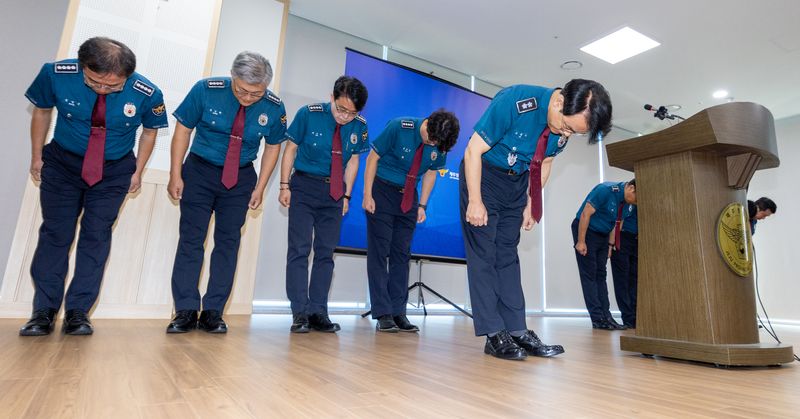
The National Police Agency's response has already expanded nationwide. Police are rechecking about 310,000 missing-person cases closed across the country over the past three years and are revising the system to generally restrict non-face-to-face closures, where a case is ended after safety is confirmed only by phone or text message.
They are also strengthening the approval process before closing a missing-person case, requiring managers to review face-to-face confirmation, identity verification, and safety confirmation materials again. The Jeju case has effectively become a trigger for redesigning missing-person manuals, electronic controls, and managerial responsibility across the national police force.
Opposition party leaders are also visiting Jeju the same day. People Power Party leader Jang Dong-hyuk is scheduled to visit the Hallim-eup site where Jang's body was found around 3 p.m. with Secretary-General Jeong Hee-yong and others, then move to the Jeju Provincial Police Agency to meet Commissioner Ko Pyeong-gi.
Jang had previously said a thorough investigation was needed into whether another missing-person case that was falsely closed was linked to a crime and whether there were any additional allegations.
Reform Party floor leader Chun Ha-ram also visited the site and met with Commissioner Ko earlier in the day. As major political figures from both ruling and opposition parties arrived in Jeju one after another, the case has expanded from a local police mishandling controversy into a broader issue of national police trust and institutional reform.
At the same time, there is also caution against equating the overall public safety situation in Jeju with this case. Democratic Party lawmaker Kim Han-kyu, who represents Jeju-si Eul, said in a radio interview that residents feel uncomfortable with claims portraying Jeju as a "crime city," adding that political circles should not unnecessarily heighten public anxiety about safety in Jeju.
In the end, the real significance of these political site visits depends less on who came to Jeju and more on what the police uncover next. The key issues are whether there were additional improper closures among the 298 cases handled by Senior Patrol Officer A, why Jang's initial report was omitted from the Jeju Provincial Police Agency commissioner's report, and at which stage the control failed in the duty-log review and command-line oversight process.
If police fail to provide clear answers to those questions, this case is likely to go beyond the criminal liability of one officer and deepen distrust in the police organization's reporting and supervision system itself.
[email protected] Jung Yong-bok Reporter