Jeju to Become a 'Global Learning Hub' as Jeju Island, JNU and HUFS Join Forces on Runcation
- Input
- 2026-08-28 15:01:22
- Updated
- 2026-08-28 15:01:22
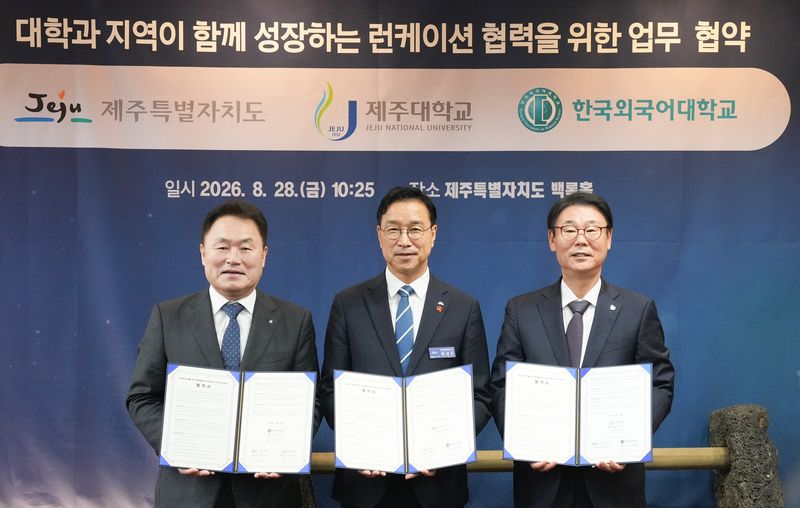
[Financial News, Jeju = Reporter Jung Yong-bok] Jeju is expanding its 'learning travel,' or runcation, model that combines local, industrial, and tourism resources with university education to HUFS. The plan is to add HUFS's strengths in foreign languages, international area studies, and artificial intelligence (AI) to JNU's regional innovation capabilities, turning Jeju into a global learning site where students from Korea and abroad can study local issues and seek solutions.
According to Jeju Special Self-Governing Province on the 28th, Jeju Island, JNU, and HUFS signed a memorandum of understanding that day at the provincial office's Baekrok Hall to build a cooperative model for learning travel in which regions and universities grow together.
The agreement is one of the flagship projects under the regional innovation talent development anchor project. Rather than simply sightseeing at a destination, the model focuses on creating an educational framework in which students stay in the region for a set period, carry out learning and projects, and interact with the local community.
The three institutions will directly connect Jeju's local issues to the curriculum. They will jointly run convergence talent global challenge project-based learning (PBL) and field projects in which students identify challenges in Jeju and local industries and propose solutions.
HUFS's strengths in foreign languages and international area studies will also be applied on the ground in Jeju. The university will create language and cultural exchange programs for foreign residents and international students in Jeju, and it will also promote programs that use the global networks of foreign students to introduce Jeju's tourism and culture overseas.
University cooperation in tourism and wellness will also be expanded. By linking Jeju's tourism, natural, and cultural resources with the educational and research capabilities of the two universities, the institutions plan to develop programs that allow students to learn in the field while connecting with local industries.
The agreement also includes cooperation on AI education. HUFS will share its basic AI education and teaching resources with universities participating in the Jeju regional anchor project, helping to strengthen the digital capabilities of local students.
For Jeju, the significance lies in expanding university exchanges beyond student visit programs and turning them into an educational platform that links local problem-solving, industrial cooperation, and international exchange.
Kang Ki-hoon, president of HUFS, said, "It is important for students to step outside the classroom and directly think about and solve local challenges on Jeju's ground." He added, "We will cooperate so that learning that begins in Jeju can extend to the world by using HUFS's language and area studies expertise and global network."
Yang Deok-soon, president of JNU, said, "We expect students and overseas scholars to come together in Jeju to think about local issues and share diverse knowledge and experiences." He added, "We will strengthen cooperation so that this exchange contributes to Jeju's sustainable development."
Wi Seong-gon, governor of Jeju Province, said, "This is the starting point for developing runcation into a global cooperation model by connecting Jeju's local, industrial, and tourism resources with the educational capabilities of the two universities." He added, "We will support efforts so that joint projects and educational programs lead to tangible results on the ground."
Going forward, Jeju Island plans to flesh out joint projects, language and cultural exchange, tourism and wellness education, and the sharing of AI educational resources based on the agreement among the three institutions. The next task is to create a virtuous cycle in which learning in Jeju and solving local problems are linked to university education, local industries, and global exchange.
[email protected] Jung Yong-bok Reporter