"Free Tuition at National Universities Should Be Redesigned Based on Students and Regions, Not University Brand"
- Input
- 2026-08-28 14:42:54
- Updated
- 2026-08-28 14:42:54
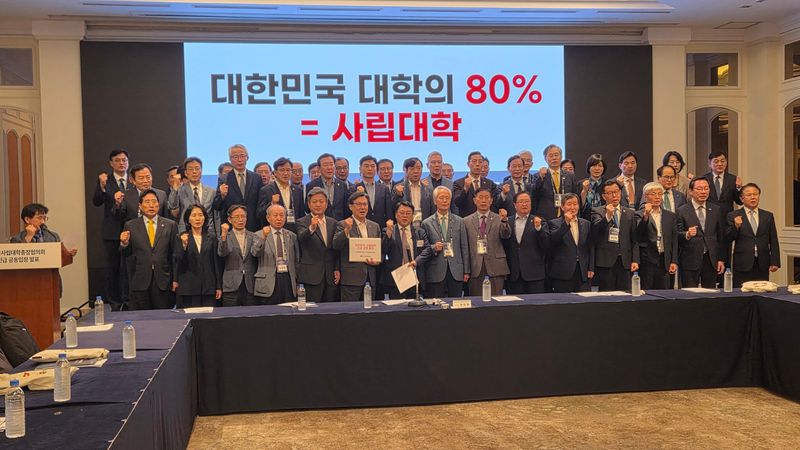
The association made the claim at an emergency general meeting on the 28th, held ahead of the '2026 Summer University Presidents' Seminar' at Lotte Hotel Jeju.
In a survey commissioned by the association from polling firm Research & Research and conducted among 500 third-year high school students nationwide, 33.3% said they would be likely to choose a university in the Seoul metropolitan area even if full tuition support for regional national universities were offered, while 19.4% said they would definitely choose one. Combined, that came to 52.7%.
Separately, 62.5% said they would still be willing to attend a university in the Seoul metropolitan area even if tuition costs were a burden, regardless of whether the policy is implemented. When asked which factors matter most in choosing a university, multiple responses allowed, 57.1% cited the university's name recognition and reputation, and 54.5% pointed to employment prospects and career opportunities. Tuition and scholarships were mentioned by only 25.8%. When preferred universities before and after the tuition support proposal were compared, the share favoring regional flagship national universities rose 4.3 percentage points from 27.6% to 31.9%, while the share favoring regional private universities fell 2.2 points from 6.6% to 4.4%.
According to the statement, as of 2025, tuition at national and public universities outside the Seoul metropolitan area is about 54% of that at private universities, while the ratio of scholarships per enrolled student to tuition is more than 20 percentage points higher at national and public universities than at private universities.
In its statement, the association said, "If the state fully covers tuition at regional national universities in this situation, the choice students and parents feel they are making will effectively widen into a gap between 'zero tuition at national universities' and 'millions of won in tuition at private universities.'" It added, "In particular, if this policy is implemented ahead of the 2027 early admissions cycle, it will inevitably deal a direct blow to student recruitment at regional private universities." It also said 64.5% of respondents agreed that full state scholarships should be provided regardless of whether a university is national or private.
Jeon Min-hyun, president of the association, explained that an analysis of 154 private universities found that about 51 are located in areas facing population decline. He warned that if students from regions at risk of extinction move to regional national universities because of scholarship benefits, it could create a reverse effect that accelerates local extinction.
Hwang In-seong, secretary general of the association, emphasized that "the government should design regional balanced scholarships based on students and regions, not on the type of university, and should invest public funds in advanced facilities and the development of strong educational programs to strengthen the education and research competitiveness of all regional universities, including private universities, which account for about 80% of higher education."
[email protected] Kim Man-ki Reporter