Cheong Wa Dae Rejects Appointment of Supreme Court Justice Nominee Son Bong-gi, Nominated by Cho Hee-dae, and Calls for Renomination
- Input
- 2026-08-28 14:48:43
- Updated
- 2026-08-28 14:48:43
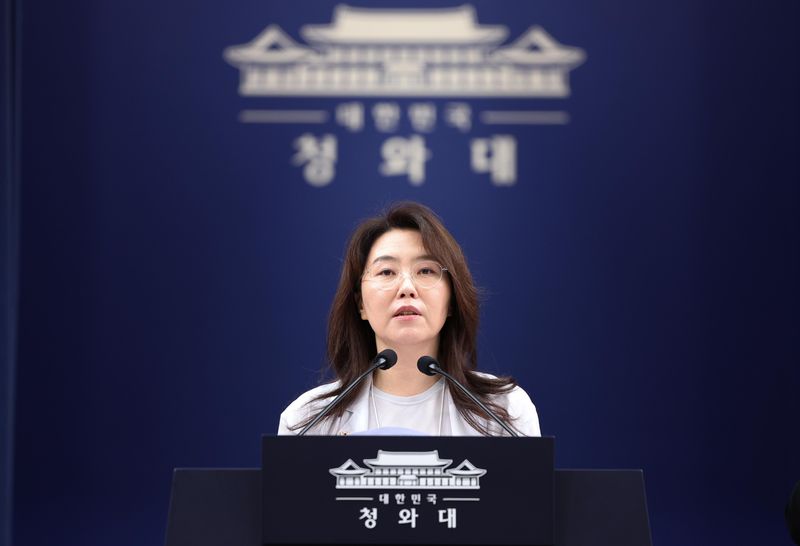
[Financial News] Cheong Wa Dae decided on the 28th not to submit the National Assembly appointment consent bill for Son Bong-gi, whom Chief Justice of the Supreme Court of Korea Cho Hee-dae had nominated as the successor to former Supreme Court Justice Rho Tae-ak. It also asked the chief justice to respect the recommendations of the existing Supreme Court Justice Nominee Recommendation Committee and renominate a candidate.
In a briefing that day, Kang Yoo-jung, Chief Spokesperson for Cheong Wa Dae, said, "The nomination for the successor to former Supreme Court Justice Rho Tae-ak does not yet have sufficient procedural completeness." She added, "The chief justice waited more than seven months before making a unilateral written nomination of Son Bong-gi on the 18th, without any substantive consultation."
Cheong Wa Dae stressed the long-standing practice of prior consultations between presidents and chief justices before Supreme Court justice nominations. Kang said, "The practice of consultation has been a procedural safeguard that prevents the Supreme Court from being formed by the will of only one side, whether the appointing authority or the nominating authority, and has effectively supported judicial independence throughout the process." She added, "For the judiciary to abandon that practice is to weaken the very basis that has sustained judicial independence until now."
Article 104, Paragraph 2 of the Constitution stipulates that Supreme Court justices are appointed by the president with the consent of the National Assembly, upon nomination by the chief justice. Cheong Wa Dae said that because the chief justice's nominating power and the president's appointment power are assigned to different constitutional bodies, the president's appointment authority must also be substantively guaranteed. Kang emphasized, "The nominating power should be understood not as a power that replaces or nullifies the appointment power, but as one that supports the proper exercise of that power."
It also pointed to a problem with the National Court Administration's move to individually contact candidates recommended by the committee just before Son's nomination and explore the possibility of restarting the recommendation process. Kang noted, "Approaching individual candidates about excluding already duly recommended nominees from consideration undermines trust in the fairness of personnel procedures."
Questions were also raised about Son himself in terms of diversity on the Supreme Court. Kang said, "Given the Supreme Court's core role in protecting the human rights of minorities and socially vulnerable people, and in guaranteeing the public's right to seek judicial relief, it is also questionable whether this nomination of Son meets the public demand for a more diverse Supreme Court composition." The successor to former Justice Rho is the first Supreme Court appointment since the launch of the Lee Jae-myung administration.
The request for renomination is effectively unprecedented since the current constitutional system was adopted in 1987. After the briefing, a Cheong Wa Dae official told reporters, "There is effectively no similar case under the current constitutional framework since 1987." The official added, "The president's appointment authority itself includes substantive review and discretion, and after legal review, we concluded that a request for renomination can be made as a power not vested in the chief justice's nominating authority."
Cheong Wa Dae said it is not calling for a new recommendation committee, but rather asking that the existing pool of candidates recommended by the committee be respected and that a new nomination be made. A Cheong Wa Dae official said, "We asked the chief justice to respect the recommendations of the Supreme Court Justice Nominee Recommendation Committee and proceed with the renomination process as quickly as possible." When asked whether President Lee Jae-myung had Kim Min-ki, a presiding judge, in mind among the candidates, the official said, "That has not been confirmed."
The appointment process for Kim Sung-soo, who was nominated as the successor to Supreme Court Justice Lee Heung-koo, will proceed as scheduled. Kang said, "As agreement was reached through consultation on Kim Sung-soo, we will submit the appointment consent bill to the National Assembly today."
On the possibility that the Supreme Court vacancy could last even longer, a Cheong Wa Dae official said, "The reason the vacancy has dragged on is the delay in nomination." The official added, "If renomination is made, Cheong Wa Dae is ready to move immediately with the follow-up procedures. We will do our utmost to ensure that the public's right to trial is not disrupted."
[email protected] Sung Seok-woo Reporter