"Could it be a hidden camera?" Point your smartphone at it, and it can be found in 5 seconds
- Input
- 2026-08-30 12:00:00
- Updated
- 2026-08-30 12:00:00
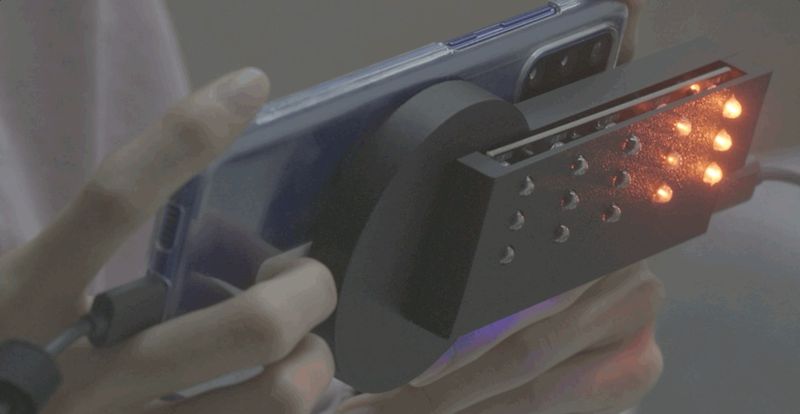
[Financial News] An AI technology has been developed that can detect hidden illegal cameras using only a smartphone and a light-emitting diode (LED) device costing around 10,000 won. The smartphone can be turned into a "hidden camera detector," offering a new security tool that anyone can use easily to protect their privacy.
KAIST said on the 30th that a research team led by Jun Han of the School of Computing, in joint research with the National University of Singapore and Singapore Management University, had developed a technology called "SweepLED" that detects hidden cameras by attaching an LED case to a smartphone.
SweepLED keeps the smartphone camera fixed while changing only the direction of the LED light and analyzes the pattern of reflected changes that appear on the surface of an object. In ordinary glossy objects, the reflection point shifts or disappears depending on the direction of the light. But a camera lens shows a uniquely distorted reflection pattern because of its internal lens, aperture, and image sensor structure.
The research team trained a deep learning-based image analysis system on these time-varying reflection patterns to distinguish camera lenses. While conventional detection methods relied on the user's eyes to simply look for a "bright spot," SweepLED stands out because AI comprehensively analyzes the movement and shape changes of reflections seen from multiple lighting angles to identify hidden cameras.
This makes it possible to more reliably detect camera lenses hidden inside a wide range of objects commonly found in accommodations, such as chargers, desk clocks, remote controls, and decorative items.
In tests on 30 objects found in real-world environments, the team recorded a detection accuracy of about 94%, and confirmed that it takes less than 5 seconds to inspect a single object. In particular, the key components of the LED case attached to a smartphone cost less than $7, or about 10,000 won, raising the possibility that it could be commercialized in the future as an affordable smartphone accessory or a consumer product.
[email protected] Youn Ji-an Reporter