Himalayas Hit by 180 km/h Flood Surge... 1,800 Dead or Missing in 7 Minutes
- Input
- 2026-08-28 13:31:54
- Updated
- 2026-08-28 13:31:54
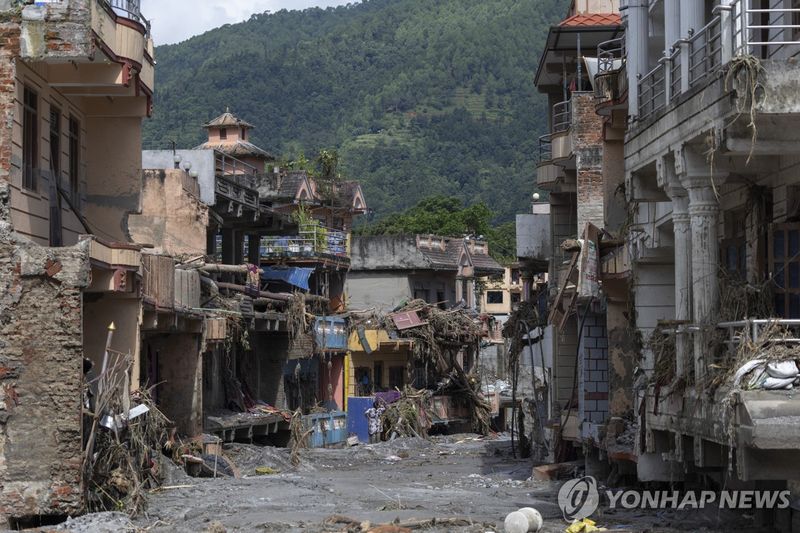
[Financial News] The death toll and number of missing people from a massive flood and landslide that struck the Himalayas on the China-Nepal border has climbed above 1,800. Analysts said bedrock and glaciers collapsed together in a high-altitude area above 5,000 meters, then turned into a debris flow racing at 180 km/h and hitting downstream areas in just seven minutes. With roads and communications networks severed, rescue efforts have been hampered. Meanwhile, ice and rock have blocked a river upstream, creating a new lake and raising fears of secondary flooding.
A torrent of debris left no time to escape
According to the governments of Nepal and China on the 28th local time, the flood and landslide that occurred on the 26th have killed 392 people and left 1,468 missing in the two countries. In Nepal, 389 people have died and 910 remain missing, while in China's Tibet Autonomous Region, three people were killed and the whereabouts of 558 others remain unknown.
The scale of the damage was driven by the disaster's extraordinary speed and force. After analyzing satellite data and field footage, researchers at the Institute of Mountain Hazards and Environment, Chinese Academy of Sciences, found that it took only seven minutes for the debris flow that began in Nepal's highlands to reach the Chinese border.
Guo Zhaocheng, head of the Geological Disaster Survey and Monitoring Center at the Center for Airborne Geophysical Exploration and Remote Sensing of Natural Resources, said, "The collapsed glacial debris flow moved at up to 50 meters per second," adding, "It was so fast that people had no time to respond, and the affected area stretched for more than 20 kilometers." A speed of 50 meters per second is equivalent to 180 km/h.
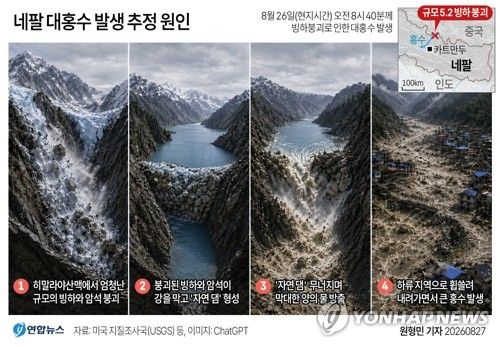
The starting point of the disaster has also become clearer. Scientists analyzing satellite images believe that bedrock beneath a glacier near Langtang Lirung collapsed first, sending a massive glacier mass tumbling into the valley as well.
Dan Shugar, an associate professor of geology at the University of Calgary, explained that "it appears not only the glacier collapsed, but also a much larger section of the mountainside bedrock came down with it."
Rock and ice that fell from an altitude of about 5,200 meters accelerated as they descended a vertical drop of roughly 3,000 meters. Along the way, some of the ice melted, and the mass picked up moraine, mud and sand, turning into a huge debris flow. The debris flow blocked the river, then burst through all at once, sweeping through downstream villages and Gyirong Port, a major land checkpoint on the China-Nepal border.
Rescue teams move to higher ground as secondary flooding looms
The number of dead and missing continues to rise, but rescue operations are facing major difficulties. In Nepal, more than 17,200 people have been deployed and have rescued more than 1,470 people, but they are relying on helicopters because roads linking Kathmandu to the hardest-hit areas have been cut off in multiple places. Eighty bridges and about 40 kilometers of road have been damaged, and communications and power networks have also been disrupted.
The bigger concern is the possibility of more flooding. Debris such as glaciers and rocks has blocked the upper reaches of the Lende River, forming a new lake. Satellite images also confirmed that the waterway was blocked at a point about 18 kilometers north of the Rasuwagadhi border checkpoint.
Nepal's disaster authorities warned that the lake's water level is rising and told residents downstream and rescue teams to leave dangerous areas. Some rescuers have also stopped searching and moved to higher ground. Rescue worker Pawan Koirala said, "I came here to carry out rescue work, but I do not want to stay near a dangerous area."
Chinese authorities also said the glacial lake currently holds about 2 million cubic meters of water, and that another 3 million cubic meters could flow in if rain falls over the next three days. As the risk of further collapse grows, China has also suspended the issuance of travel permits in border areas of Xigaze.
Experts say climate change is increasing the dangers facing the Himalayas. Rising temperatures are melting not only glaciers but also permafrost that has held rocks and soil together for thousands of years, making the ground itself increasingly unstable in high-altitude regions.
Allton Byers, a senior researcher at the University of Colorado Boulder, said, "All indicators point to the impact of global warming," adding, "Permafrost that supported rock, ice, soil and glaciers is weakening and becoming unstable."
[email protected] Kim Kyung-min Reporter