"Just a Move-in Registration Could Mean Three Years in Prison"...Cards, TVs and Telecom Data All Under Review [Real Estate A to Z]
- Input
- 2026-08-29 14:00:00
- Updated
- 2026-08-29 14:00:00
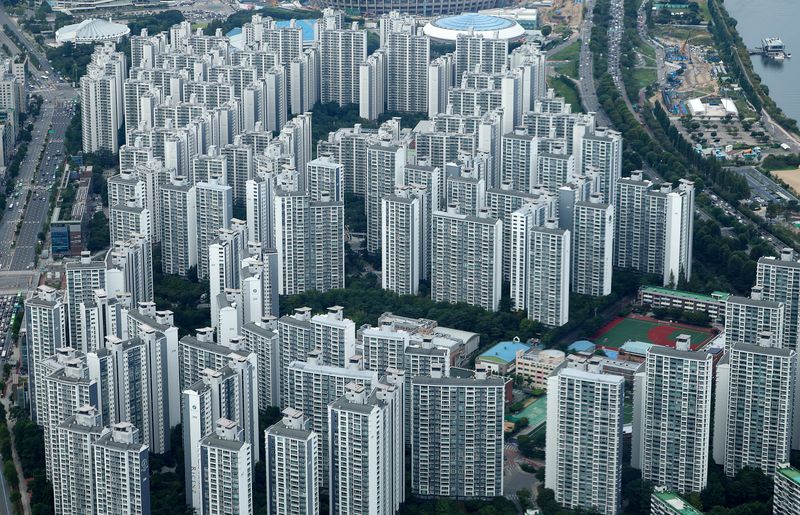
[Financial News] The Ministry of Land, Infrastructure and Transport said in a recent report to the National Assembly that it would move to block illegal acts that exploit loopholes in the system. One of the measures is a fact-finding survey on violations of the owner-occupancy requirement for homes subject to the price ceiling system.
The three-year grace period for the owner-occupancy requirement on price-capped homes has been in effect since March 2024. The end of that grace period is now approaching. Although the three-year delay has been controversial, no reform has been made yet amid indifference from the government and the political circle.
"Is the owner actually living there?"...A sweeping fact-finding survey
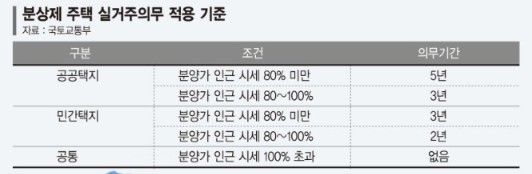
Homes subject to the price ceiling system are assigned an owner-occupancy requirement based on the ratio of the sale price to market prices. For homes on public land, the requirement is five years if the sale price is below 80% of nearby market prices, and three years if it is between 80% and 100%. For homes on private land, the requirement is three years and two years, respectively. In both public and private land cases, no owner-occupancy requirement applies when the sale price is set above nearby market prices.
The owner-occupancy requirement is decided through local government review. Kim Gyu-jung, a real estate analyst at Korea Investment & Securities Co., Ltd., said, "The length of the occupancy requirement ultimately depends on which complexes local governments classify based on nearby market prices."
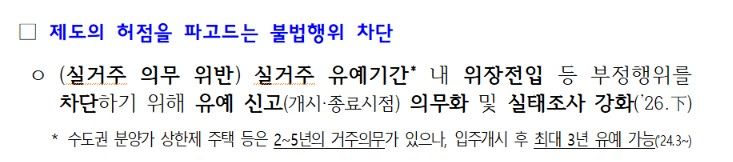
According to MOLIT's plan, it will require grace-period filings at the start and end of the period and conduct fact-finding surveys to prevent fraudulent acts such as false move-in registrations during the grace period. Detailed surveys are expected to begin early next year after related systems are revised.
The survey method will also become more detailed. According to the government, the survey will focus on verifying actual residence rather than whether a person is registered on paper. On-site inspections, in which investigators visit the property directly, will be carried out in parallel. To improve the effectiveness of these inspections, the government also plans to use telecom usage data, credit card records, TV reception data and records held by building management offices.
If a person subject to the occupancy requirement for a home under the price ceiling system does not actually live there during the required period and falsely claims to have done so, they could face up to three years in prison or a fine of up to 30 million won under the Housing Act.
"They promised reform, then showed indifference"...No one seems to care
In fact, there are many problems with the owner-occupancy requirement that should be fixed. First, whether the requirement applies, and for how long, varies depending on local government discretion.
For example, Acro Ritz County in Bangbae-dong, Seocho District, which accepted applications in December 2024, was a so-called lottery complex under the price ceiling system, with potential market gains of up to about 800 million won for successful buyers. But the owner-occupancy requirement did not apply. The local government determined that the sale price had been set above nearby market prices. Even among price-capped complexes in the Gangnam area, the rules vary widely.
Another problem is the conflict with the lease renewal request right. The owner-occupancy rule allows a three-year grace period, but rental contracts guarantee at least four years under the "2+2 years" system. In other words, if the tenant wants to stay, they can remain for four years. Yet the owner's occupancy obligation within three years effectively strips tenants of their rights.
Earlier, the Yoon Suk Yeol administration promised to abolish the owner-occupancy requirement through its Jan. 3 housing measures in 2023. However, the related legal revision stalled due to opposition from the then-opposition party and was later amended to a three-year grace period before passing in February 2024. The move was seen as an effort to take the general election held in April that year into account.
At the time, the basis for choosing "three years" was also unclear. In addition, conflicts with the renewal request right became a source of controversy. In response to the criticism, the government and political circles said they would "first implement it and then fix the problems."
But even now, three years later, no reform has been made. As the end of the three-year grace period approaches, the government has now brought out the card of a large-scale fact-finding survey.
[email protected] Reporter Lee Jong-bae Reporter