Jeju's Compact Satellite System Confirmed as a Growth Engine; Companies Call for Infrastructure First
- Input
- 2026-08-28 10:28:24
- Updated
- 2026-08-28 10:28:24
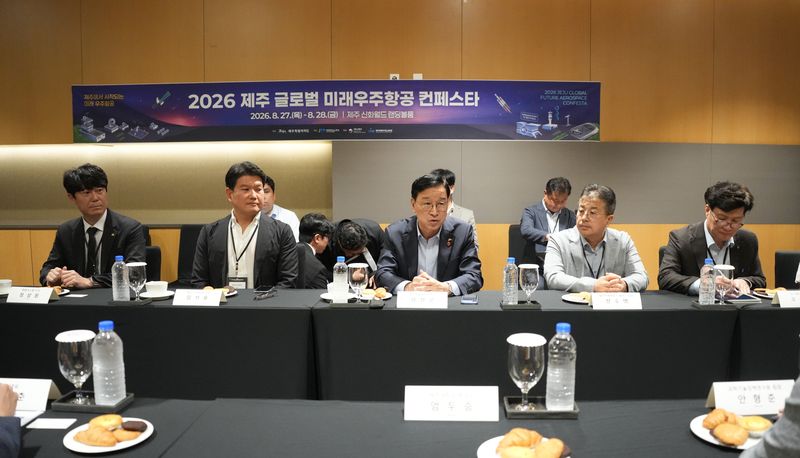
[Financial News, Jeju = Reporter Jung Yong-bok] With Jeju's Compact Satellite System officially designated as one of the government's five major regional growth engines, space companies have identified industrial clustering around satellite manufacturing facilities, shared test and launch infrastructure, and support for demonstration costs as top priorities. In response, Jeju Province plans to accelerate the creation of a full-cycle space industry ecosystem, from satellite production and sea-based launches to control, operations and data utilization.
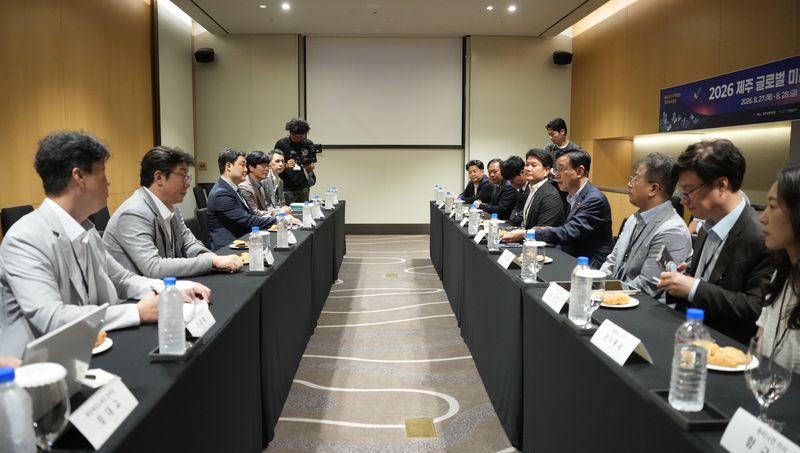
According to Jeju Special Self-Governing Province on the 28th, Governor Wi held a meeting with space companies and research institutions the previous day at the 2026 Jeju Global Future Aerospace Confesta at Jeju Shinhwa World to discuss ways to foster Jeju's space industry.
The meeting came right after the Compact Satellite System was formally selected as one of the three key growth engines for the Jeju region at the Central and Local Government Cooperation Council chaired by President Lee Jae Myung on the 26th. After the government set the industrial direction, the meeting focused on what conditions companies actually need in the market.
Companies attending the meeting included Hanwha Systems, CONTEC, Perigee Aerospace, Quaternion, TelePIX, SPEX and InSpace, covering satellite manufacturing, launch, control and data services. The Korea Aerospace Research Institute (KARI) and the Science and Technology Policy Institute also took part.
The first demand from companies was clustering. Rather than simply attracting a single satellite manufacturing facility, they said Jeju needs an industrial base where parts suppliers and partner companies can gather around manufacturers so the island can grow into a true space industry hub.
They also called for expanded test and demonstration infrastructure. Companies said shared test facilities and launch sites should be expanded, and the cost burden of early-stage demonstrations should be reduced.
They also proposed expanding testbeds that directly apply satellite data to local issues in Jeju. Companies suggested creating more demonstration environments where satellite-generated data can be used for local challenges such as the environment and agriculture, allowing business viability to be tested. The idea is for Jeju to become more than just a place to build and launch satellites, but also a market that connects data to real industries and public services.
Securing specialized talent was also identified as a key task. Companies asked for a system to train customized personnel who can be immediately deployed in the space industry, in cooperation with local educational institutions such as Jeju National University (JNU).
The industrial structure Jeju Province envisions follows the same direction. The Compact Satellite System, designated as a growth engine for the Jeju region, is focused on linking compact satellite manufacturing, sea-based launches, control and operations, and satellite data use into a single industrial chain.
Jeju has been working to attract private space companies and build a foundation for the space industry. With this growth engine designation, the province has secured a basis for expanding its support policy from individual companies and projects to an industrial ecosystem strategy that combines clustering, infrastructure, talent and demonstration.
Governor Wi said, "We will review the shared simulation programs, test and demonstration support, and the creation of an industrial base where parts suppliers and partner companies can grow together that were proposed by companies."
The satellite utilization industry will also be one of the initial growth pillars. Jeju believes that applying satellite data to local issues such as the environment and agriculture can provide companies with demonstration opportunities while creating new industrial services for the region.
Governor Wi said, "We will work to create in Jeju what Toulouse, France, has achieved, where the city and the space industry grow together," adding, "We will build an industrial ecosystem in which companies grow in Jeju and the benefits are returned to residents."
Jeju Province will begin drawing up detailed development plans for each growth engine in September. The growth engine development plan to be finalized within the year will review the clustering strategy, test and launch facilities, demonstration support, satellite data utilization and specialized workforce training measures raised by companies at this meeting.
Whether these industry demands are translated into concrete policies on land, infrastructure and cost support at a level that can lead to actual investment is expected to be the first test for Jeju's space industry growth engine.
Meanwhile, the 2026 Jeju Global Future Aerospace Confesta is being held at Jeju Shinhwa World from the 27th to the 28th. The event features an international academic conference and exhibitions and hands-on programs covering future aviation, drones, and space industry trends. More than 300 experts from 17 countries took part in the International Conference on Space Artificial Intelligence hosted by the International Academy of Astronautics.
[email protected] Jung Yong-bok Reporter