The government says it will nurture Jeju's energy, space and bio industries, but the province is left out of electricity bill discounts
- Input
- 2026-08-28 09:46:42
- Updated
- 2026-08-28 09:46:42
[Financial News, Jeju = Reporter Jung Yong-bok] The South Korean government has announced a seven-part support package, including fiscal, financial and tax measures, to turn Jeju Province into a demonstration hub for future energy, space and bio industries. But it excluded the island from the industrial electricity rate cuts designed to improve business location competitiveness. To attract more companies in the future, Jeju will need a complementary measure that can offset the advantage of the electricity bill reductions of up to 10% that other non-capital regions will receive.
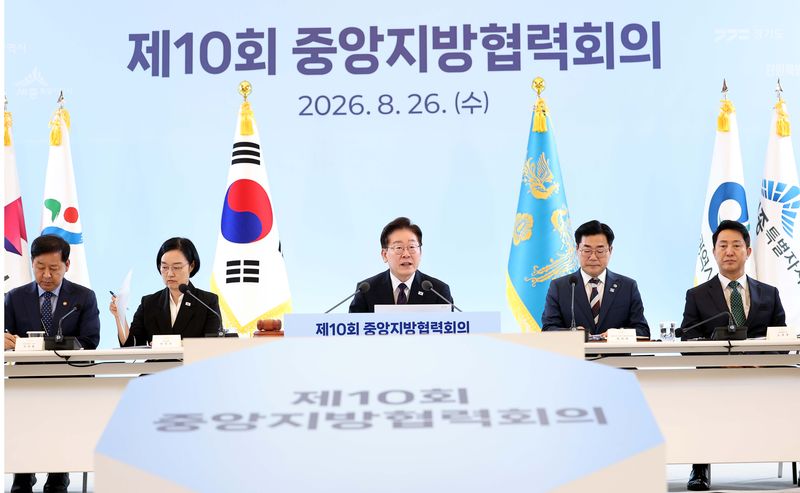
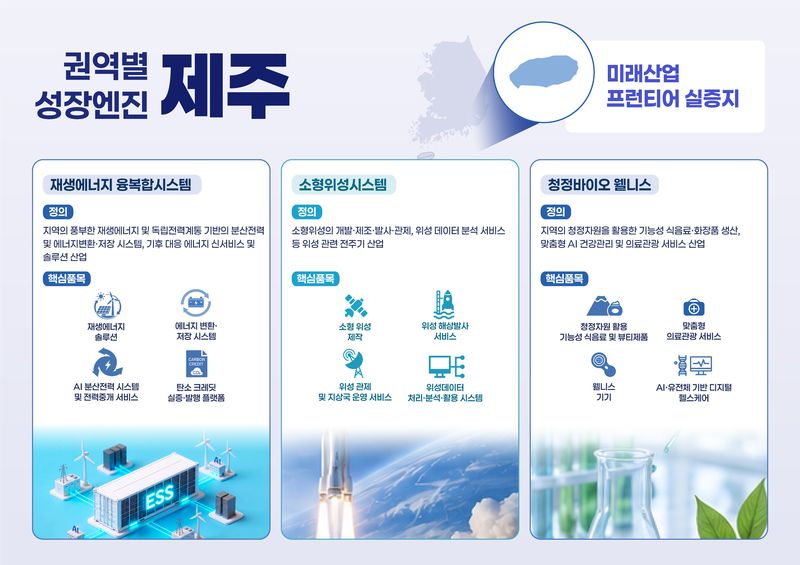
Coincidentally, the two policies were unveiled on the same day, the 26th. At the Central-Local Cooperation Meeting, the South Korean government selected three growth-engine industries for Jeju Province: renewable energy convergence systems, small satellite systems and clean bio wellness.
The slogan summarizing Jeju Province's future industrial direction was also set as "a frontier test bed for future industries." Growth-engine industries are core sectors selected by the South Korean government for each region after considering local industrial conditions, corporate investment plans, future growth potential and the national industrial strategy. The government plans to connect these industries with a cross-ministerial support package covering fiscal, financial, tax, institutional, talent, technology and infrastructure measures to back corporate investment and build an industrial ecosystem.
Jeju Province also refined its three growth engines through 26 rounds of high-level and working-level consultations with the Ministry of Trade and Industry.
In the energy sector, Jeju plans to use its high share of renewable energy and independent power grid to demonstrate and commercialize new energy industries such as energy conversion and storage, AI-based distributed power and carbon credits.
In the space sector, it aims to build an industrial ecosystem that connects small satellite manufacturing with sea launches, control and operations, and the use of satellite data. In bio, the province will expand into functional foods and beverages, beauty products, medical tourism, and AI- and genome-based digital healthcare using Jeju's clean natural resources.
Jeju Province plans to draw up detailed development measures for each growth engine starting in September and finalize its growth-engine promotion plan for the year by the end of 2026. Its strategy is to identify key projects linked to corporate investment plans and secure the government's seven-part support package to drive industrial clustering and job creation.
However, Jeju was left out of the "industrial regional electricity tariff" announced the same day by the Ministry of Climate, Energy and Environment and KEPCO. The new tariff adds a "regional adjustment charge" to industrial electricity rates, which have been applied uniformly nationwide, so that differences in local power generation and consumption conditions are reflected in prices.
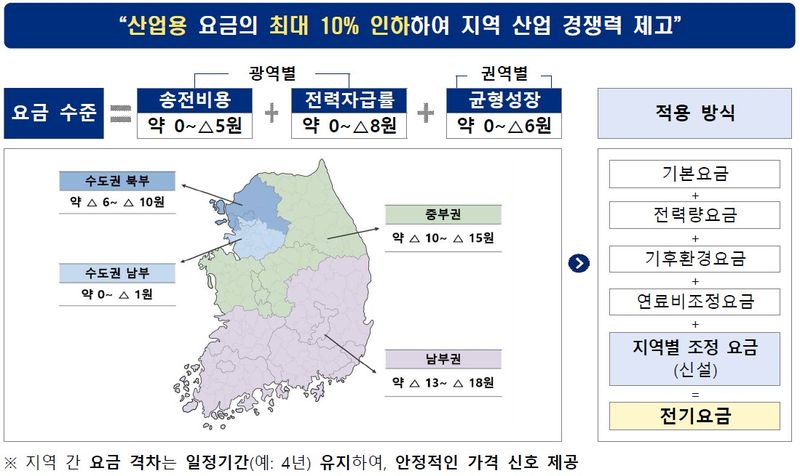
The country will be divided into four broad power-grid regions — the southern Seoul metropolitan area, the northern Seoul metropolitan area, the Central Region and the southern region — and then combined with four balanced-growth zones that reflect local preference indices and industrial crisis areas, creating a total of 11 subregions.
The calculation is based on three factors: transmission costs, power self-sufficiency and balanced growth. The idea is to lower electricity rates in areas that generate more power and have relatively weaker industrial bases, thereby encouraging companies and electricity demand to move out of the capital region.
The discount is substantial. The southern Seoul metropolitan area will either keep current rates or see only a slight adjustment of around 1 won, while the northern Seoul metropolitan area, including Incheon, will see cuts of up to about 10 won. The Central Region, including Gangwon State and the Chungcheong region, will see reductions of up to about 15 won.
The Gyeongsang and Jeolla regions in the south, where nuclear power plants and renewable energy facilities are concentrated, could see cuts of up to 18 won, or about 10% of the 2025 average industrial electricity selling price of 181.9 won.
The South Korean government estimates that the overall burden of industrial electricity rates will fall by about 2.8 trillion won. It said the rate cuts are intended to encourage high-tech industries to invest outside the capital region and to ease production costs and improve export competitiveness for existing local companies.
Jeju, however, will not receive this price signal. The Ministry of Climate, Energy and Environment and KEPCO excluded the province, citing its status as an island region and the special nature of its power supply and demand.
The background is Jeju's power market, which differs from that of the mainland. According to KEPCO, renewable energy accounted for about 65% of Jeju's generation in 2025, far above the roughly 8% on the mainland. KEPCO said the island is serving as a test bed for new power market systems, using its high renewable share to pilot measures before they are introduced on the mainland.
In Jeju, new wholesale market systems are being tested first, including a real-time power market, a renewable energy bidding system and a centralized contract market for energy storage systems (ESS).
In the retail market, the province is also considering pilot programs for systems that need to be linked to wholesale prices in real time, such as peak-save tariffs, dynamic electricity tariffs and renewable energy charging tariffs, in addition to the existing time-of-use tariff (TOU).
KEPCO believes that if the nationwide industrial regional electricity tariff were applied to Jeju at the same time, it could be difficult to separate the effects of the power market and retail tariff systems that are being tested separately.
A KEPCO official explained, "Jeju has a high share of renewable energy, so it is testing new power market systems such as the real-time market and the renewable energy bidding system ahead of the mainland," adding, "Excluding Jeju from the industrial regional electricity tariff is not meant to deny benefits, but to preserve the continuity of the existing test-bed system and continue its role as a test bed for future power market development."
The issue, however, is how it looks from a company's perspective. One of the stated goals of introducing the industrial regional electricity tariff is to encourage corporate investment in the regions. In particular, the policy is meant to lower production costs and draw high-tech industries away from the capital region.
Jeju, too, has been selected by the same government as a growth-engine industry base that must attract energy, space and bio companies.
If Jeju, which must compete with other non-capital regions to attract companies, is left without a direct cost incentive such as lower electricity rates, the key question will be how much fiscal, financial and tax support can make up the difference.
In particular, the energy sector that Jeju is trying to develop as a growth engine is itself built on the power market. If the province later expands to attract companies with large power demand, such as AI and data-driven industries, electricity rates will become a factor that is hard to ignore when deciding where to locate.
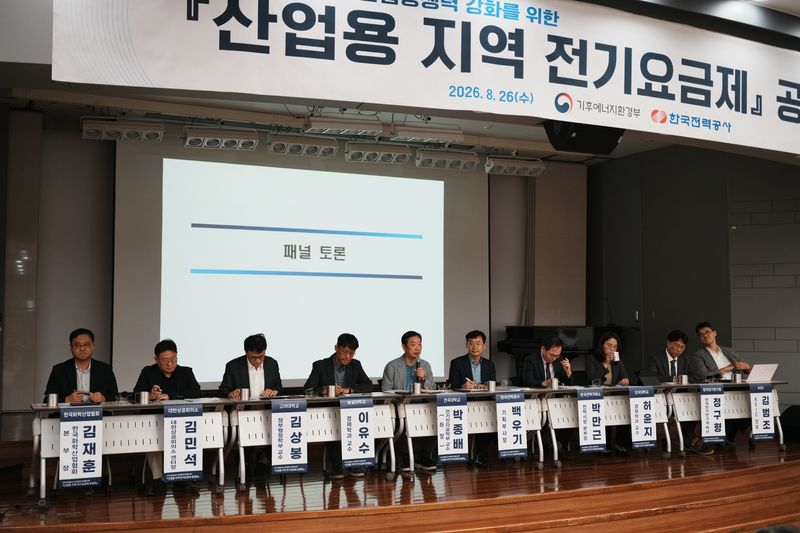
It is still too early to say whether the government's two policies are truly in conflict. The seven-part growth-engine package only outlines the direction of support, and the specific scale of fiscal, tax and infrastructure assistance for Jeju will be fleshed out in the province's development plan later this year. The industrial regional electricity tariff is also still only a draft discussed at a public hearing, and the regional divisions and final rates have not yet been set.
The key issue, then, is whether Jeju can remain a separate power market test region while also creating corporate attraction measures that can match the electricity rate cuts granted to other non-capital regions.
This issue also needs to be reflected in the growth-engine promotion plan that Jeju Province will prepare by the end of the year. To narrow the gap between the government's strategy of making Jeju a "frontier test bed for future industries" and the actual location conditions companies need, the province will have to design power prices, grid access, renewable energy use, storage systems and regulatory exemptions as one package.
Wi Seong-gon, Governor of Jeju Special Self-Governing Province, said of the growth-engine industry selection, "This is an important opportunity to develop Jeju's regional strengths and growth potential into a national future growth engine," adding, "We will build an industrial ecosystem where corporate investment, demonstration and commercialization continue, and grow Jeju into a hub for demonstration and innovation in Korea's future industries."
Whether the government's designation of Jeju as a future industry test bed will actually lead to corporate investment now depends, along with the details of the seven-part support package, on how the province will offset the cost disadvantage of a Jeju without electricity bill discounts.
[email protected] Jung Yong-bok Reporter