In Jeju, monthly rainfall was 19% of normal, but the eastern region reached 112%... Jeju City reservoir levels plunge to 28%
- Input
- 2026-08-28 09:16:33
- Updated
- 2026-08-28 09:16:33
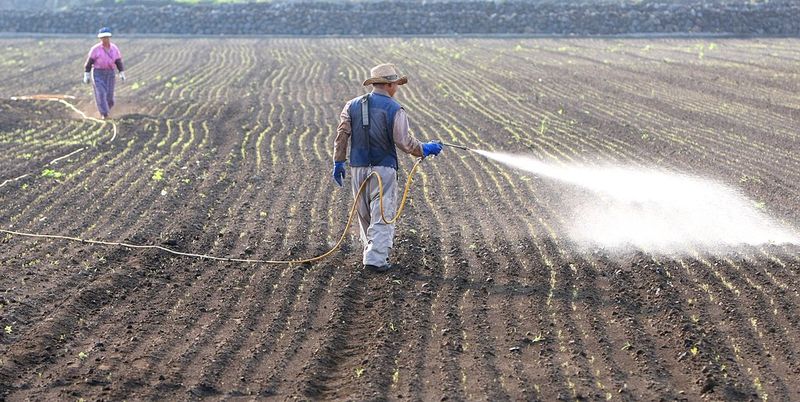
[Financial News Jeju = Reporter Jeong Yong-bok] Even within Jeju, the past month brought a stark split between areas that received less than 20% of normal rainfall and those that exceeded the average. As rainfall disparities continued across the island, reservoir levels in Jeju City dropped to 28.3%, about half the normal level, drawing close attention to regional water management, especially for agricultural use.
According to the Jeju Regional Office of Meteorology's "Jeju Island Meteorological Drought Information" released on the 28th, cumulative rainfall at the Jeju station from July 27 to the 26th of this month totaled 45.2 mm. That was just 19.2% of the normal 236.0 mm.
Chujado Islands recorded 33.5 mm, or 18.9% of normal, while Yusuam reached 71.5 mm, or 23.6%. Gapado Island stood at 36.1% of normal, Eorimok Trail at 39.8%, Gosan at 41.1%, and Hallim Port at 55.2%.
By contrast, eastern Jeju showed a completely different pattern. During the same period, Gujwa-eup received 277.5 mm of rain, or 111.9% of the normal 248.0 mm. Seongsan also recorded 331.6 mm, or 109.6% of the normal 302.6 mm.
Seongpanak logged the highest absolute rainfall at 412.0 mm, but that still amounted to only 63.7% of normal. Because the normal rainfall amount differs by location, both actual rainfall and the percentage of normal should be considered together.
The rainfall gap across the island is also evident in the six-month cumulative figures. From February 27 to the 26th of this month, cumulative rainfall reached 690.0 mm in Yusuam, or 58.6% of normal; 1,288.0 mm in Eorimok Trail, or 65.0%; and 625.5 mm at the Jeju station, or 70.9%.
By contrast, Gujwa-eup recorded 1,150.5 mm, or 113.3% of normal, while Seongsan reached 1,457.8 mm, or 115.0%. Jeju Namwon also came in at 101.2% of normal.
Over the past six months, cumulative rainfall across Jeju's observation sites ranged from 603.0 mm in Hallim Port to 2,703.5 mm in Seongpanak.
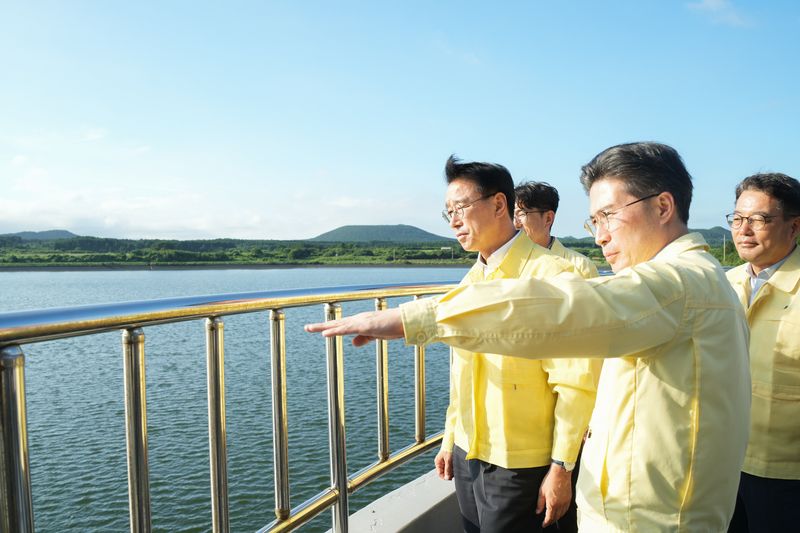
The reservoir situation shows an even clearer north-south divide. According to a tally by the Jeju Regional Office of Meteorology using data from the Korea Rural Community Corporation, the total storage capacity of reservoirs in Jeju City stood at 2.744 million cubic meters as of the 26th, with a fill rate of 28.3%.
That is 15.4 percentage points lower than 43.7% in the same period last year and 27.8 percentage points below the normal level of 56.1%. In other words, the current fill rate is only about half of normal.
Seogwipo City is the opposite. Its reservoirs are holding at 71.5% of their total capacity of 1.552 million cubic meters, exceeding both last year's 58.8% and the normal level of 64.7%. The gap in reservoir fill rates between Jeju City and Seogwipo City reaches 43.2 percentage points.
However, these figures alone should not be used to label the entire island as being in drought. As of the 26th, the Jeju Regional Office of Meteorology assessed both Jeju City and Seogwipo City as being in the "normal" stage, with no meteorological drought.
That is because meteorological drought and agricultural or household water conditions are judged by different standards. The weather agency determines whether dry conditions have persisted for a certain period compared with the average, based on indicators such as the standardized precipitation index derived from cumulative rainfall over the past six months. Actual agricultural water conditions, on the other hand, are affected by recent rainfall distribution, soil moisture, the location and capacity of reservoirs and wells, and crop-specific water demand.
There has not been a complete absence of meteorological drought this year, either. From January 1 to the 26th of this month, the number of drought days was tallied at 27 in Jeju City and 18 in Seogwipo City.
Jeju Island also detected warning signs in the farming sector last month, when rainfall shortages were especially pronounced. A soil moisture survey conducted at 39 sites on July 23 found 11 sites to be "insufficient" and five to be "slightly insufficient." The island activated a comprehensive drought response center for crops the following day to monitor agricultural water supply and crop growth conditions.
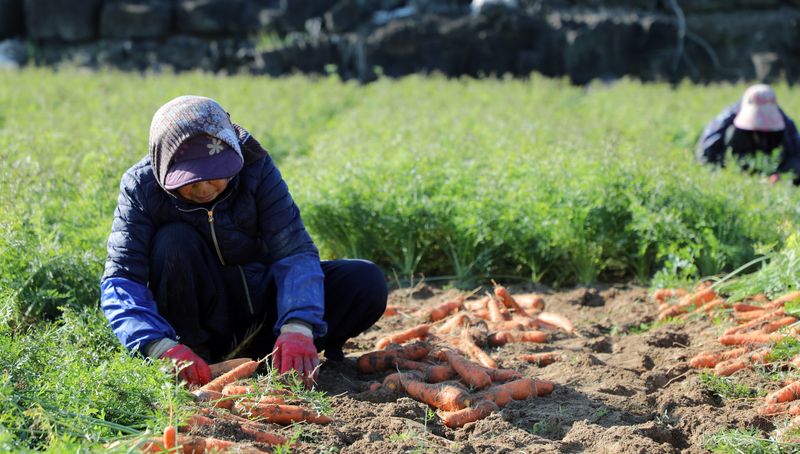
In the eastern region, where water demand rises as winter vegetables such as carrots are planted, response measures were also prepared, including opening water towers, installing shared water bags, and circulating agricultural water supplies. The drought-response facilities secured at the time included 904 public wells, 206 water towers, 318 pumps, 517 water bags, and 20.93 km of water pipelines. A second-stage response plan was also drawn up to concentrate water trucks and equipment in vulnerable areas if the drought worsens.
Demand for household water has also added to the burden of summer water management. On the 6th, Jeju Island reported that the daily tap water supply across the island reached 475,154 cubic meters, or 92% of the total facility capacity of 515,498 cubic meters. As the heat wave persisted, water use at the time was about 9% higher than the previous year's average, rising by 40,000 to 50,000 tons per day.
To stabilize household water supply, Jeju Island has put 70 of its 90 reserve groundwater wells into additional operation and is running an emergency water supply task force through September 30.
How much rain falls from here will also be a key variable. In the Jeju Regional Office of Meteorology's three-month outlook, the probability that September rainfall in Jeju will be below the normal range of 115.1 mm to 235.2 mm was set at 50%.
On a weekly basis, the probability that rainfall from September 14 to 20 and from September 21 to 27 will be below normal is also 50% each. For the period from August 31 to September 13, the outlook gives a 40% chance each that rainfall will be near normal or below normal. For October and November, the probability of rainfall being near normal or above normal is 40% each.
Although no official meteorological drought warning has been issued for the entire island, the "normal drought" indicator alone is not enough to judge local water conditions. With rainfall over the past month and reservoir levels varying widely by region, there is a growing need to examine actual agricultural water supply and well operation in Jeju City reservoirs and major farming areas together.
In particular, if rainfall shortages continue as the autumn planting season for carrots, garlic, winter radish, and cabbage gets underway, securing agricultural water could directly affect production costs and crop yields. Attention is therefore turning to future changes in rainfall and reservoir levels.
[email protected] Jeong Yong-bok Reporter