Hanwha Aerospace presents integrated manned-unmanned 'One Sky' engine, accelerating independent development
- Input
- 2026-08-28 08:48:54
- Updated
- 2026-08-28 08:48:54
[Financial News] As manned-unmanned teaming (MUM-T) emerges as a key pillar of future warfare, Hanwha Aerospace has officially unveiled its roadmap for developing proprietary aircraft engines that cover both manned and unmanned platforms under the 'One Sky' strategy. The company plans to combine 47 years of accumulated design and manufacturing infrastructure with artificial intelligence to sharply reduce engine development cycles and costs. It also aims to create a virtuous cycle in which mass-production technologies proven in unmanned engines are transferred to next-generation manned aircraft engines. The move is expected to accelerate efforts to achieve self-reliance in the 'Korean fighter jet engine,' long regarded as the final technological barrier in the defense industry, while also strengthening its position in the global unmanned engine market.
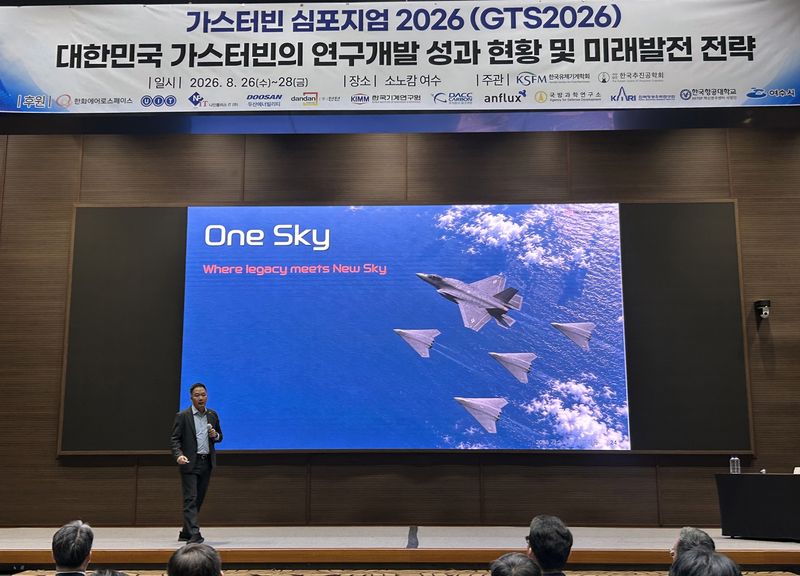
Hanwha Aerospace said on the 28th that it introduced the integrated manned-unmanned aircraft engine development paradigm, 'One Sky,' at the Gas Turbine Symposium 2026 held on July 27 in Yeosu City, South Jeolla Province. In a special lecture, Kim Seon, vice president of Hanwha Aerospace, emphasized the mutual technological convergence of 'Legacy Excellence,' centered on high-performance manned weapon systems, and 'New Sky,' the unmanned engine line focused on speed and cost efficiency. The company said the importance of rapidly mass-producing large numbers of aircraft engines at reasonable cost has grown as low-cost drones and unmanned systems have increasingly been used in exchange-rate tactics to neutralize high-value strategic assets in recent conflicts in Europe and the Middle East.
Hanwha Aerospace highlighted its vast engine data and manufacturing capabilities, accumulated over half a century, as a core strength. It has trained its in-house AI model, 'En-genius,' on experience from more than 10,000 engine test runs that resolved over 1,000 design and process defects, as well as a database of about 35,000 aircraft engine materials. The company aims to use AI simulation and 3D printing to minimize the tens of billions of won in costs and months of delays that can result from engine test failures. It is also enhancing its management capabilities across quality, cost and delivery by combining smart factories with global supply chain networks in the United States, Vietnam and other countries.
Localization of the engine pipeline is also becoming visible. In July, Hanwha Aerospace unveiled a prototype 5,500-pound-force turbofan engine for low-observable unmanned formation aircraft, developed with its own technology, along with a 1,400-horsepower-class turboprop engine for medium-altitude unmanned aircraft. Based on these achievements, the company plans to focus its capabilities on a 10,000-pound turbofan engine for future stealth drones, as well as the government-led 'advanced aircraft engine' project aimed at powering the follow-on version of the Korean supersonic fighter KF-21 Boramae and sixth-generation fighters.
Industry observers say the One Sky strategy could offer a practical solution to the high barriers to entry and enormous R&D risks involved in aircraft engine development. The approach makes it possible to secure short-term profitability and component reliability through mass production of unmanned engines, then expand that foundation into advanced high-output gas turbines.
Vice President Kim Seon said, "Technology and experience accumulated over 47 years are like designing with the answer sheet in hand." He added, "By combining accumulated data with advanced AI technology, we will concentrate our development capabilities so that South Korea can lead the new Sky era in the future aircraft market."
[email protected] Kim Dong-ho Reporter