Republican U.S. Senator Slams South Korea as "Ungrateful"...Calls for Retaliation Over Coupang
- Input
- 2026-08-28 07:17:36
- Updated
- 2026-08-28 07:17:36
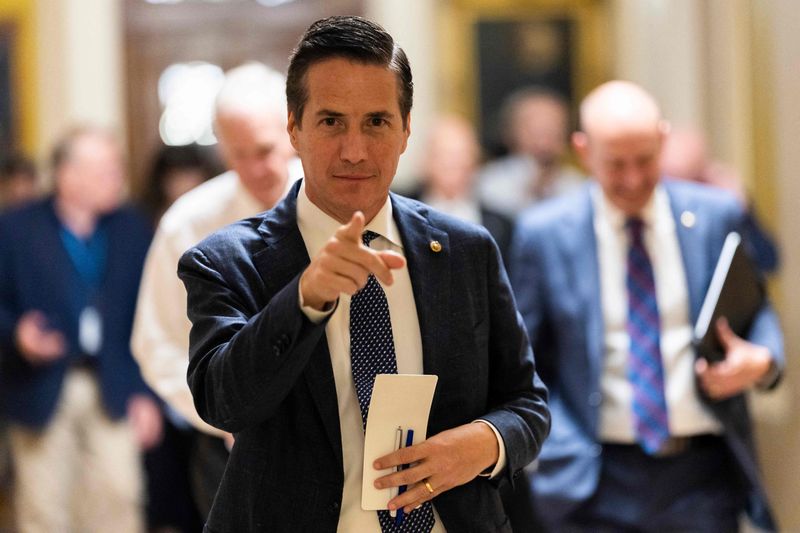
[Financial News] A ruling-party senator in the United States criticized the South Korean government's investigation into Coupang and accused South Korea of being "ungrateful." He then urged U.S. trade authorities to consider tariff retaliation against South Korea.
Republican Senator Bernie Moreno of Ohio said in a press release posted on his congressional website on the 27th, local time, that he had sent a letter to Jamieson Greer, the U.S. Trade Representative, earlier that day. In the letter, he wrote, "I will not stand by while the South Korean government weaponizes its agencies against innovators who contribute to the economies of both our countries."
He claimed in the letter that "South Korea is waging an open campaign of hostility against foreign companies through excessive compliance obligations, excessive fines, criminal prosecutions of corporate executives, and biased regulatory enforcement." He added, "Alarmingly, South Korea's offensive is disproportionately focused on American companies, undermining a long-standing alliance and trade agreement."
He specifically cited Coupang as a U.S. company that had been harmed. Moreno said of the Coupang data breach, "This data leak is a matter worthy of investigation and could be subject to fair law enforcement," but added that "the broader pattern emerging in South Korea is deeply concerning." He argued that "South Korea has used one small incident as a pretext for a broader campaign against American companies."
In the letter, Moreno referred to U.S. sacrifices during the Korean War, the presence of U.S. Forces Korea, and extended deterrence, then wrote, "It is outrageous that South Korea is repaying this partnership with systematic discrimination against American companies." He also called for an official investigation under Section 301 of the Trade Act of 1974, the launch of consultation procedures under trade agreements, and preparation of proportional countermeasures.
Enacted in 1974, Section 301 of the Trade Act of 1974 allows the United States to retaliate with import bans or tariffs when a trading partner harms U.S. companies through unfair practices or discrimination. To trigger retaliation, the Office of the United States Trade Representative must first investigate the alleged unfair conduct, and such investigations usually conclude within a year.
The United States has already invoked Section 301 of the Trade Act of 1974 to impose additional tariffs on countries around the world under other laws instead of the so-called "reciprocal tariffs," which were struck down in February. In March, the Office of the United States Trade Representative launched an investigation into unfair practices on the grounds of forced labor and overproduction, and last month it imposed a 12.5% tariff on South Korean imports on the grounds of allowing products made with forced labor. The results of the overproduction-related investigation have not yet been released.
Since late last year, U.S. politicians have repeatedly claimed that the South Korean government has been excessively targeting Coupang over the data breach incident. In January, U.S. Vice President JD Vance mentioned the Coupang issue directly, and in February a Coupang representative appeared before the House Judiciary Committee to explain the conflict with the South Korean government. Last month, the committee also cited much of Coupang's argument in a 35-page report, claiming that the South Korean government had discriminated against U.S. companies and violated a trade agreement.
Representative Brian Mast, chairman of the House Foreign Affairs Committee from Florida and a Republican, said in a Fox News interview on the 23rd that "they are hurting American companies like Coupang." Mast also said, "They are not fulfilling their promise to provide more semiconductors and ships and to support us in the United States in that regard."
[email protected] Park Jong-won Reporter