[Exclusive] Instead of Selling, 100-Year Leases... A Fast Track for U.S. Military Land Supply [Development of Returned U.S. Military Sites Accelerates]
- Input
- 2026-08-27 18:22:50
- Updated
- 2026-08-27 18:22:50
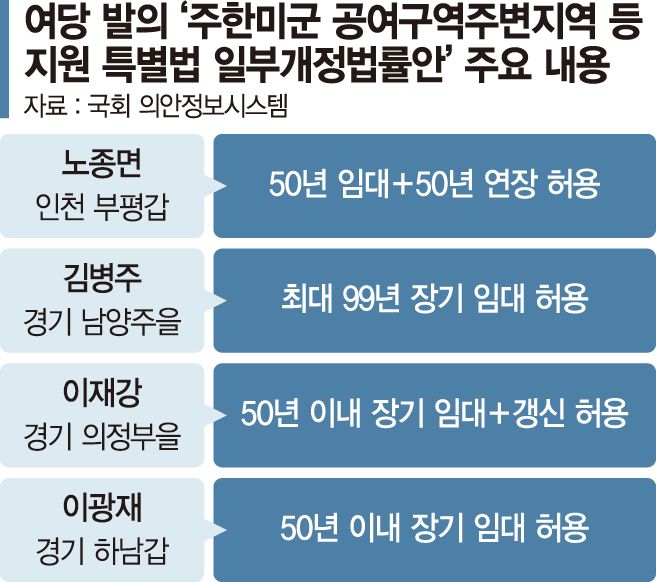
According to Financial News on the 27th, legislation is being pursued in the National Assembly to change the development method for returned U.S. military sites from a sale model to a lease model of up to 100 years. Rep. Noh Jong-myun of the Democratic Party of Korea, who represents Incheon Bupyeong-gap, introduced a revision bill the previous day to the Special Act on Support for Areas Surrounding USFK-Gifted Sites. The bill would create a legal basis for the state to lease state- and public-owned land, including returned U.S. military sites, to local governments or developers for up to 50 years, with a one-time extension of up to another 50 years if needed.
Under the current law, local governments or private developers with an interest in development must receive the land as a transfer from the Ministry of National Defense or purchase it in order to use returned sites. However, in northern Gyeonggi Province and Incheon Bupyeong, development has long been delayed because the enormous land acquisition costs have placed a heavy financial burden on local authorities.
If the bill passes, land could be leased for as long as 100 years, making it easier to build not only housing but also everyday and welfare infrastructure such as cultural and sports facilities. Because developers would be able to design projects in line with their own plans, the measure would lower upfront costs and encourage long-term investment. It is also being seen as a deregulation step aligned with the government's push for aggressive supply expansion.
Earlier, President Lee Jae-myung had expressed his intention to improve the system for using returned USFK sites in northern Gyeonggi Province during a town hall meeting in the region last November. At the time, he said, "We will overhaul the entire system so that donated land can be sold for 50 years and leased for up to 100 years."
Gyeonggi Province Governor Choo Mi-ae also proposed on the 27th of last month at a joint meeting on peace and safety in border areas that a cheaper leasing model be used instead of sales to ease the financial burden on local governments such as Dongducheon-si and Uijeongbu-si.
Several related bills are currently listed on the National Assembly Bill Information System, mainly by ruling party lawmakers from districts that include returned U.S. military sites. Rep. Kim Byung-joo of Namyangju-eul, Gyeonggi Province, included a provision in his revision bill to shift the development method from sale to long-term lease of up to 99 years. Rep. Lee Jae-gang of Uijeongbu-eul, Gyeonggi Province, proposed allowing long-term leases of up to 50 years initially, with the option of renewal afterward. Rep. Lee Kwang-jae of Hanam-gap, Gyeonggi Province, also proposed limiting lease terms to within 50 years while extending the long-term installment repayment period for sales from "at least five years and no more than 20 years" to "at least five years and no more than 50 years."
The Security and Public Administration Committee of the National Assembly is currently reviewing the bills, and they are expected to be examined by the subcommittee as early as September.
Meanwhile, the returned sites in the Seoul metropolitan area outside Seoul total 20.31 sq. km when Gyeonggi Province's 19.87 sq. km and Incheon Bupyeong's 440,000 sq. m are combined. That is about seven times the size of Yeouido, which covers 2.9 sq. km.
[email protected] Reporter Jeon Min-kyung Reporter