Base Rate Raised to 3%... 'Back-to-Back' Tightening Amid Inflation Pressure [Era of 3% Base Rate]
- Input
- 2026-08-27 18:22:47
- Updated
- 2026-08-27 18:22:47
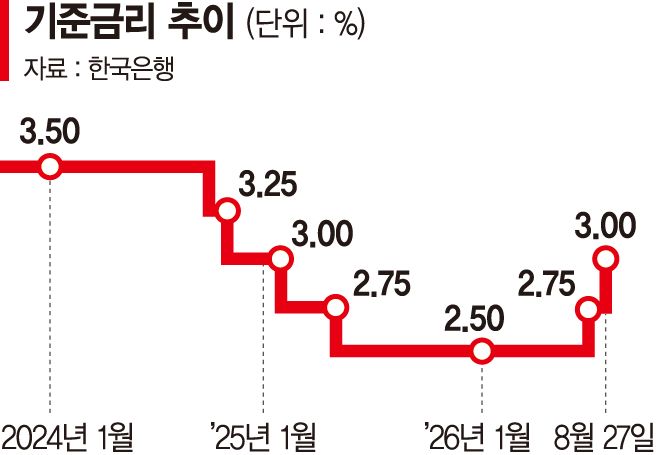
At its meeting on monetary policy direction on the 27th, the Monetary Policy Board set the base rate at 3.00% per year. After raising it by 0.25 percentage point the previous month, it delivered another increase of the same size just one month later in a so-called back-to-back move. As a result, the freeze that had lasted for 14 months since the base rate was cut to 2.50% in May last year has ended, marking the start of a full-fledged tightening cycle. Earlier, many in the market had also favored keeping the rate unchanged. But the Monetary Policy Board placed greater weight on bringing inflation under control early. At a press briefing that day, Governor of the Bank of Korea Hyun Song Shin even used the expression, "It is better to fix a small problem early than to let it grow," underscoring the need for preemptive tightening.
Governor Hyun explained, "A preemptive monetary policy response can stabilize inflation expectations sooner than a delayed response, reducing the intensity and duration of tightening and ultimately minimizing the cost to growth." He added, "By raising rates twice in a row, an unusual step by convention, we sent a strong signal to the market."
The implication is that if tightening is delayed and policy falls behind the curve, the economy as a whole will pay a bigger price. In fact, the forecast for consumer price inflation this year and next was unchanged from the May outlook at 2.7% and 2.3%, respectively. By contrast, the projected rise in core inflation, which the BOK places greater emphasis on, was revised up to 2.5% for both this year and next from 2.4% and 2.3%. On a half-year basis, those forecasts were also raised from 2.4% to 2.6% and from 2.2% to 2.4%, respectively. The expected inflation rate has also remained in the 2.7% to 2.8% range.
Another factor considered by the Monetary Policy Board was the stabilization of the won–dollar exchange rate. More specifically, the aim was to curb the rise in import prices caused by a weaker won and prevent it from feeding into domestic inflation. Governor Hyun noted that although the exchange rate has recently fallen to the 1,300-won range, it is still "high by historical standards" and said it should be addressed preemptively given the pace of import price increases.
At the same time, the weaker outlook for economic growth eased concerns about the unavoidable side effects of tightening, including damage to vulnerable borrowers. The BOK announced on the day that it had raised its forecast for this year's economic growth rate to 3.3%, up 0.7 percentage point from the May estimate of 2.6%. Its forecast for next year was also lifted by 0.8 percentage point to 2.9%, reinforcing expectations that the semiconductor export boom will last longer.
[email protected] Kim Tae-il Reporter