Local governments with weak fiscal self-reliance, as well as private developers, may be able to lease land and build housing [USFK-returned land development gains speed]
- Input
- 2026-08-27 18:21:01
- Updated
- 2026-08-27 18:21:01
■ A win-win for the public and developers... boosting private development
According to industry sources on the 27th, the ruling party and the government’s move to lease returned USFK land to development entities such as local governments over the long term, rather than selling it, can effectively be seen as introducing a land-lease system. Under this model, the public retains ownership of the land while development proceeds. It is regarded as a win-win strategy for both landowners and developers.
Lee Eun-hyung, a senior researcher at the Korea Research Institute for Construction Policy (RICON), explained, "For the Ministry of National Defense or the state, which owns the land, it is simpler on paper than a sale because they keep the asset while receiving rent." That removes the need for ownership transfer and registration procedures, as well as concerns over asset reduction. For developers, another advantage is that they can sharply reduce the capital needed to buy land and, with lease terms of 50 to 100 years, push immediate liabilities into the future. Lee said positively that it would "open the way to development by paying only rent."
According to a series of amendments recently introduced by the ruling party to the Special Act on Support for Areas Surrounding United States Forces Korea Bases, development entities are not limited to local governments and may also include private companies. That raises the likelihood of private development being activated on returned USFK land. IFC Mall, a landmark in Yeouido, is a representative land-lease building in Seoul. It was developed under a 99-year land lease from the Seoul Metropolitan Government.
■ Returned land could be used for a "push for supply"
Meanwhile, the government approved an amendment to the Enforcement Decree of the Special Act on Support for Areas Surrounding United States Forces Korea Bases on the 7th of last month. The revision raises the central government subsidy rate for local governments buying returned USFK land to create parks, roads and rivers from the previous 60% to 80% range to as much as 95%. The bill summary only mentions "park, road and river development," but a closer look at the revision shows that housing construction is also allowed. Article 10 of the decree, which covers the "scope and targets of projects," specifies not only park development and school expansion, but also housing construction projects and projects that the Minister of the Interior and Safety deems necessary for regional development or utilization and announces by notice. This is why some say the decree, along with the ruling party’s push to lease returned USFK land, is closely tied to the government’s "supply at all costs" stance. The government plans to announce additional land candidates for more than 73,000 homes within this year.
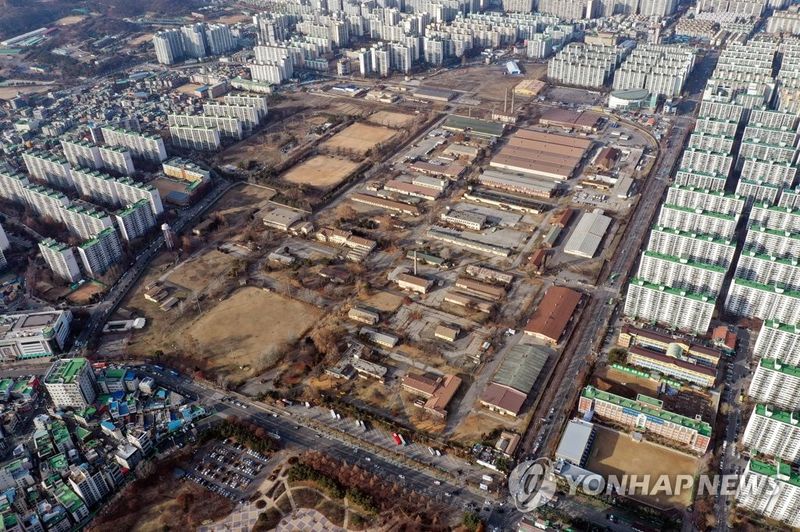
A representative returned site that could be used for housing supply is Zone D of Camp Market in Bupyeong, Incheon, which covers 229,235 square meters out of the base’s total 440,000 square meters. Zone A had been slated for a second medical center, but it has failed for years to clear the hurdle of the government’s preliminary feasibility review. Zone B, meanwhile, saw plans for an Incheon botanical garden effectively collapse, and a high-end advanced library and park are now being pursued instead. Incheon Metropolitan City Government is drawing up an overall plan for the entire returned site, but Zone D is still at an early stage. A local official said, "Because soil decontamination in Zone D began relatively late, the development plan will need to take into account variables in the cleanup process," adding that "there are many possible ways to use the site."
Returned sites in Gyeonggi Province total 19.87 square kilometers, and many of the delayed projects are concentrated in the northern part of the province. At Camp Edwards in Paju, a plan to supply 7,338 homes across about 677,525 square meters has been under way since 2022. Hanam City began selecting private participants in January for the development of a mixed self-sufficient district that includes more than 1,000 homes at Camp Colburn. Dongducheon is currently calculating the economic, social and fiscal damage caused by the long-term non-return of USFK land. In Uijeongbu, development of the Camp Jackson and Camp Stanley sites has been delayed. In November last year, Gyeonggi Province also eased development requirements after lifting the greenbelt designation on USFK-related areas, reducing the rental housing ratio from 50% to 35% and the park and green space ratio from 25% to 20% to improve project viability.
[email protected] Jeon Min-kyung Reporter