Samsung, SK, and Hyundai Motor Speed Up U.S. Investment Plans
- Input
- 2026-08-27 18:20:53
- Updated
- 2026-08-27 18:20:53
■Samsung and SK race ahead in advanced packaging and foundry
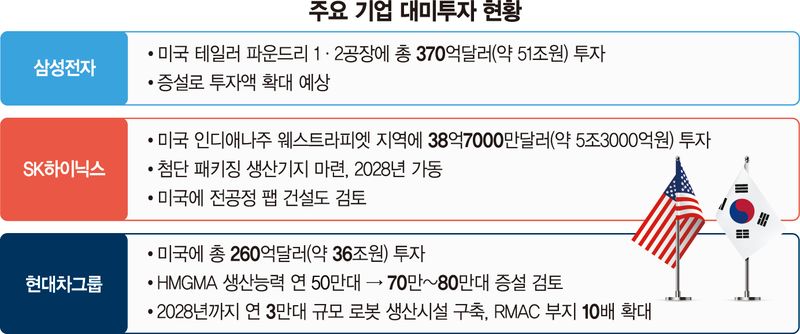
According to industry sources on the 27th, SK hynix will begin building its local production base with a groundbreaking ceremony for an advanced packaging back-end plant in West Lafayette, Indiana. The company will invest a total of $3.87 billion, or about 5.3 trillion won, to establish an advanced packaging production base for high-bandwidth memory (HBM) used in artificial intelligence (AI), along with research and development (R&D) facilities.
The company is also keeping open the possibility of building additional front-end production facilities in the United States after the packaging plant. Chey Tae-won, chairman of SK Group, said in a foreign media interview shortly after SK hynix's NASDAQ listing ceremony for its American Depositary Receipt (ADR) that "additional investment in semiconductor production facilities in the United States is possible if the right location and conditions are in place." The remark was interpreted to mean that a memory chip factory could also be built in the United States if conditions such as power, water, labor and supply chains are secured. Samsung Electronics is also rapidly expanding its production base in the United States. The company is investing a total of $37 billion, or about 51 trillion won, to build a semiconductor foundry in Taylor, Texas. The Taylor fab, which will serve as a key base, is in its final preparation stage with the goal of starting operations this year, while construction on Taylor fab 2 is scheduled to begin at the end of this year, with mass production targeted for 2030.
These moves also come as the United States has recently shown discomfort over the expansion of Korean investment in advanced industries at home, including the Honam semiconductor cluster. In particular, U.S. Secretary of Commerce Howard Lutnick has publicly called on Samsung Electronics and SK hynix to expand memory production in the United States, adding to pressure for further investment.
■Hyundai Motor to pour $26 billion into its robot hub by 2028
Investment in the United States is also picking up speed in the finished-vehicle and future mobility sectors. Hyundai Motor Group will invest a total of $26 billion, or about 36 trillion won, in the United States through 2028 across steel, automobiles and robotics. By sector, $12 billion will go toward building a local production system for 1.2 million vehicles, $7 billion will be allocated to strengthening the supply chain, including steel mills, and another $7 billion will be invested in future industries such as autonomous driving, robotics and AI.
Expansion is being considered at the flagship Hyundai Motor Group Metaplant America (HMGMA) site in Georgia. In a CNBC interview on the 20th local time, Hyundai Motor Company President José Muñoz said the company is reviewing plans to raise HMGMA's annual production capacity from the current 500,000 units to 700,000 to 800,000 units by 2028.
The robot business, a next-generation growth engine, will also use the United States as a forward base. After opening the Robot Metaplant Application Center (RMAC) in Georgia in June, Hyundai Motor Group decided to expand the site to 10 times its current size by the end of the year. The facility trains manufacturing AI robots in an environment identical to an actual production site. The Atlas humanoid robot, which has completed verification, will be deployed at HMGMA starting in 2028. The group is also pushing ahead with a robot mass-production plant capable of producing 300,000 units a year, with operations targeted for 2028.
[email protected] Lim Subin Reporter