Criticism of the Future Response Fund as a "slush fund" prompts a rebuttal over "mid- to long-term fiscal capacity"
- Input
- 2026-08-27 17:27:26
- Updated
- 2026-08-27 17:27:26
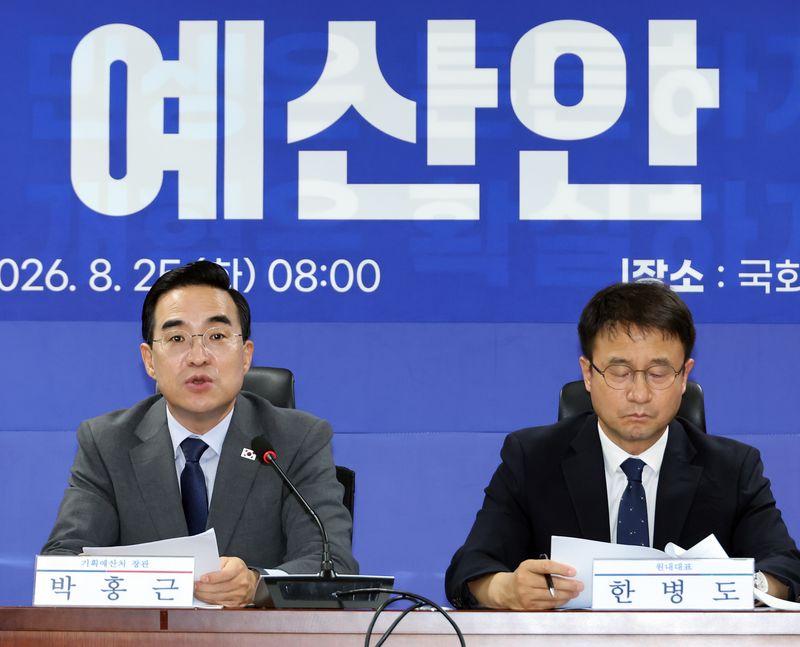
[Financial News] The Lee Jae-myung administration is pushing to create a 100 trillion won Future Response Fund using additional tax revenue generated by the semiconductor boom. The plan is intended to support future investments in advanced industries and talent development, but critics say it could become a "slush fund" that bypasses National Assembly budget oversight. In response, the Ministry of Planning and Budget has pushed back, saying the fund would secure mid- to long-term fiscal capacity.
A forum titled "Excess Tax Revenue: Strategic Fiscal Allocation and Utilization for the Future" was held on the 27th by Ahn Do-geol of the Democratic Party of Korea, a member of the National Assembly Planning and Finance Committee, along with Lee Kwang-jae, chair of the Special Committee on Budget and Accounts of the National Assembly, and Jung Tae-ho, the committee's secretary. The Future Response Fund was the main topic of discussion.
Park Seong-hoon, head of the Ministry of Planning and Budget's task force for the fund, attended the event. With sharp criticism centered on the People Power Party, which has called it a "fund for boosting approval ratings," the ministry stepped in to explain the plan directly.
Park highlighted one key feature of the Future Response Fund: accumulation. He said that by setting aside part of any excess tax revenue as it arises, the government can build mid- to long-term fiscal capacity. The People Power Party's main criticism is that, unlike other funds, this one has no clearly defined purpose and is effectively no different from the general account. Park did not deny that point, but argued that the fund's strength lies in its ability to build up fiscal reserves.
Park explained, "Unlike the general account, a fund can accumulate reserves, so it can serve as a fiscal stabilization mechanism and, in the mid to long term, as a growth engine." He added, "The idea is to institutionalize mid- to long-term fiscal capacity and use excess tax revenue for productive spending and capital spending."
Park Myung-ho, a professor in the School of Economics at Hongik University who delivered the keynote presentation, also said excess tax revenue should be used in two ways: to support growth by backing advanced industries and to cushion fiscal shocks. He argued that excess tax revenue does not guarantee sustainability. For that reason, he said it would be more effective to avoid welfare-related and rigid spending that must be carried out continuously, and instead use the money for infrastructure investment that supports growth and for building fiscal room to prepare for a crisis.
However, some also warned that because the fund would be replenished whenever excess tax revenue is generated, it could encourage intentional revenue forecasting failures. Lee Sang-min, a senior research fellow at The Center for Fiscal Reform, said, "Excess tax revenue is ultimately a forecasting failure, and this would be giving incentives for failure." Comparing the general account to "regular troops" and the Future Response Fund to "private troops," he warned, "If you deliberately create forecasting failures, keep the regular troops and build up the private troops, you could undermine the principle of total budget control."
[email protected] Kim Yun-ho Reporter