Jeju soft corals collapsing as temperature and salinity are tracked for five years down to 30 meters
- Input
- 2026-08-27 16:42:42
- Updated
- 2026-08-27 16:42:42
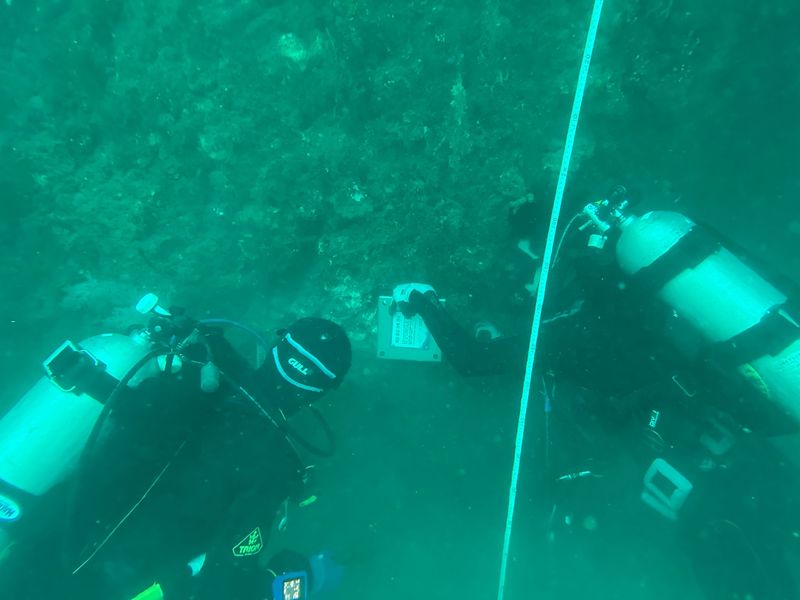
[Financial News, Jeju = Reporter Jung Yong-bok] As soft corals in a colony off Seogwipo, Jeju, are increasingly toppling over or detaching, Jeju Island has begun a long-term study of water temperature and salinity at their actual habitat depths to identify the cause.
According to the Jeju Island World Heritage Headquarters on the 27th, temperature and salinity are being monitored at nine sites around Beomseom Island and Hyeongjeseom Island to determine the cause of the soft coral collapse in the Natural Monument known as the 'Jeju Coastal Soft Coral Colony.'
Jeju Island began monitoring in August last year by installing thermometers around Beomseom Island with state funding. This year, it has expanded the survey area in cooperation with a research team led by Kim Tae-hoon at KIOST, tracking not only temperature but also salinity.
The monitoring sites were divided according to the actual depths where the soft corals live. Three sites at depths of 5, 10 and 20 meters were set up around Hyeongjeseom Island, while six sites at depths of 5, 10, 15, 20, 25 and 30 meters were established around Beomseom Island, each equipped with temperature and salinity sensors.
Because temperature and salinity can vary by depth even within the same waters, the study will compare environmental changes at each depth with the condition of the soft corals.
The soft coral colonies in the southern waters off Seogwipo and in the waters off Songaksan were designated as a Natural Monument on Dec. 13, 2004, the only such designation in the country.
Recently, soft corals in the area have been observed toppling to the seafloor or detaching from the substrate. Jeju Island said the affected area has expanded this year compared with 2024.
Rising sea temperatures linked to climate change are being cited as a possible factor affecting the soft corals, but no direct cause of the collapse has been confirmed at this stage. In particular, there has been insufficient data on temperature and salinity by depth, making it difficult to scientifically assess the relationship between marine environmental changes and the collapse.
The long-term monitoring effort is aimed at filling that data gap. The World Heritage Headquarters and KIOST plan to continuously analyze whether collapses increase when certain temperature or salinity changes appear, by comparing the accumulated data from each site with changes in the condition of the soft corals.
They have also decided not to draw conclusions from short-term data alone. In consultation with the Korea Heritage Service, the World Heritage Headquarters plans to continue surveys of soft coral changes and marine environmental monitoring for at least five years.
If the long-term study confirms a link between soft coral damage and specific environmental conditions, the findings could serve as basic data for future conservation and management standards for the Natural Monument soft coral colonies.
Kim Hyeong-eun, head of the Jeju Island World Heritage Headquarters, said, "The Jeju coastal soft coral colony is a unique marine resource and an important habitat for diverse marine life." She added, "Through long-term monitoring, we will accurately identify the cause of the collapse and use the results to establish conservation measures."
[email protected] Jung Yong-bok Reporter