Governor Wi Seong-gon asks the Korea Heritage Service for national funding for Jeju heritage sites, seeking support for Seongeup Folk Village and fossil sites
- Input
- 2026-08-27 16:09:05
- Updated
- 2026-08-27 16:09:05
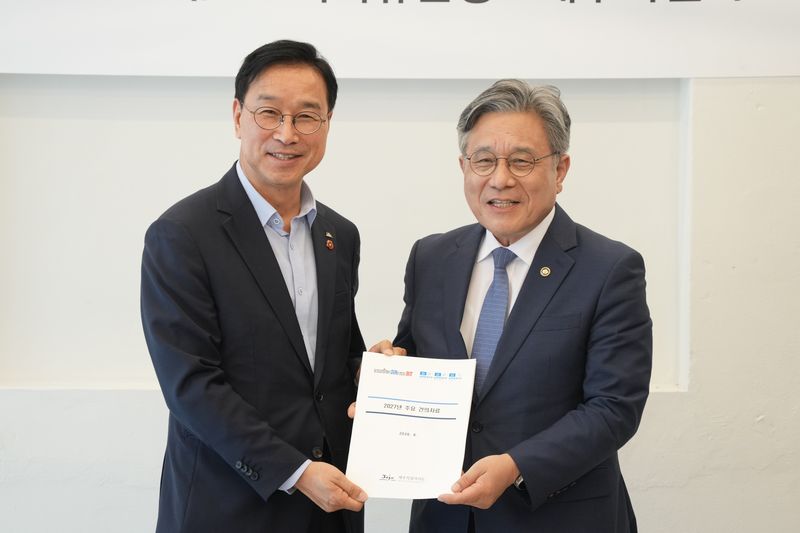
[Financial News Jeju = Reporter Jeong Yong-bok] Jeju has asked the government to expand support for the preservation of national heritage sites, including Seongeup Folk Village, where declining population is weakening the transmission of traditional culture, and coastal fossil sites, where fossils are disappearing due to wave erosion. The province will also work with the Korea Heritage Service to push for the early establishment of the National Jeju Heritage Research Institute and the UNESCO listing of Jeju stone wall building as Intangible Cultural Heritage of Humanity.
According to Jeju Special Self-Governing Province on the 27th, Governor Wi met with Huh, who visited Jeju that day, and requested national funding and institutional reforms for heritage preservation and utilization projects.
Huh visited Jeju to inspect heritage sites in the province, including the fossil site of shellfish in the Seogwipo Formation, Manjanggul Lava Tube, and Jeju Stone Park.
The first project Jeju requested support for was the "K- Folk Village Revitalization" project, which would allow residents to directly operate and revitalize Seongeup Folk Village.
Jeju has drawn up a plan to invest a total of 20 billion won over five years from 2027 to 2031 and requested 2 billion won in national funding for next year. The goal is to have residents and preservation groups directly run permanent traditional culture programs so that preservation, tourism and local life can be sustained together.
Seongeup Folk Village is designated as a national heritage site in its entirety, which restricts construction and other activities. Jeju said worsening living conditions and population decline are also weakening the everyday foundation for passing down traditional culture.
At present, traditional culture programs such as the procession of Jeongui magistrate are held only about once a month, making it difficult to link them to tourism products, according to the province. Governor Wi said, "Just like the Changing of the Guard at Gwanghwamun, permanent performances should be held on fixed days and at fixed times so they can be connected to travel packages and continue to attract visitors," and called for sustained government support.
Jeju also proposed new repair standards that reflect the regional characteristics of Jeju thatched houses. Jeju thatched roofs use a grass called sae instead of straw, and their walls are made with volcanic ash soil, which is weaker than clay. The province said uniform repair methods that do not take these material differences into account make it difficult to preserve the original form properly.
Huh said the service would consider combining permanent programs with performances that highlight the village’s character, as well as nighttime media art. He also said budget support for repairs to Jeju thatched houses would be reviewed once objective evidence on local characteristics is prepared.
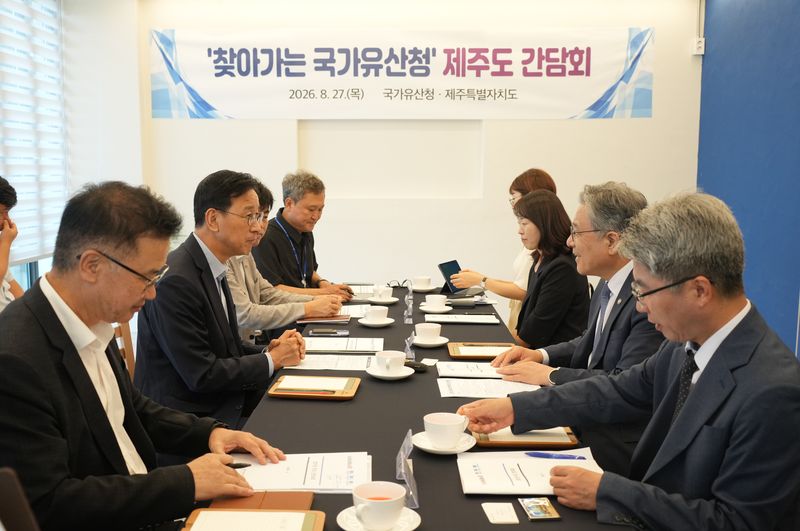
The establishment of the National Jeju Heritage Research Institute, with 47.2 billion won to be fully funded by the state, was also included among the key requests.
The National Jeju Heritage Research Institute would be a state-run institution that conducts comprehensive research on Jeju heritage in fields such as archaeology, history, conservation science and marine studies. A plan is being pursued to build the institute in Geonip-dong, Jeju-si, with a total floor area of 7,000 square meters.
At present, regional research institutes under NRICH are spread across seven regions nationwide, but Jeju has no independent research institution. Research on Jeju is handled by the Naju Heritage Research Institute in South Jeolla Province.
Governor Wi said, "Jeju has its own cultural sphere known as Tamna culture, but it is currently included in the Honam regional research system," and asked for the swift establishment of a state institution dedicated to the study of the Tamna historical and cultural region.
Huh said the Tamna historical and cultural region is legally classified as a separate historical and cultural zone, and added that research in the area would be expanded after the Jeju institute is established.
For the preservation of the natural monument "Jeju Human and Animal Footprint Fossil Site," which is being worn away by waves, Jeju requested 270 million won in national funding next year. The province plans to recover fossil rocks broken off by coastal erosion, preserve them through conservation treatment, and improve storage facilities.
Jeju also asked the Korea Heritage Service to support efforts to have Jeju stone wall building inscribed on the UNESCO Intangible Cultural Heritage of Humanity list in 2028. The project will move forward as an expanded inscription, with Jeju added as a participating country to the "Art of dry stone construction, knowledge and techniques," which has already been listed by 13 European countries. Jeju designated Jeju stone wall building as a provincial intangible heritage in September last year.
Jeju plans to submit its nomination dossier to the Korea Heritage Service this December, and the service plans to file the application with UNESCO in March 2027.
Huh said, "Jeju is a world-class region that has achieved UNESCO’s triple crown," and added, "At the Korea Heritage Service level, we will look for the support needed so that the value of Jeju’s heritage can be properly recognized."
Governor Wi said, "There are still institutional and financial difficulties at the sites that protect our heritage," and added, "We will strengthen cooperation with the Korea Heritage Service so that Jeju’s heritage, including its UNESCO World Natural Heritage, can be passed on intact to the next generation."
[email protected] Jeong Yong-bok Reporter