Kim Chi-wan, head of Jeju National University's Tamna Cultural Research Institute, says, "We will make Jeju a place that produces theory" [Interview]
- Input
- 2026-08-27 15:45:53
- Updated
- 2026-08-27 15:45:53
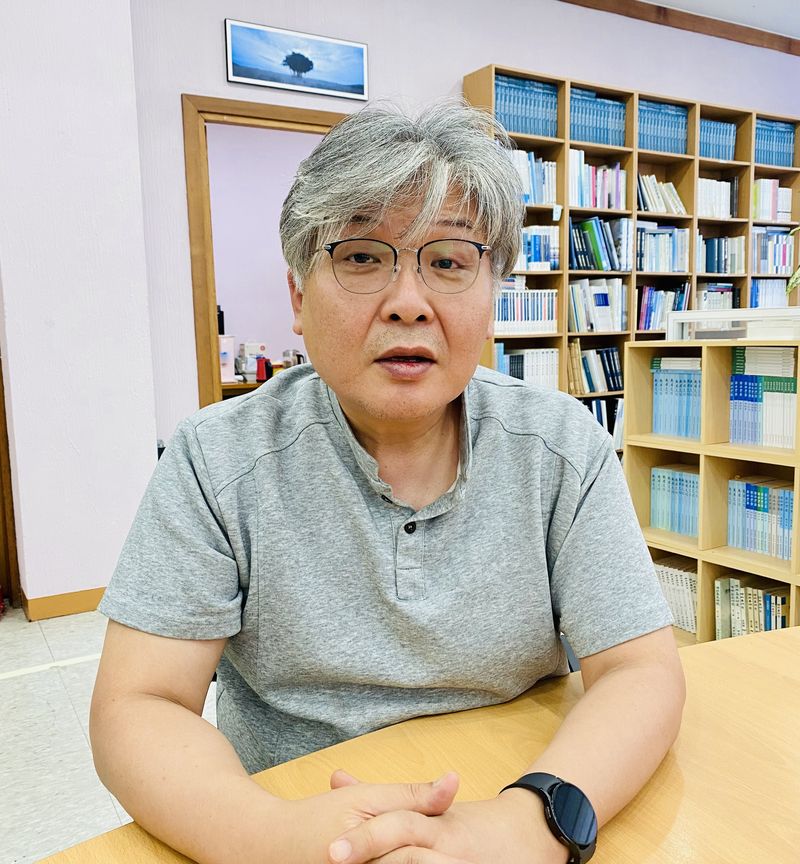
【Jeju, Financial News = Reporter Jung Yong-bok】 "I do not want us to stop at researching Jeju and writing papers. I want theories and practical models created in Jeju to be used in other regions as well."
In an interview with Financial News on the 27th, Kim Chi-wan, head of Jeju National University's Tamna Cultural Research Institute, summed up the institute's seven-year goal after being selected for the Ministry of Education and the National Research Foundation of Korea's Humanities Korea 3.0 (HK3.0) support program.
The future he envisions for the Tamna Cultural Research Institute goes beyond a local research center that simply explains Jeju. It would study migration, language, community, ecology and social conflict on Jeju, develop new humanities theories, apply them to policy and local communities, and then expand them across the Asia-Pacific.
Kim said, "Jeju has been called a test field in many areas in the past, and I hope we can create at least one model in the humanities that can be applied nationwide." He added, "Rather than research that produces papers from a desk, I want to create results that actually work in Jeju."
Jeju National University's Tamna Cultural Research Institute was recently selected for HK3.0 for the first time since the university was founded. Under the agenda "Kumda Humanities in an Era of Global Anomie: The Life of Islands and the Knowledge of Hybridity," it will receive 4.8 billion won in state funding over the next seven years.
The most important word in Kim's vision is "Qumda." It comes from a Jeju dialect word meaning to embrace.
The starting point was the 2018 refugee crisis involving Yemeni asylum seekers on Jeju Island. Since 2019, the institute has studied "The History of Jeju Island and Refugees Through Qumda," tracing issues of hospitality and exclusion, migration and settlement, and coexistence in Jeju society.
This HK3.0 project will greatly broaden the research focus that had centered on refugees.
The research scope will now include coexistence between migrant workers and long-term residents, the relationship between the Jeju dialect, standard Korean and migrant languages, climate crisis and development, changes in communities, and the relationship between humans and nature. The plan is to analyze the complex instability of modern society, where social cohesion and norms are weakening, through the lens of "global anomie" and seek alternatives in Jeju.
Kim explained, "We started with a specific issue, refugees, but now Jeju is home to many more people, including foreign migrant workers. Kumda humanities must expand its research scope to match this reality."
The way Jeju is viewed will also change.
While existing regional studies often analyze local areas through theories made in the center, this project places greater weight on turning the experiences and knowledge found in Jeju into new theory.
Jeju is a place where rapid tourism development, capital inflows, population growth from migration, weakening of the Jeju dialect and community restructuring are all unfolding at once. The institute plans to use Jeju not merely as a case study of regional particularities, but as a "base for alternative theory production" that develops accumulated experience and knowledge into new humanities theory.
What Kim repeatedly emphasized more than papers was the "field." At the center of that effort is the Kumda Living Lab. Rather than researchers analyzing local problems and presenting conclusions, residents, migrants, researchers, government agencies and field practitioners will work together to identify problems and test solutions.
Kim said, "The Kumda Living Lab is not meant to deal only with migration issues. Based on what we study, we want to work with the local community to create solutions to the many issues Jeju faces."
The institute plans to operate the living lab around the Kumda Cultural Center under the HK3.0 project team. It will also build a structure that connects Jeju Island and other local governments with regional institutions so that research results can lead to actual policy.
Specific initiatives include the Kumda Humanities Studio, where residents discuss local issues and policy alternatives; the Kumda Academy for citizens; education programs for immigrants; and the Kumda Knowledge Hub, which will make research materials public. The plan also includes a feedback system through which research findings on foreign residents and immigration policy can be reflected in local government policy and budgets.
Kim said, "For a university to conduct research while also meeting local residents and running programs, it needs space and partner institutions." He also outlined plans to expand cooperation with local governments, public institutions and community organizations.
The path to HK3.0 selection was not smooth. In an earlier attempt, the institute failed at the eligibility review stage because of application requirements related to participating personnel.
Kim recalled, "We did not abandon the agenda we had prepared at the time. We developed it again."
In the meantime, the institute expanded its research focus beyond refugees and built a partnership with The University of Queensland. It also strengthened ties with the Critical Island Studies Consortium, broadening its scope from Jeju and refugees to issues of islands and coexistence in the Asia-Pacific.
This year, after submitting the research proposal in April, the institute underwent an in-person evaluation on July 14. About a month later, it received preliminary selection results, followed by the final selection after the objection period.
Kim said the earlier failure ultimately became an opportunity to refine the research plan.
The goal of internationalization is not simply to host a few overseas academic conferences. The institute plans to connect the research network it has already built with Osaka Metropolitan University, the University of the Ryukyus, Academia Sinica, National Sun Yat-sen University and The University of Queensland, and develop Jeju into a hub for Asia-Pacific island studies.
The strategy is to broaden the scope of Jeju studies internationally by comparing Jeju uprising, the February 28 Incident, the migration and settlement of Jeju Koreans in Japan, and the colonial experiences, migration, language and community issues of islands including Okinawa Prefecture.
Kim cited the East-West Center at the University of Hawaiʻi as a long-term model.
He said, "I hope the Tamna Cultural Research Institute can become a place where researchers from across Asia and the Americas come to study freely and produce results, just as people are drawn to research centers in Asia and the United States."
He added, "A single seven-year project cannot create a world-class research institution. But at the very least, we must lay the foundation for moving in that direction."
Retaining people is also important for that goal. At the start of the project, six HK research professors will conduct the research, and additional researchers in social studies and history will be openly recruited to secure long-term research personnel.
A training system for the next generation will also be built, spanning undergraduates, master's and doctoral students, postdoctoral researchers and early-career scholars. It will connect the "Jeju Kumda Content Literacy" program, "Reexamining Jeju Studies," research methodology seminars, research groups, participation in domestic and international conferences, small-scale research grants and publication support.
Kim identified securing research space to match the expanded staff as an immediate task.
He said, "For research professors and researchers to work stably, they need basic material foundations such as laboratories, classrooms and meeting spaces. As the number of researchers grows, the space and research environment must grow with them."
He also outlined a plan to upgrade the institute itself after seven years. After HK3.0 ends, the Tamna Cultural Research Institute would be expanded and reorganized into the Tamna Academy, with an affiliated Kumda Humanities Society to be established. The goal is to create a structure that can secure its own research personnel and funding even after state support ends.
The institute also plans to leave behind papers and books. During the project period, it aims to publish 104 papers in domestic specialized journals, six papers in internationally recognized journals, and 12 volumes of the Kumda Humanities Series. It also plans to hold 18 domestic and international academic conferences and 44 colloquia.
But the achievement Kim envisions seven years from now is not just about numbers.
"If there is one world-class research institution in Jeju, it becomes a major asset for both Jeju National University and Jeju itself. Expanding the idea that began in Jeju through Qumda into something global, and building a foundation where the models created here can be used in other regions as well, is what I most want to begin over the next seven years."
[email protected] Jung Yong-bok Reporter