Himalayan Flood Leaves 1,300 Missing... Cause Was Glacier Collapse, Not an Earthquake
- Input
- 2026-08-27 15:35:24
- Updated
- 2026-08-27 15:35:24
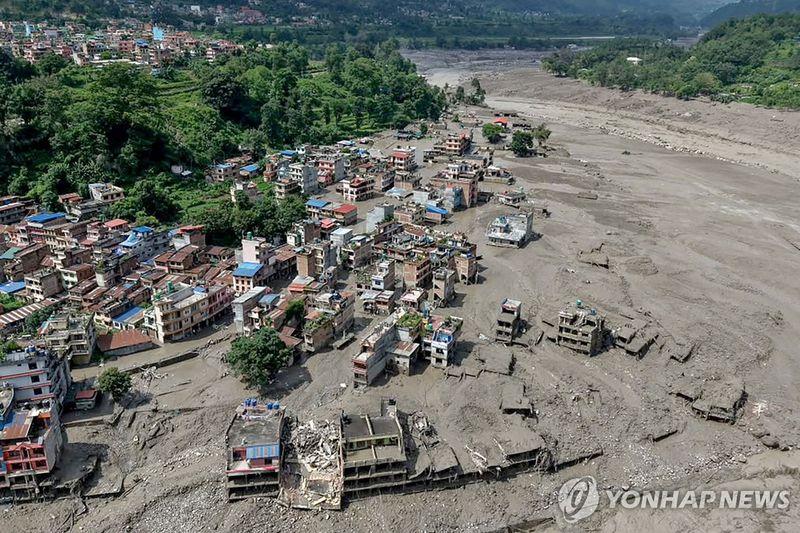
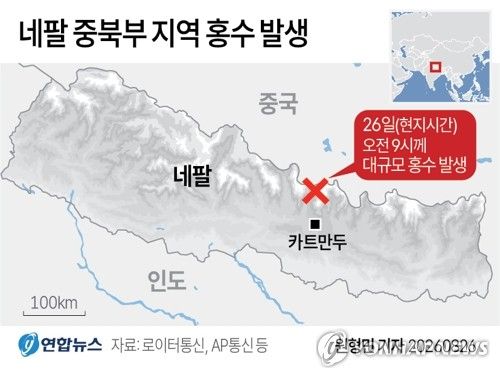
[Financial News] More than 1,300 people are missing in Nepal and China after a massive flood swept through the Himalayan region of Nepal along the border with China. In Nepal alone, the number of missing rose by nearly 350 in a single day, and nine Koreans have also lost contact. Foreigners were hit especially hard because the flood struck an area crowded with pilgrims and trekking tourists from around the world. An earthquake was initially blamed, but it later turned out that the shock had been misread as a quake after a large glacier and rock mass collapsed.
826 Missing in Nepal... 600 of Them Foreigners
On the 27th local time, Nepal police said 826 people were missing after floods that hit the northern Bagmati Province the previous day. The number of missing, which had stood at 484 at one point the day before, rose by about 350 in just one day as more reports came in. Of those, about 600 were foreigners from roughly 28 countries, including India, the United States, the United Kingdom, Australia, Malaysia, Italy and Ukraine.
Nine Koreans from Korea South-East Power and Doosan Enerbility, who were at a hydropower construction site in the area, are also missing. A joint rapid response team made up of the Ministry of Foreign Affairs, the National Police Agency and NFA departed for Kathmandu on the same day.
The death toll rose by eight from the previous day to 165. In Gyirong County, Xigaze, in China's Tibet Autonomous Region, three people were killed and 558 were reported missing in a landslide. Combined, the number of missing in Nepal and China exceeds 1,300. Nepal police said, "More bodies will likely be recovered, and the death toll is expected to rise." In Nepal, 80 bridges and about 40 kilometers of roads were damaged, and 83 security personnel, including police and soldiers, are also missing, making rescue efforts difficult.
Foreigners were hit particularly hard because the disaster zone lies along a route used by pilgrims and trekkers. The flood struck during the season when pilgrims heading to Mount Kailash, a sacred mountain in Hinduism, Buddhism and Jainism, were arriving in large numbers. According to an earlier tally by Nepal's tourism authorities, at least 133 of the missing were Indians on the Mount Kailash pilgrimage route.
Nepal is currently in the monsoon season, which is not suitable for ordinary Himalayan mountaineering, but the Mount Kailash pilgrimage and trekking season is at its peak. Damage appears to have worsened as local residents also gathered ahead of a traditional Nepali holiday.
It was not an earthquake after all: the cause was glacier collapse
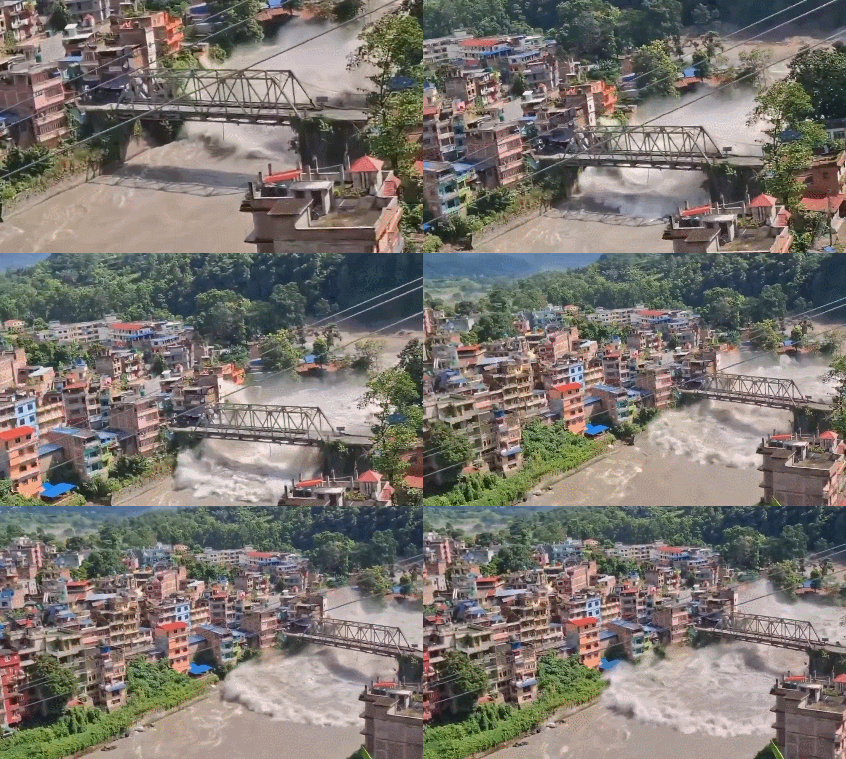
The cause of the disaster also changed within a day. The Nepalese government and the USGS initially believed the flood was triggered when a glacier collapsed after a magnitude 4.4 earthquake in Tibet. The Nepalese government cited the fact that the flash flood was reported about three minutes after the quake. But after further analysis of long-period seismic waves and satellite images, the USGS corrected its assessment, saying, "The seismic energy was actually generated by a landslide," and "there was no earthquake."
It is believed that a huge mass of glacier and rock crashed into the valley, blocked the river, and then burst under the pressure of the water, sending water and debris downstream all at once. The USGS concluded that the glacier collapse and debris flow triggered a chain of disasters downstream.
Experts are focusing on the rapid pace of warming in the Himalayas. In the Himalayas, a key water source for about 2 billion people in Asia, glaciers have been disappearing more than twice as fast in the 21st century as they did before. Before 2000, glacier thickness shrank by about 34 centimeters a year on average, but since then it has been declining by about 73 centimeters annually. As glaciers melt, mountain terrain becomes less stable, and if water levels rise in glacial lakes, the risk of collapse, debris flows and flash floods increases in a chain reaction. Chang Chang-gung, who oversees climate and environmental risk at ICIMOD in Kathmandu, warned, "There are still blocked sections upstream of the rivers along the Nepal-China border, so a second flood could occur."
[email protected] Kim Kyung-min Reporter