[Report] "Future CEO Candidates Are Nurtured from Freshmen Year" ... Parents Flock to LG Display's Contract Department
- Input
- 2026-08-27 16:44:39
- Updated
- 2026-08-27 16:44:39
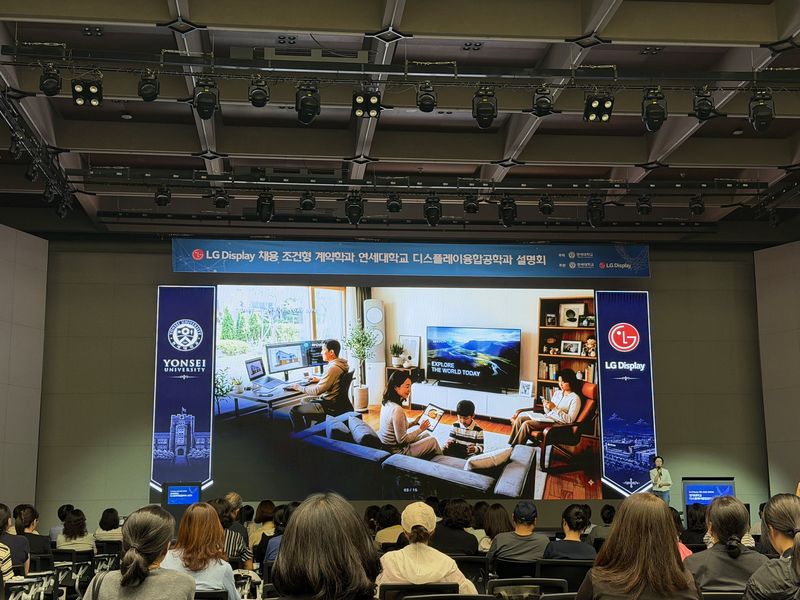
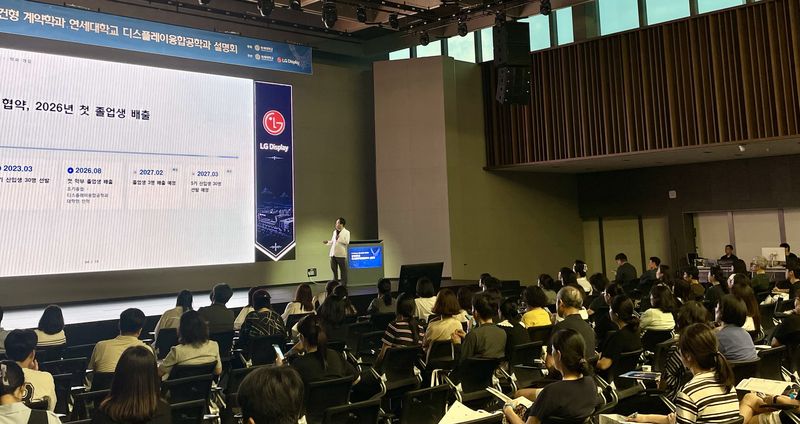
[Financial News]"We are running this program with the belief that one of these students will definitely grow into LG Display's CEO."At 7 p.m. on the 24th, LG Sciencepark in Magok District, Seoul, was packed. Even though it was a weekday evening, the admissions briefing room for Yonsei University's Department of Display Convergence Engineering was filled with more than 100 parents eager to gather information about their children's future studies. Some arrived straight from work in suits and carrying briefcases, while many others came as families with their children. Every time the curriculum, admissions process, or post-graduation career paths appeared on the screen, the sound of smartphone cameras clicking filled the room.
What Gu Ji-hyun, executive managing director in charge of human resources at LG Display, said from the podium that day was even more striking. The goal is not merely to secure new hires four years in advance, but to identify and directly nurture key talent from the moment they enter college, with the aim of developing future CEOs, chief technology officers, and business division heads.
The conditions for bringing in these future executives are also unusual. The Department of Display Convergence Engineering, jointly run by LG Display and Yonsei University, selects 30 students each year. In addition to tuition support, students who are selected as LGenius industry scholarship recipients during the semester are guaranteed employment at LG Display. Most current students have already secured jobs. Upon joining the company, they are placed under a separate salary system that offers compensation at the top end of the industry, along with annual special incentives.■ Snack trucks during exam periods, gifts for soldiers ... close management of 30 studentsLG Display has pulled the starting line for recruitment all the way back to college freshmen because the competition for talent in advanced industries is becoming increasingly intense. Speaking with reporters that day, Gu explained the background behind the contract department program. "In the past, we also selected talent through scholarship programs in the third and fourth years of college, but that was not enough. We thought we needed to bring forward the timing of talent acquisition," she said. With semiconductor and IT companies, as well as medical schools and overseas big tech firms, all competing for top science and engineering students, the company concluded that hiring only right before graduation would not be enough to secure core technical talent in a stable way.
The company has chosen a model of "small-group, long-term development." It selects only 30 students a year, and from the moment they enter university, the company and the department closely monitor each student's growth. During exam periods, it sends snack trucks and provides laptops and tablets. It even sends gifts to students serving in the military. "With a group of 30, we can care for each student individually and help shape them into our people," Gu said. "We believed it would be more meaningful than hiring 10 or 20 people from outside to develop talent with a strong understanding of technology and a sense of loyalty."
The company's long-emphasized "technology leadership" has also shaped this approach to talent development. Many of its current top executives, including CEO Jeong Cheol-dong, CTO Choi Young-seok, and business division head Choi Hyun-cheol, came from engineering backgrounds. The idea is to secure technically minded talent early and grow them into the next generation of leaders. Gu added, "We look at the students as potential CEO, CTO, or business division head candidates."■ Guaranteed jobs are changing choices ... even top students are choosing engineeringLG Display is not the only company racing to secure freshmen. In semiconductors, Samsung Electronics and SK hynix are operating contract departments with Yonsei University, Sungkyunkwan University, Korea University, Sogang University, and Hanyang University, and the model is spreading across advanced industries such as batteries and mobility.
Interest in contract departments is also soaring. In the 2026 regular admissions cycle, the average competition ratio for five semiconductor contract departments run with Samsung Electronics and SK hynix was 7.16 to 1, higher than the national average of 6.61 to 1 for medical schools. The Department of Display Convergence Engineering at LG Display has also gained recognition, with the academic cutoff for admitted students rising from 1.47 last year to 1.24 this year under the school-record recommendation track. The average percentile score for the top 70% of regular-admission enrollees was also 96, higher than those of the electrical and electronic engineering and mechanical engineering departments. That corresponds to roughly the top 4% nationwide by percentile.
This suggests that the admissions landscape, once dominated by the "medical school black hole" that drew in top science and engineering talent, is beginning to change. As the semiconductor boom, high compensation, scholarships, and job guarantees come together, more applicants are weighing not only which university to attend, but also which industry and company they will be connected to.
An industry official said, "Students admitted to contract departments at science and engineering companies such as semiconductors and displays are less likely to drop out than students in other departments." The official added, "Their strength is that they can focus on one field from the moment they enter university, rather than worrying about career paths after graduation."
[email protected] Jung Won-il Reporter