Listed Mid-sized Firms See Better Profitability, but Debt Ratios and Borrowing Dependence Rise
- Input
- 2026-08-27 15:40:07
- Updated
- 2026-08-27 15:40:07
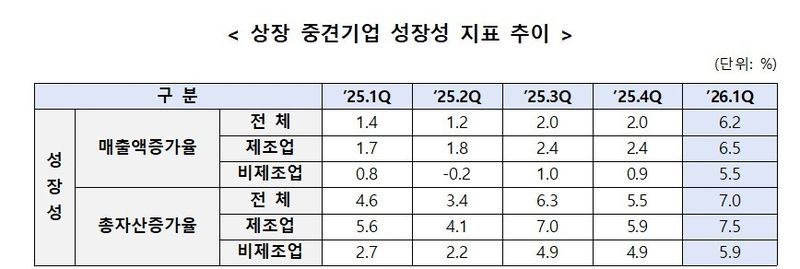
According to the '2026 First-Quarter Management Analysis of Listed Mid-sized Companies' released on the 27th by the Korea Federation of Mid-sized Enterprises, the sales growth rate rose 4.8 percentage points from a year earlier to 6.2%. Total asset growth also increased by 2.4 percentage points to 7.0%.
Sales growth expanded in both manufacturing and non-manufacturing sectors. The sales growth rate was 6.5% for manufacturing and 5.5% for non-manufacturing, up 4.8 percentage points and 4.7 percentage points, respectively.
Profitability also improved. The operating margin on sales for listed mid-sized companies rose 1.3 percentage points from a year earlier to 7.9%. The improvement was driven by a decline in the share of cost of sales in revenue, from 77.9% in the first quarter of last year to 76.6% this year.
Higher non-operating income also helped. As foreign exchange gains increased by 160.09 billion won from a year earlier, the pretax profit margin on sales rose 3.5 percentage points from 8.1% to 11.6%.
The improvement was especially strong in the non-manufacturing sector. Its operating margin on sales rose 2.0 percentage points to 10.4%, while its pretax profit margin climbed 4.2 percentage points to 15.2%. In manufacturing, the operating margin and pretax profit margin also improved to 6.8% and 10.0%, respectively.
By contrast, financial stability indicators deteriorated. The debt ratio of listed mid-sized companies rose 1.6 percentage points year on year to 69.5%. Their dependence on borrowings also increased 0.2 percentage points to 15.6%.
In particular, the debt ratio in manufacturing climbed 2.3 percentage points to 71.2%, a larger increase than in non-manufacturing, which stood at 66.2% and rose 0.1 percentage point.
The federation said a financial environment that supports companies' investment capacity is needed to sustain growth. It added that policy and private-sector productive finance should be strengthened so firms can ease the financial burden created by expanded investment.
Kim Hyun-chul, full-time vice chairman of the federation, said, "We need to address the inevitable weakening of stability among mid-sized companies, such as rising debt ratios from active investment, by strengthening the productive finance paradigm in both policy and the private sector." He added, "We should also boost vitality across industry by rationalizing regulations in areas such as labor and the environment."
[email protected] Kim Hyun-chul Reporter