Seoul’s Births Rise for Second Straight Year... "Results of the Nation’s Top-Level Birth Support Policies"
- Input
- 2026-08-27 14:57:49
- Updated
- 2026-08-27 14:57:49
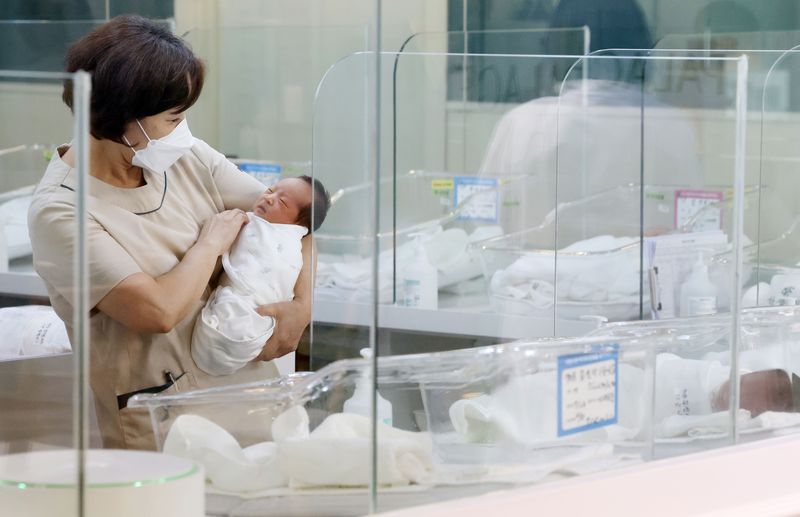
[Financial News] Seoul’s number of births has risen for two straight years. The Seoul Metropolitan Government says its nationwide first and top-tier birth support policies are now bearing fruit.
According to the Seoul Metropolitan Government on the 27th, the Ministry of Data and Statistics' '2025 Birth Statistics' showed that 45,516 babies were born in Seoul in 2025, up 9.4% from the previous year. That was the highest growth rate among the country’s 17 cities and provinces.
Seoul’s total fertility rate had gradually fallen from 1.0 in 2015 to 0.55 in 2023. It rebounded to 0.58 in 2024 and rose again to 0.63 in 2025, marking two consecutive years of recovery. The city’s fertility rate has consistently exceeded the government’s annual projections.
The rebound has become even more pronounced this year. According to the Ministry of Data and Statistics' 'Population Trends for June 2026 and the Second Quarter,' Seoul’s cumulative births in the first half of 2026 reached 26,924, up 18.7% from the same period last year. The number of marriages also came to 26,840 from January to June, an increase of 10.9% year on year. Both births and marriages posted the highest growth rates nationwide.
To tackle low birth rates, the Seoul Metropolitan Government has rolled out birth support policies that are the first of their kind in the country and among the most generous. Key measures include the maternity transportation subsidy, which eases travel burdens during pregnancy, and the Seoul postpartum care subsidy, which helps mothers recover after childbirth. So far, about 210,000 pregnant women have received transportation subsidies, and about 120,000 mothers have received postpartum care subsidies. Since March this year, the city has increased support for second and subsequent children, expanding benefits for families with multiple children.
Support for infertility treatment for couples has also helped set a nationwide standard. Since 2023, the city has abolished income requirements and limits on the number of treatments by procedure, and it supported about 210,000 cases through last July. Mirinae House public housing program, a housing support project for newlyweds, had supplied a total of 7,108 homes as of August 2026.
A survey by The Seoul Institute found that caregivers’ perception of Seoul as 'a city where it is good to have and raise children' rose for two straight years, from 3.50 out of 5 in 2023 to 3.58 in 2024 and 3.66 in 2025. The share of respondents who said they intended to have a child within three years also increased. Among childless couples, the figure rose from 68.5% in 2024 to 79.4% in 2025. Among couples with children, it climbed from 30.3% to 39.9% over the same period.
The Seoul Metropolitan Government is focusing on building the structural foundation that encourages marriage and childbirth. Beyond support for pregnancy and childbirth, it plans to establish a comprehensive low-birth-rate response system that also covers child development and family support, while expanding assistance for programs with strong policy demand.
Ma Chae-sook, director of the Women and Family Bureau of the Seoul Metropolitan Government, said, "The fact that both the number of births in Seoul and the number of marriages, which can be seen as a leading indicator of births, are rising together shows that a virtuous cycle is clearly taking shape in Seoul, where more marriages are leading to more births." She added, "To sustain this recent trend over the long term, we will strengthen support not only for childbirth but also for childcare and families, and build a comprehensive response system to low birth rates."
[email protected] Lee Seol-young Reporter