President Lee: "If We Cannot Solve Capital Region Concentration and Regional Extinction, South Korea Has No Future"
- Input
- 2026-08-27 14:09:37
- Updated
- 2026-08-27 14:09:37
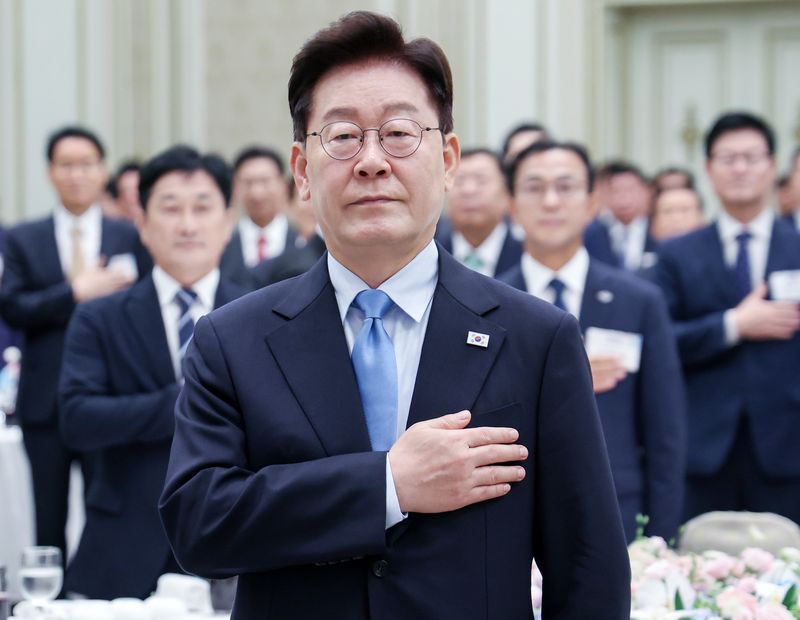
[Financial News] President Lee Jae-myung stressed on the 27th that "only by easing the chronic concentration of people and resources in the capital region and awakening the potential of the entire country can we create an 'era of growth for all,' in which every region rises together, and only then will we have a future and hope."
At the luncheon, Lee invited mayors, county heads and district chiefs elected in the 9th local elections to Cheong Wa Dae for talks over lunch. He said, "If the central and local governments become one team and move in step with one another, I am confident we can build a Korea where all citizens are happy." The event was attended by 187 of the country's 227 basic local government heads, along with central government officials including Prime Minister Han Seong-sook, Deputy Prime Minister and Minister of Finance and Economy Koo Yun-cheol, and Minister of the Interior and Safety Yun Ho-jung. Also present at Cheong Wa Dae were Chief of Staff to the President Kang Hoon-sik and Senior Presidential Secretary for Political Affairs Hong Ik-pyo.
Lee said, "South Korea is now facing a major crisis, including the problem of regional extinction caused by the concentration of population in the capital area, as well as other challenges such as low birth rates and an aging society. In particular, the explosive pressure on the capital region and the threat of regional disappearance are both seriously endangering the country's future." He added, "If we cannot solve these problems, South Korea has no future."
He went on to say, "The reason the Popular Sovereignty Government is pushing ahead with the 3 Major Mega-Projects and the Five Mega-Regions and Three Special Self-Governing Provinces Policy, and is actively working to improve local living conditions including housing, education, welfare and culture, is precisely this. Only by easing the chronic concentration in the capital region and unlocking the potential of the entire country can we create an 'era of growth for all,' where every region rises together, and only then will we have a future and hope."
Lee also said, "We will continue efforts to expand the real authority and fiscal capacity of local governments so that each region can make use of its own characteristics and strengths to plan, grow and develop on its own." He added, "We have introduced a regional preference index so that support becomes stronger the farther a region is from Seoul, and we are continuing to identify new special measures based on that index. I hope you will also propose as many reasonable ideas as possible whenever the opportunity arises."
He added, "Through concentrated investment that combines education spending for nurturing talent and technology, investment in wide-area transportation and cultural facilities to improve quality of life, and tourism policy, we will further strengthen the foundation for region-led growth."
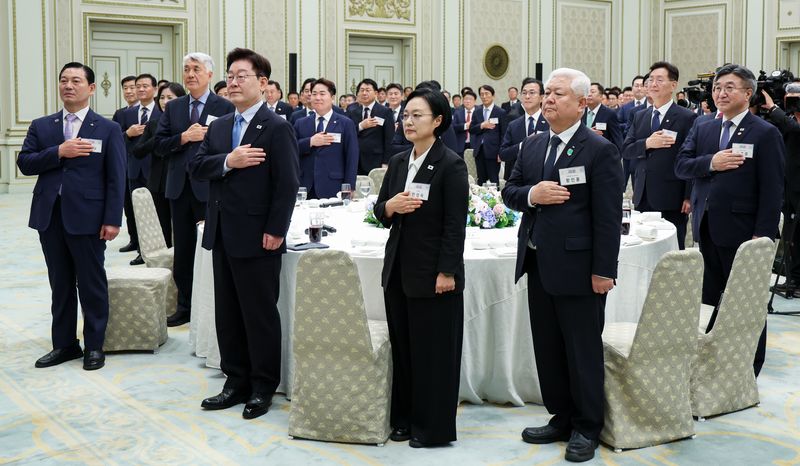
Lee repeatedly emphasized the importance of coordination between the central and local governments. In particular, he said, "No single issue can be resolved by the central government alone." He explained that "to overcome the one-pole system centered on the capital region and ensure that the capital area and the provinces coexist and develop together, cooperation between the central and local governments is essential."
Meanwhile, Lee postponed the senior aides meeting scheduled after the luncheon and changed his schedule to chair an emergency review meeting on the impact of flooding in Nepal on South Korean nationals. At the meeting, he is expected to receive reports on the local damage, the progress of search and rescue operations for the missing, and measures to ensure the safety of South Koreans overseas. Kang Yoo-jung, chief spokesperson at Cheong Wa Dae, said, "In light of the fact that all efforts are being focused on ensuring the safety of our citizens, the luncheon with Democratic Party of Korea lawmakers scheduled for the 28th has also been postponed." The party had originally planned to hold a luncheon at the Yeongbingwan State Guest House at Cheong Wa Dae, hosted by Lee, after a two-day, one-night lawmakers' workshop from the 27th to the 28th.
Before the luncheon began, Lee also said, "I am very glad to meet all of you, but I also feel deeply saddened because the whereabouts of nine of our nationals are currently unknown." He added, "I ask you all to keep them in your thoughts and hope for their safe return as soon as possible."
Earlier, a massive flood struck north-central Nepal on the 26th local time, causing heavy casualties. At least 160 people were killed, and 403 people, including 341 foreigners, remain missing.
Nine South Korean employees from Korea South-East Power and Doosan Enerbility, who were building a hydroelectric power plant in the area, also lost contact. Ten other South Koreans were stranded, but are believed to be safe.
[email protected] Choi Jong-geun Reporter