Financial union to launch general strike over bank relocation, 4.5-day workweek and 6% wage hike
- Input
- 2026-08-27 14:17:58
- Updated
- 2026-08-27 14:17:58
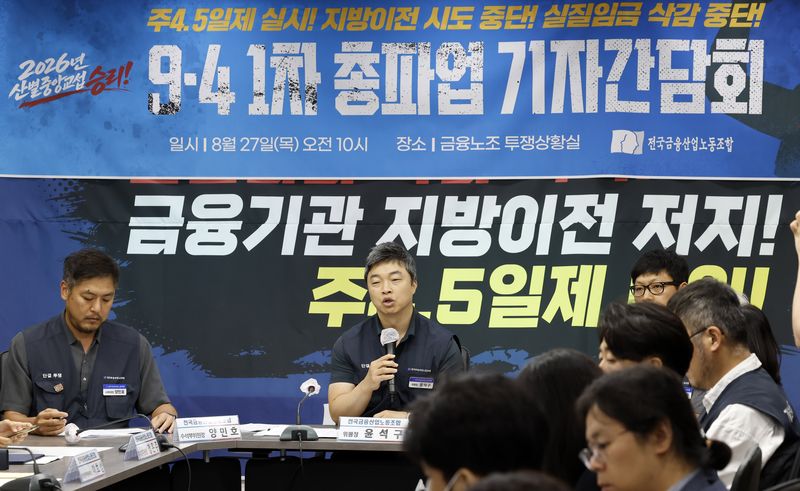
On the 27th, the union held a press briefing at the Dong-A Building in Jung District, Seoul, and said, "If the government pushes ahead with a unilateral relocation that shakes the financial industry and workers' lives, we will not back down any further."
The union will escalate its campaign with a rally on the 28th, followed by the Sept. 4 general strike. Its key demands include a halt to relocation talks involving Korea Development Bank (KDB), Industrial Bank of Korea (IBK) and The Export-Import Bank of Korea (KEXIM), a 6% wage increase and the establishment of a 4.5-day workweek.
The government is pushing to relocate financial public institutions such as the Financial Services Commission (FSC), Financial Supervisory Service, Korea Deposit Insurance Corporation (KDIC) and Bank of Korea (BOK) to the regions. It is also reportedly seeking to move state-run banks including KDB, KEXIM and IBK.
Earlier, the Ministry of Land, Infrastructure and Transport said it would follow the principle of minimizing the number of institutions remaining in Seoul. As expectations grow that a second round of public institution relocations will be announced in the second half of this year, unions at the state-run banks that are central to the debate have made their opposition clear.
Unions at KDB, KEXIM and IBK held a rally on the 11th titled the "All-out struggle rally to block the relocation of the three state-run bank unions." Unions at KDIC and the Financial Supervisory Service also held a joint press conference on the 24th to oppose relocation. The Financial Supervisory Service union is also internally reviewing whether to join an umbrella labor group such as the Korean Confederation of Trade Unions (KCTU).
The unions are now pressuring not only the government but also the management of each institution. The KDB union asked Chairman Park Sang-jin to directly tell the government that KDB should be excluded from the second relocation list and to publicly oppose the move. The IBK union has also repeatedly urged President Jang Min-young to publicly state her opposition to relocation. The KDIC union is pressuring its board and management through board member Kim Dae-ui, a former union vice chairman.
Yoon said that "the answer to balanced regional development should not be to physically split up and move functions that the financial industry has already built," arguing that a hasty relocation would destroy workers' living areas and weaken financial competitiveness.
The union is also calling for the introduction of a 4.5-day workweek to reduce working hours.
Jeong Eun-ju, chairwoman of the union's women's committee, said, "A poverty of time, widespread burnout and a devastated quality of life are our deficits and our crisis." She added that "the financial industry is a sector where a pilot reduction in working hours would have fewer side effects and greater effectiveness than in other manufacturing industries." She also explained that in wage negotiations by industry, the union proposed a 6.0% pay increase, taking inflation and economic growth into account, but the employers' council has stuck to a 2.5% proposal. The union argued that "real wages must not be cut."
Yoon said the union will again deliver a strong message of opposition at the "all-out struggle rally" to be held in front of the National Assembly on the 28th, but added that "we will keep the door to negotiations open until the very last moment."
On the 12th, the union secured the right to strike after 96.1% of 68,878 members voted in favor of industrial action in a ballot. The union includes branches at 42 companies, including commercial, regional, specialized and state-run banks, as well as Korea Credit Guarantee Fund (KODIT), Korea Technology Finance Corporation (KOTEC), Korea Asset Management Corporation (KAMCO), Korea Housing Finance Corporation (HF), Korea Financial Telecommunications and Clearings Institute (KFTC) and Koscom Corporation.
[email protected] Park Moon-soo Reporter