160,000-Pyeong Cornfield Becomes the Heart of AI... 'Made in USA HBM' Gets Underway
- Input
- 2026-08-28 01:00:00
- Updated
- 2026-08-28 01:00:00
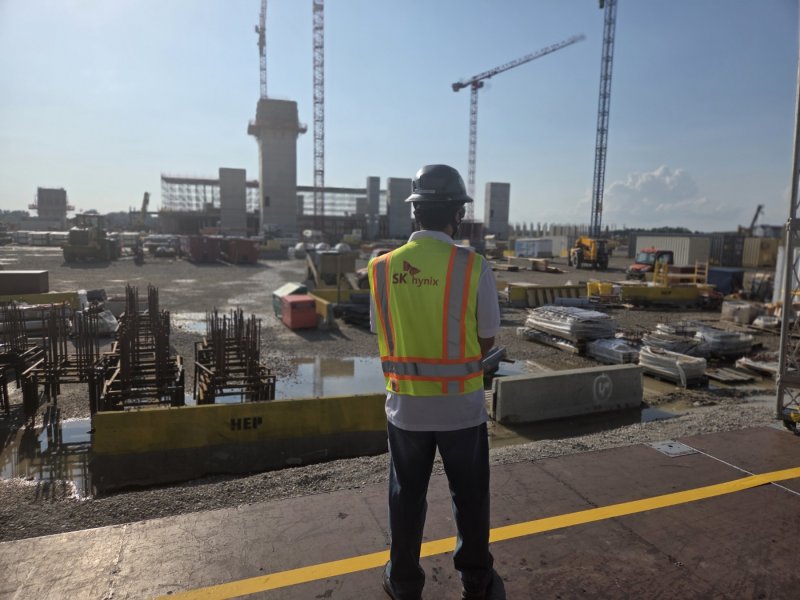
"This used to be a cornfield," said Kim Hyun-joong, head of SK hynix's construction team, underscoring how the transformation has only just begun. Since full-scale site work started in April, about 90 percent of the first-floor slab has been completed, and crews are now erecting columns that will support the second floor. Once finished, HBM production equipment will be installed on the second floor, while the first floor will house pumps and other support systems, including scrubbers that clean exhaust gases. Because the facility must support heavy semiconductor equipment that is highly sensitive to vibration, its columns are being placed much more densely than in a typical building.
The scale of the plant is staggering. The entire site covers 133.5 acres, or about 160,000 pyeong, enough space for roughly 100 American football fields. The cleanroom alone will span 181,475 square feet, or about 5,100 pyeong. The building will stand about 100 feet tall, roughly the height of a 10-story building.
The scale becomes even more striking when the construction materials are converted into distance. If the rebar used here were laid end to end, it would stretch about 2,635 miles, enough to reach from New York to Los Angeles. The steel frame weighs 24,157 tons, enough to make about 220 of Chicago's iconic Cloud Gate sculptures. The piping installed in the plant will total 84 miles, and the wiring will run 935 miles. The facility will also process 3.8 million gallons of water a day, enough to fill about six Olympic-size swimming pools.
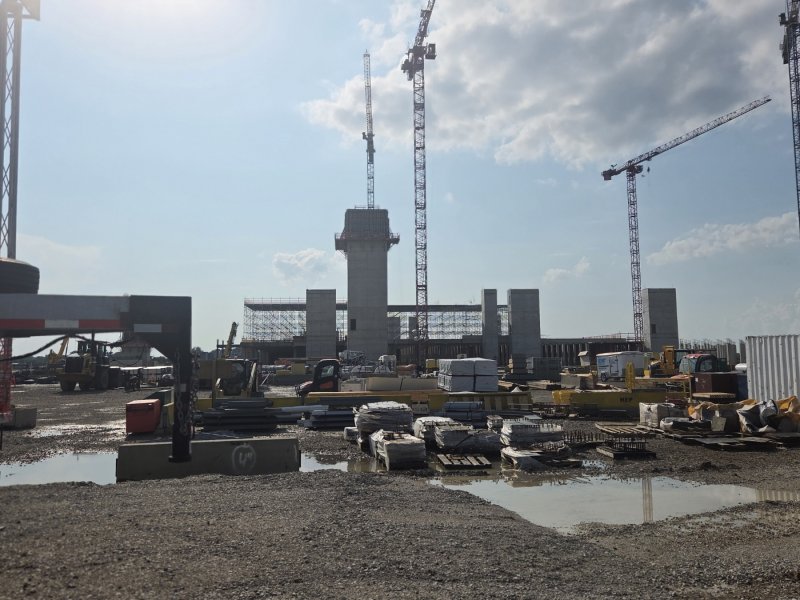
Industry observers expect the plant to produce around 10 percent of SK hynix's annual DRAM wafer output, which is estimated at 6 million wafers. Advanced HBM wafers made in South Korea will cross the Pacific Ocean and arrive in Indiana, where they will undergo wafer-level packaging and testing before being supplied to AI customers in the United States. In effect, South Korea's HBM manufacturing expertise and U.S. AI demand are being linked through a single production line.
The semiconductor plant will not be limited to mass production. It will also include an HBM production line, testing space, and research and development (R&D) facilities. Pointing to the section where the steel frame is going up, a site official explained, "The area behind the large columns is the wafer-level packaging space, where the actual HBM will be made."■ Combining South Korean Semiconductor Know-How with U.S. Construction ExperienceThe construction process itself is a site of U.S.-South Korea cooperation. General building work is currently being handled by U.S. companies. However, because there is limited experience in Indiana with advanced semiconductor cleanrooms and equipment installation, SK hynix is drawing on the expertise of Korean firms for electrical work and equipment inside the cleanroom. Korean supervisors are passing on technical know-how and work methods to local workers, while the actual construction crews are made up mainly of U.S. workers. At peak construction, about 3,000 workers are expected to be on site each day.
The construction methods are also different from those used in South Korea. In South Korea, it is common to assemble concrete structures that were prefabricated at a factory. Here, however, crews are building forms, placing rebar, and pouring concrete on site. Unlike South Korea, where bedrock is common, this area has almost none underground, so more piles must be driven in to support heavy equipment. Kim said, "The culture, language, and environment are all different from South Korea." He added, "Every day we are learning something new, adapting to the U.S. way of doing things, and at the same time sharing the strengths of South Korean semiconductor plant construction."
When this project, which began as a cornfield, is completed, the United States will have its first HBM production base. A new supply chain linking South Korea's HBM manufacturing strength with the U.S. AI industry through local production is taking shape in Indiana.
[email protected] Reporter Lee Byung-chul Reporter