Rice cultivation area falls by 19,000 hectares this year, but government still misses target
- Input
- 2026-08-27 12:00:00
- Updated
- 2026-08-27 12:00:00
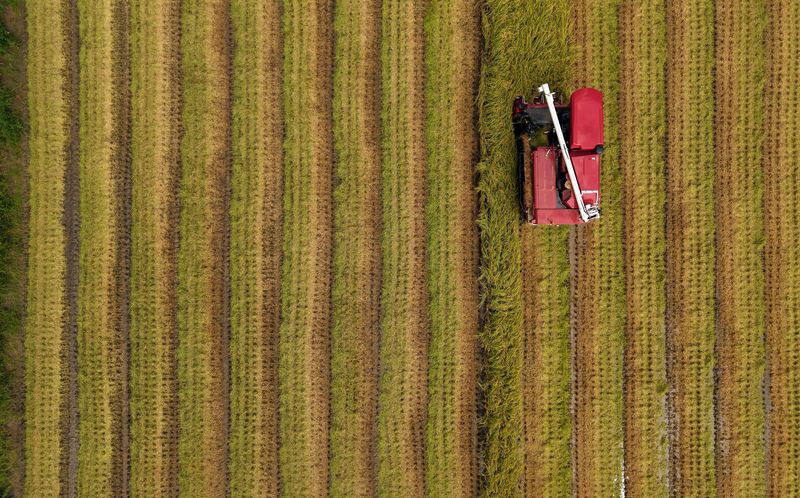
[Financial News] This year's rice cultivation area was estimated at 670,000 hectares, exceeding the government's target of 650,000 hectares for the optimal production of rice. To address the surplus rice problem, the government is expanding a policy that provides strategic crop direct payments to farmers who grow crops other than rice. However, the reduction in rice acreage appears to be moving slowly because of the aging rice-farming population, the ease of growing rice compared with other crops, and stable sales channels.
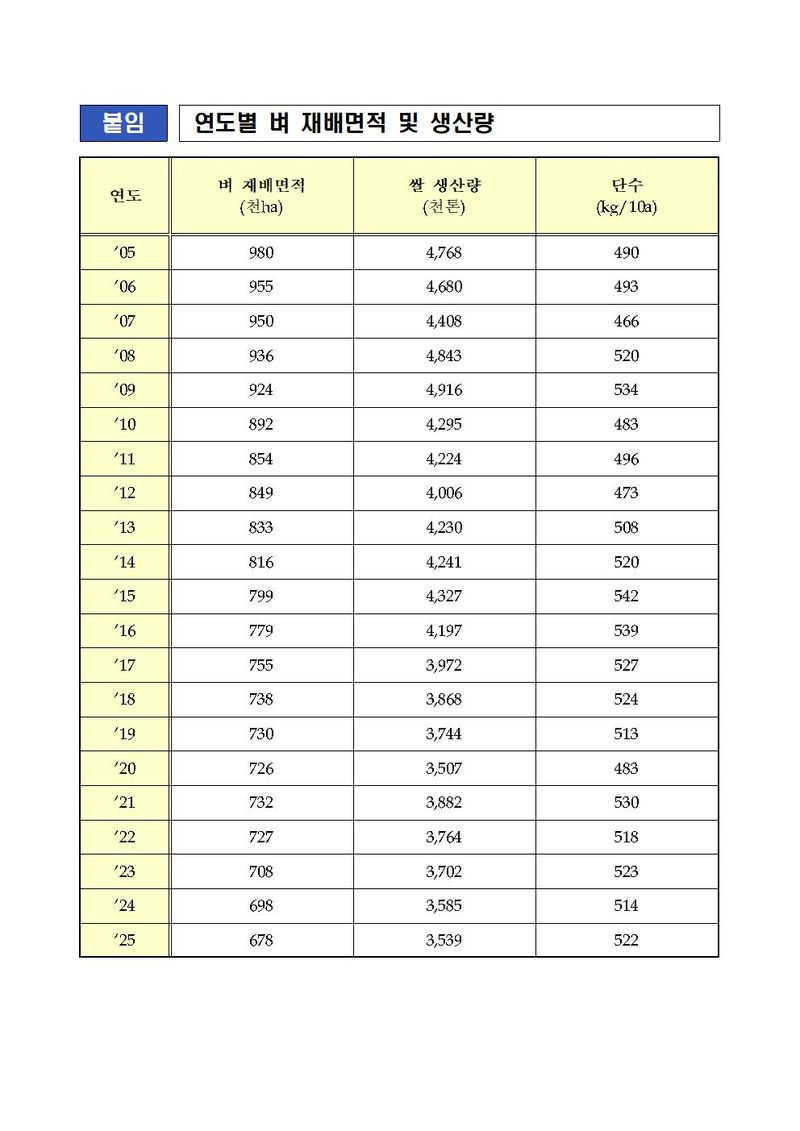
According to the Ministry of Agriculture, Food and Rural Affairs (MAFRA) on the 27th, citing the Ministry of Data and Statistics' provisional results for the 2026 rice cultivation area survey, this year's rice acreage came to 670,000 hectares. That is down 7,500 hectares from last year’s 678,000 hectares. Excluding the 11,000-hectare application area for rice for supply-demand adjustment, which is supplied for processing, MAFRA said the figure is expected to be about 659,000 hectares. The area excluding rice for supply-demand adjustment fell by 19,000 hectares from a year earlier, equivalent to about 26,611 soccer fields.
In February, MAFRA said in its 2026 grain supply and demand plan that the rice acreage needed to balance supply and demand for the 2026 harvest would be around 640,000 hectares, about 38,000 hectares less than last year. It later revised the estimate upward to 650,000 hectares in May. With this year's area at 659,000 hectares, the government fell short of reducing acreage by more than 10,000 hectares from its original plan. Although the strategic crop area was planned at about 90,000 hectares this year, rice farmers did not switch to other crops as actively as expected. A MAFRA official said, "The expected reduction of 19,000 hectares this year is twice the recent five-year average annual decline of 9,600 hectares."
MAFRA is pushing policies to reduce rice acreage because the decline in rice planting area has been smaller than the drop in rice consumption, leaving supply above demand. Rice acreage fell 8.2 percent over the seven years from 738,000 hectares in 2018 to last year. By contrast, per capita rice consumption dropped 11.6 percent, from 61 kilograms in 2018 to 53.9 kilograms last year. As oversupply continued, fiscal burdens grew and farm income declined. Over the past four years, the government has repeatedly removed about 280,000 tons of rice from the market each year. From 2021 through last year, it spent about 3.4 trillion won to purchase a total of 1.11 million tons.
To encourage rice farmers to switch to other crops, MAFRA increased the budget for strategic crop direct payments from 244.0 billion won last year to 419.6 billion won this year. The strategic crop direct payment program provides subsidies to farmers who grow crops with high import dependence or alternative crops instead of table rice, with the aim of raising food self-sufficiency and stabilizing rice supply and demand. As a result, rice acreage has been on a downward trend since it rose by 6,000 hectares in 2021. It then fell by 5,000 hectares in 2022, 19,000 hectares in 2023, 10,000 hectares in 2024, and 20,000 hectares in 2025.
Starting this year, rice for supply-demand adjustment was added as an item under the strategic crop direct payment program. Under this payment scheme, participating farmers must ship the rice they produce to a rice processing complex and receive both the direct payment and the proceeds from rice sales. In normal times, the rice they ship is supplied only for processing, keeping it out of the table rice market in advance. It is then quickly redirected to table rice only in emergencies such as crop failures.
Rice for supply-demand adjustment was introduced to strengthen domestic raw material self-sufficiency in line with the growth of the rice processing industry. Previously, government-managed grain reserves stored for one year were supplied to rice processors as raw material rice. With rice for supply-demand adjustment, however, private-sector new harvest rice can be supplied, improving product quality. Farmers participating in the program will receive 5 million won per hectare in strategic crop direct payments.
Jeong Hye-ryeon, director for food policy at MAFRA, said, "We will closely monitor weather conditions, crop conditions, inventories, and rice consumption trends to quickly assess the supply and demand situation for the 2026 harvest. If necessary, we will prepare measures to stabilize supply and demand during the harvest season in October to help stabilize the market."
[email protected] Choi Yong-jun, agriculture reporter Reporter