Finding the Answer to School Safety in the Field... Jeju Education Superintendent Ko Ui-suk Talks with Education Stakeholders
- Input
- 2026-08-27 11:12:31
- Updated
- 2026-08-27 11:12:31
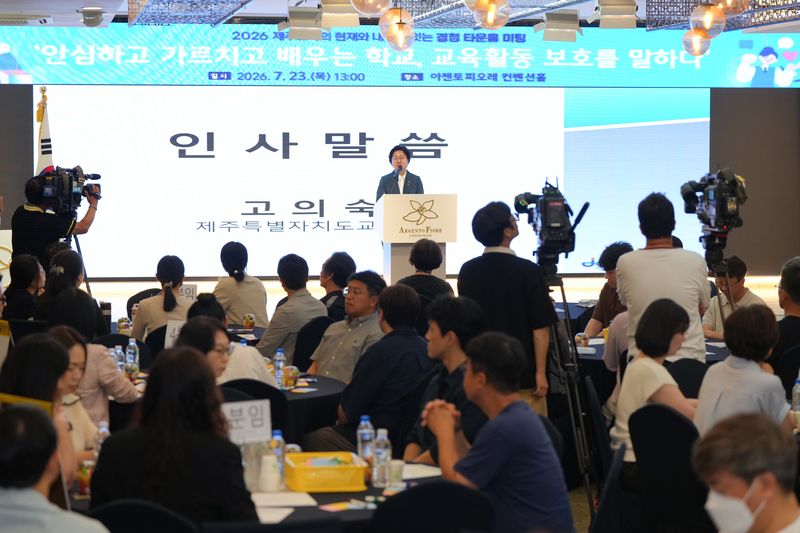
[Financial News, Jeju = Reporter Jeong Yong-bok] Rather than solving safety issues in Jeju schools with measures already set by the education office, a forum will be held where students, parents, and staff can directly identify risk factors and decide which problems should be addressed first. Following the first town hall on protecting educational activities, this session will focus on redesigning the safety net for school life based on voices from the field.
According to the Jeju Special Self-Governing Provincial Office of Education on the 27th, the second event of the '2026 Listening Town Hall Meeting Connecting the Present and Future of Jeju Education' will be held at 2 p.m. that day at Agento Fiore Convention Hall.
The theme is 'A school where a safe day becomes part of everyday life, building a Jeju education safety net together.' Teachers, students, parents, and others will take part and directly propose safety issues they experience in school life and the policies needed to address them.
What sets this town hall apart is that it is not simply an event to explain safety policies. Participants will be directly involved in the process, from diagnosing problems to setting priorities for solutions.
Full-scale small-group discussions will begin at 2:20 p.m. The first question is, 'What is the safety situation at our school?' Participants will first identify the risks and blind spots they have experienced or are concerned about in school life.
They will then propose concrete solutions to the question of what is needed to make schools safer. In the final discussion, they will choose the most urgent task to pursue from among the proposed alternatives.
Over about 55 minutes, the session will move in one flow from assessing the current situation to proposing policies and setting priorities.
From 3:30 p.m., the results from each group will be shared with all participants. The process will compare problems and solutions from different settings rather than remaining limited to the experiences of a single school or a specific education stakeholder group.
A direct dialogue between Ko Ui-suk and the participants will also take place for 40 minutes. From 3:55 p.m. to 4:35 p.m., students, parents, and staff will discuss issues raised in the sessions and policy proposals with Ko. The meeting is expected to provide a chance to hear questions from the field directly and explain the direction for future review.
This event is the second of two Listening Town Hall Meetings planned by the Jeju Special Self-Governing Provincial Office of Education this year.
At the first town hall, held on July 23, teachers in Jeju discussed key issues related to protecting teachers' authority, including violations of educational activities, burdens in student guidance, and support for affected teachers, under the theme 'A school where teaching and learning can take place with peace of mind, talking about protecting educational activities.'
Even then, the format was a roundtable discussion that focused not on delivering policies prepared by the education office, but on diagnosing problems based on teachers' real experiences and finding improvements that could be applied in the field.
In the second session, participation will expand to include students and parents, and the agenda will broaden from protecting teachers' educational activities to the safety of school life as a whole.
School safety is not limited to facilities or accident prevention. It is connected to many issues students face throughout the day at school, including commuting, life on campus, school violence, relationships among students, and responses to crisis situations. As a result, the risks people feel and the measures they need may differ depending on the education stakeholder.
That is why the Jeju education office is asking participants not only what problems exist, but also what the most urgent solution is.
The provincial office plans to manage the opinions raised in the two town halls by dividing them into tasks that can be improved in the short term, tasks that require medium- to long-term review, and tasks that need institutional reform. It will also examine whether they can be reflected in actual policy after review by the relevant departments.
In the end, the success of this town hall will depend not on how many opinions are voiced during the event, but on how much the priorities chosen in the field are reflected in future school safety policies.
Ko also plans to listen directly to the school safety issues raised by participants and use them in policy decisions to strengthen Jeju's education safety net in the future.
[email protected] Jeong Yong-bok Reporter