End the prolonged dispute over Busan Port North Port integrated transfer center
- Input
- 2026-08-27 10:49:53
- Updated
- 2026-08-27 10:49:53
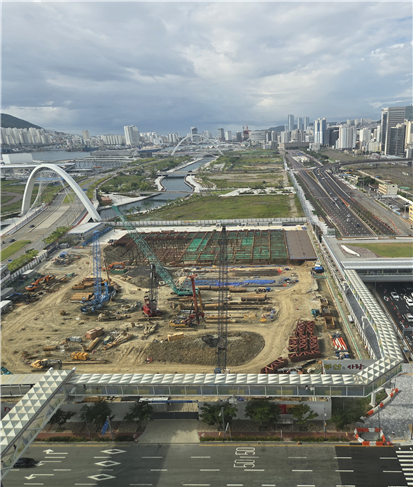
[Financial News] The Busan Port Future Policy Institute, co-directed by Jeong Seong-gi and Lee Gwang-guk, said on the 27th that concerns are growing as construction has been suspended amid a conflict between Busan Port Authority (BPA) and the project operator over the North Port integrated transfer center project. It added that it is proposing a reasonable mediation plan to help the project return to normal as soon as possible.
The proposal is based on public-interest goals: strengthening transfer functions, expanding commercial and office facilities, returning development gains to the local community, and promoting coexistence between the North Port and the old downtown area.
At the heart of the dispute are the height and level-difference issues in the public pedestrian passage of the integrated transfer center.
According to the district unit plan, the pedestrian route linking Busan Station and the North Port should be connected without any level difference. In the actual design process, however, a gap of about 3.3 meters emerged, undermining pedestrian connectivity and raising concerns over blocked views.
As BPA belatedly recognized the issue and demanded corrections, trust with the operator collapsed. The dispute eventually escalated into termination of the land sale contract, a stop-work order, and civil litigation.
The institute warned that if the project remains suspended for a long period, the region may fail to seize development opportunities such as the construction of the new headquarters of the Ministry of Oceans and Fisheries (MOF). It could also waste precious time on the North Port redevelopment project once again, creating what it called a "lost decade." The damage, it said, would ultimately fall on Busan citizens and the entire North Port redevelopment project.
With the real estate market still sluggish and project financing (PF) remaining tight, a suspension of the flagship integrated transfer center could also hurt private investment and development at other sale sites within the North Port, the institute said.
It added that this could have significant ripple effects on major projects, including the new MOF headquarters, the relocation of public institutions related to oceans and fisheries, and the relocation of HMM's headquarters.
The institute stressed that the transfer center issue should be treated not as a simple contract dispute between BPA and the developer, but as a major matter directly tied to the success or failure of the North Port redevelopment project.
The Busan Port Future Policy Institute proposed three measures to normalize the integrated transfer center.
First, the operator submitted a revised design plan reflecting BPA's views to Dong-gu Office at the end of last month. To win public trust in the project's normalization, it should publicly and clearly state that it will faithfully carry out the design changes needed to resolve the level-difference issue.
Second, the center should expand its transfer functions and increase commercial and office facilities in line with its original purpose. To build an integrated transfer system that includes barrier-free mobility facilities for vulnerable travelers and links with personal mobility devices (PMD), the transfer space on the first floor should be significantly enlarged. In addition, the plan centered on officetels should be reconsidered, and the share of commercial and office facilities should be increased to create new jobs and contribute to local economic revitalization.
Third, development gains should be returned to the local community to promote coexistence between the old downtown area and the North Port. The pedestrian routes connecting Busan Station, Chinatown, Choryang Traditional Market, and the North Port should be greatly improved, and a symbolic street reflecting the identity of the Port of Busan should be created. The operator should also provide public contributions within a reasonable range it can bear, including support for tram construction costs to improve access to public transportation, in order to return development gains to the community.
The institute also said BPA should take a responsible approach and reopen negotiations promptly if the operator faithfully presents measures to resolve the level difference, expand transfer functions, increase commercial and office facilities, and provide public contributions. It added that Busan Metropolitan City Government and Dong-gu Office should thoroughly review the building permit changes, structural safety checks, and traffic impact assessments to prevent repeated mistakes, and should provide swift support so that administrative procedures are not unnecessarily delayed.
Jeong Seong-gi, co-director of the Busan Port Future Policy Institute, said, "I hope BPA and the operator will quickly reach agreement on a reasonable mediation plan based on a shared sense of responsibility to revitalize Busan's sluggish economy and successfully advance the North Port redevelopment project." He added, "This conflict should be turned from a crisis into an opportunity, serving as a turning point to strengthen the transfer functions and public value of the integrated transfer center and to energize the entire North Port redevelopment project."
[email protected] Byun Ok-hwan, Baek Chang-hoon Reporter