Why Hyperbaric Oxygen Therapy in Hair Transplantation Is Compared to Dragon Ball's "Senzu" [Kim Jin-oh's Hair Loss Escape]
- Input
- 2026-08-27 13:54:57
- Updated
- 2026-08-27 13:54:57
[Financial News] In the Dragon Ball comic, the most coveted item is Senzu, a magical bean that fully restores stamina and heals wounds. Son Goku can keep fighting until his body is completely battered, and then get back on his feet after eating one. During surgery, there are moments when Senzu comes to mind. It is the instant when a surgeon wonders, "Can the patient really withstand this technique? If only we had Senzu, it would be possible."
"High-density hair transplantation" is not completed by manual skill alone.
When patients undergo hair transplantation, they usually want as many grafts as possible in a single session. Doctors also want to create a visible change. But they must judge how adding more follicles will affect the surgical outcome.
Transplanted follicles do not receive an independent blood supply for a while. Right after transplantation, they survive by drawing oxygen and nutrients from surrounding tissue. Later, they settle in as new microvessels connect. That is why the first few days after surgery, when blood vessels are reconnecting, are so important.
Planting more grafts means placing follicles at very close intervals. However, if the distance between grafts is too narrow or the placement is too deep, existing microvessels can be damaged, and more follicles must survive within a limited blood flow. This is why high-density transplantation cannot be achieved by close placement alone.
When surgery is performed using a non-incisional method, recovery of the back of the head must also be considered. If thousands of follicles are harvested, thousands of wounds must heal at the same time. Extra caution is needed for scalps with scars from previous procedures, scalps with firm and thin skin, and patients whose wounds heal slowly because of smoking or diabetes.
The real challenge may be knowing how far the scalp can go, even while pursuing the best possible result through aggressive surgery. In hair transplantation, that judgment may be the hardest skill of all.
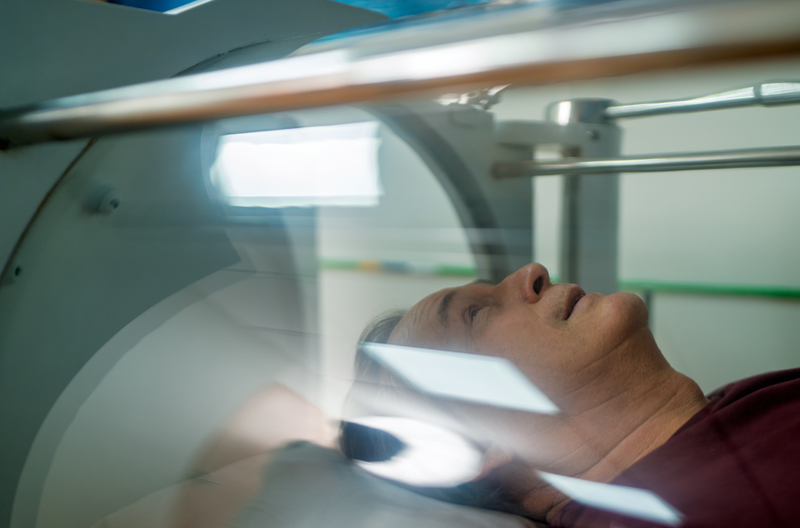
After surgery, HBOT helps control inflammation and supports wound healing.
In the past, recovery was seen simply as a waiting period after surgery. Today, however, recovery is treated as part of the procedure itself. Doctors control inflammation before surgery, reduce the time follicles spend outside the body, and check in advance for conditions that could interfere with wound healing. HBOT, which supplies the scalp with more oxygen after surgery, is part of that approach.
With HBOT, the amount of oxygen dissolved in plasma increases under high pressure. This extra oxygen reaches tissues even when blood flow is insufficient. It helps control inflammation immediately after surgery and supports the formation of new blood vessels and wound healing.
In clinical trials involving hair transplant patients, those who received HBOT experienced less itching and fewer cases of folliculitis after surgery. Temporary shedding after transplantation also decreased. The clearest benefit seen so far is that it helps follicles and the scalp pass through the most unstable period after surgery more comfortably.
The breathing room created by HBOT also affects a surgeon's plan. In large-scale transplants that correct a wide bald area in one session, in procedures that require sufficient density in a narrow area, and in revision surgeries for scarred areas with irregular blood vessel distribution, the technique used to place follicles is just as important as the method used to stabilize tissue after surgery.
Even in situations where surgeons are unsure whether to lower the density or divide the operation into multiple sessions, combining HBOT can make a more aggressive plan possible. The therapy supplements the oxygen needed until transplanted follicles secure a new blood supply, while also helping the donor site recover from countless tiny wounds. If high-density transplantation is the force that moves things forward, recovery support is what allows that force to be used to the fullest.
What made Son Goku strong was not just his special moves. It was Senzu, which allowed him to rise again after fighting to his limit. Hair transplantation is not completed by the act of placing grafts alone. When doctors prepare the scalp and follicles to recover properly after surgery, they can use their skills more boldly.
[email protected] Kim Hyun-sun Reporter