Lee Chang-heum Appointed as Jeju's First Deputy Governor for Climate and Economy... Province Launches Climate-Economy Control Tower
- Input
- 2026-08-27 10:34:39
- Updated
- 2026-08-27 10:34:39
At the meeting, Minister Ahn held close consultations with the companies, listened to the difficulties facing the petrochemical industry, and discussed government support measures.
Minister Ahn Duk-geun's communication
Minister of Trade, Industry and Energy Ahn Duk-geun speaks with the heads of petrochemical companies
LG Chem and Lotte Chemical attended the meeting. LG Chem also introduced its COMPOSTFUL plastic in Busan.
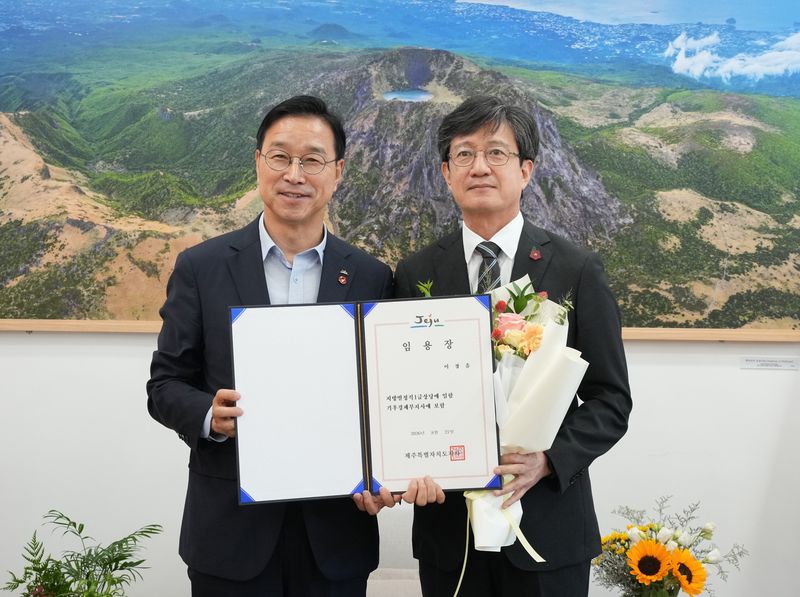
Wi Seong-gon, Governor of Jeju Province, and Lee Chang-heum, the newly appointed deputy governor for climate and economy, hold their appointment letters at the provincial government office in Jeju on the 27th. The deputy governor will serve as Jeju's first deputy governor for climate and economy under the 9th popularly elected provincial administration, overseeing the transition to clean energy and the promotion of future industries such as AI, space and biotechnology. /Photo provided by Jeju Special Self-Governing Province
[Financial News, Jeju = Jeong Yong-bok] Lee Chang-heum, former head of the Climate and Carbon Policy Bureau at the Ministry of Climate, Energy and Environment, has been appointed as Jeju's first deputy governor for climate and economy, who will lead climate and energy policy as well as future industries under the 9th popularly elected provincial administration. Jeju has now launched a policy control tower to fully implement its vision for a 'Jeju-style climate economy,' which links the transition to clean energy with corporate investment, jobs and residents' income.
According to Jeju Special Self-Governing Province on the 27th, Governor Wi Seong-gon presented the appointment letter to Lee Chang-heum, the new deputy governor for climate and economy, that day.
The appointment came just one day after the Jeju Special Self-Governing Provincial Council's special committee on the personnel hearing for the deputy governor candidate adopted a report concluding that he was 'suitable.'
The deputy governor for climate and economy is a post created through the reorganization of the provincial government under the 9th popularly elected administration, replacing the former vice governor for political affairs. The role covers not only responses to the climate crisis and the energy transition, but also connecting future industries such as Artificial Intelligence (AI), space and biotechnology with regional economic growth.
Born in Sinrye-ri, Namwon-eup, Seogwipo City, Lee graduated from Namju High School and the Department of Public Administration at Kyung Hee University. He later earned master's and doctoral degrees in political science from the Department of International Relations at Keele University in the United Kingdom. After passing the 40th High Civil Service Examination, he entered public service in 1997 and went on to serve as secretary to the minister of the Ministry of Climate, Energy and Environment, head of the Environmental Industry and Economy Division, spokesperson, head of the Wonju Regional Environment Office, Policy Planning Officer, head of the Climate and Carbon Policy Bureau, and climate and environment secretary at the Presidential Office. In 2023, he became the first person from Jeju to rise to the top civil service rank at the ministry, establishing himself as an expert in climate and environmental policy.
He also has deep ties to Jeju's environmental policy. He has been involved in local issues and policy initiatives, including the Environmental Resource Recycling Center, expansion of water and sewage facilities, support for the upgrade of Cheonmicheon to a national river, designation as a carbon-neutral model city, and the expansion of electric vehicle adoption.
With his appointment, Jeju Island plans to accelerate policies that link the expansion of renewable energy to regional industrial growth.
A key task is to use clean energy generated from Jeju's wind and sunlight for distributed energy and the development of new industries, while building a structure in which the benefits of the energy transition flow not only to companies but also to local communities and residents. Future industries that Jeju is strategically nurturing, including AI, space and biotechnology, are also among the deputy governor's main responsibilities. Jeju is pushing ahead with plans to build an industrial ecosystem that links research, talent, startups and companies, including a joint campus connecting the island with the four national science and technology institutes. Attention is also on whether Lee can turn the policy experience and network he built in the central government into national funding, inclusion in state plans and institutional reform. He begins his term with issues raised during the provincial council's personnel hearing that still need to be addressed. While the council positively assessed his roughly 30 years of expertise in climate and environmental policy and his experience in policy coordination, it also urged him to deepen his direct experience in the energy and economy sectors and improve his understanding of Jeju's local issues. The council also recommended that, after his appointment, he transparently disclose the progress of major policies and carry out his duties responsibly so that environmental protection, future industry development and the interests of residents are balanced. At the personnel hearing, Lee outlined a policy direction aimed at ensuring that the benefits of renewable energy return to local communities and residents, and at linking the energy transition and carbon reduction to new industries, jobs and residents' income. On contentious issues such as the second airport, he said he would listen evenly to both supporters and opponents, objectively verify the points of dispute and seek a solution that residents can accept. Lee Chang-heum, the new deputy governor for climate and economy, said, "Based on Jeju's strengths in clean energy and the environment, I will respond proactively to climate change and create new growth opportunities." He added, "I will listen carefully to voices from the field and work to deliver policy results that residents can feel."
The Ministry of Trade, Industry and Energy holds a meeting with the heads of petrochemical companies.
The Ministry of Trade, Industry and Energy holds a meeting with the heads of petrochemical companies.
[email protected] Jeong Yong-bok Reporter