Nighttime 30 km/h Limit in School Zones Eased, with 160 More Sites Planned by Year-End
- Input
- 2026-08-27 12:00:00
- Updated
- 2026-08-27 12:00:00
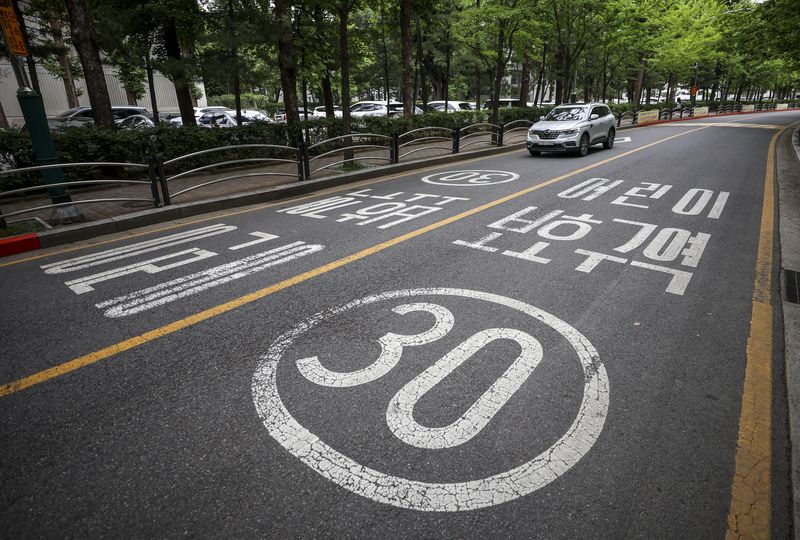
[Financial News] Time-based speed limits will be expanded in child protection zones, allowing higher limits during late-night hours when fewer children are on the road. The policy will now apply to roads with at least one lane in each direction, up from the previous standard of roads with at least two lanes in one direction. The default operating hours will be from midnight to 6 a.m. The measure will be implemented only in locations that meet safety requirements, after review and installation of facilities. Police are also pushing to add about 160 more sites by the end of the year.
According to the National Police Agency on the 27th, police have drawn up a revised guideline for operating time-based speed limits in child protection zones. The system temporarily raises the speed limit in school zones, where the usual limit is 30 km/h, during periods when few or no children are present. It was introduced after a pilot program in September 2023, and as of April, it was being used at 84 of the country's 15,856 child protection zones, or 0.5%.
By region, Gangwon State had the most with 19 sites, followed by Jeollanam-do with 12, North Jeolla Province with 11, Southern Gyeonggi with 10, Seoul with 7, and Gwangju with 6.
Under the revised plan, the policy will apply not only to roads with at least two lanes in one direction, but also to roads with at least one lane in each direction. However, the sites must have safety facilities such as separated sidewalks and roadways, guardrails, crosswalks and traffic signals, and unmanned speed enforcement devices. Locations where two or more child pedestrian traffic accidents occurred over the past three years will also be excluded.
The default operating hours will be from midnight to 6 a.m. A review of child pedestrian accidents in school zones over the past five years found no cases during that time period. Depending on local conditions, the start time can be moved up to 10 p.m., or the end time can be extended to 7 a.m.
While time-based speed limits are in effect, speeds will be adjusted in consideration of the limits on nearby connecting roads. For example, if surrounding roads have limits of 40 km/h or 50 km/h, the school zone limit will be aligned accordingly. Lee Yong-gwan, head of the Traffic Planning Division at the National Police Agency, said, "The aim is to reduce inconvenience for the public during hours when safety is secured, as long as children's safety is not compromised." He added, "This does not mean that regulations will be uniformly relaxed in all school zones."
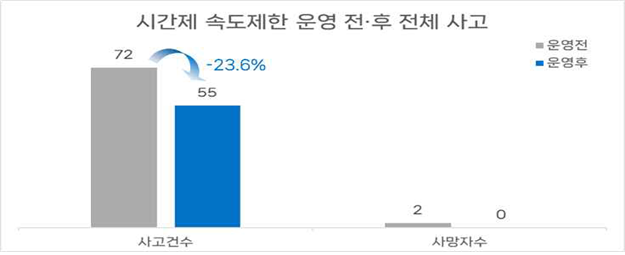
Police also reflected existing operating results and accident statistics in the revised standards. Last year, there was one child pedestrian death in a school zone, sharply down from eight in 2015. In 39 sites that had operated time-based speed limits for more than a year, total traffic accidents fell 23.6% from 72 before operation to 55 after, while deaths dropped from two to zero.
In a survey of 500 people conducted in April, 76.4% said they supported the time-based speed limit system. Twenty percent of respondents had children in elementary school or younger. Police developed the revised plan after a research study by KoROAD and consultations with local governments, provincial police agencies, and autonomous police committees.
After surveying field conditions, police estimated that about 6,000 of all child protection zones meet the requirements for time-based speed limits. Areas on back roads or places where there is no difference between the speed limit in the protection zone and the surrounding roads are excluded.
Police plan to work with local governments to add about 160 more sites by the end of the year, on top of the 84 currently in operation. However, the 160 sites are not final selections. They are an estimated figure based on the revised standards, local budgets and demand, and may change depending on field inspections and review procedures.
It is expected to take time before the policy is actually put into place. Local governments must install facilities such as time-based speed limit signs and variable speed limit signs, and then undergo inspections. Even for sites that meet the requirements, it may take about three months before operations begin. Installation and maintenance costs will be borne by local governments.
Police said they will continue to review safety every year through field surveys after the system is in operation. At sites that no longer meet the operating standards or where risks have increased, they will reconsider whether to continue time-based speed limits.
[email protected] Kim Ye-ji Reporter