NVIDIA Faces Memory Crunch as Margins Fall Even If Sales Rise 70% Next Year
- Input
- 2026-08-27 10:41:07
- Updated
- 2026-08-27 10:41:07
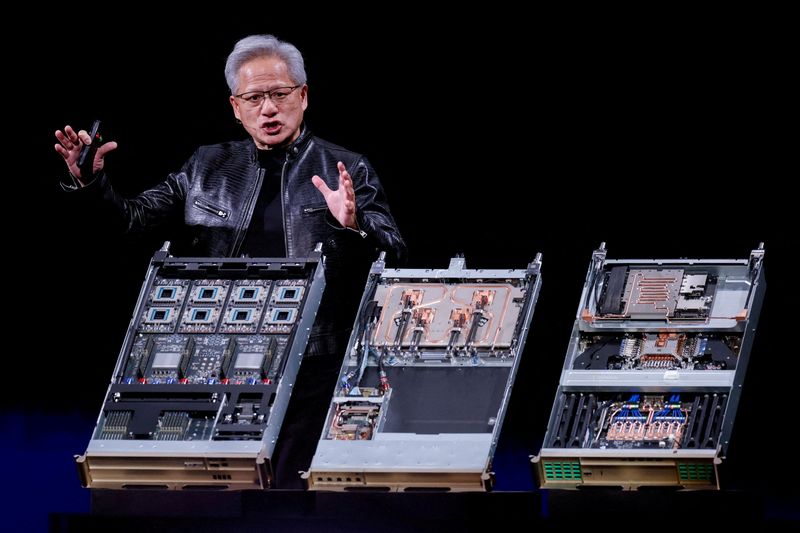
[Financial News] NVIDIA, which has set a new revenue record for 13 consecutive quarters, said it expects sales to rise by about 70% next year. However, margins are expected to decline because of higher memory chip costs.
According to local media outlets including The Wall Street Journal (WSJ), NVIDIA Chief Financial Officer Colette Kress said during its earnings release on the 26th (local time) that revenue for fiscal 2028 (February 2027 to January 2028) is projected to grow by about 70% from current levels.
Despite the sales increase, NVIDIA expects margins to narrow. Based on gross profit, which is revenue minus cost of sales, the gross margin for the second quarter of fiscal 2027 (May 2026 to July 2026) stood at 75%. NVIDIA estimated that the figure would fall to 74% in August through October and to 71% to 72% from November through January next year. It then said fiscal 2028 gross margin would stabilize at 72% to 73%.
U.S. business publication MarketWatch noted that NVIDIA has long tried to keep its gross margin in the mid-70% range. It added that the company may find it difficult to maintain that target amid the recent "extreme" surge in memory chip prices. NVIDIA currently builds AI accelerators for data centers and other customers by combining its own graphics processing units with high-bandwidth memory (HBM) chips made by SK hynix and Samsung Electronics. Prices for HBM and other memory chips have continued to rise on strong AI demand.
At the earnings call, Kress said, "I want to address this clearly rather than leave it as an open question," adding, "The current memory supply shortage is largely a result of AI infrastructure buildout itself." She argued that "tight memory supply is one symptom of the same surge in demand that is driving our growth." She added, "We will continue to work to keep gross margins in the mid-70% range through cost improvements, shorter production cycles and product mix adjustments." According to U.S. media outlets including CNBC on the 22nd, NVIDIA recently informed major customers that it will raise prices for next-generation AI servers such as Vera Rubin by 15% starting next year.
In its announcement on the 26th, NVIDIA said revenue for the second quarter of fiscal 2027 reached $96.22 billion, up 106% from a year earlier. As a result, the company posted record revenue for a 13th straight quarter. By segment, data center revenue, which includes AI chips, rose 117% year on year and 18% from the previous quarter to $89 billion. That accounted for 92% of total revenue. Revenue from hyperscalers, the large-scale data center operators, more than doubled to $48.7 billion from $24.2 billion a year earlier.
That same day, Kress also addressed concerns over so-called "circular financing," in which NVIDIA provides financial guarantees to help customers build data centers. She said cutting-edge AI companies such as OpenAI will become "the largest technology companies in history" and explained that they need NVIDIA's financial support to secure the massive computing resources required for product development and model improvements. She added, "I know some people call this circular financing," but said, "We see it differently, and the return on equity from invested capital will be very strong."
On the same day, NVIDIA CEO Jensen Huang also said, "We are going through a platform shift, and it is affecting every computer company," adding, "These companies will become some of the most important technology companies in history."
[email protected] Park Jong-won Reporter