Why Is Lung Cancer Screening Available Only at General Hospitals? Screening Rate Stands at Just 52.7%
- Input
- 2026-08-27 10:55:52
- Updated
- 2026-08-27 10:55:52
[Financial News] Screening for the five major cancers — stomach, breast, colorectal, cervical and liver cancer — is available at clinics and hospitals that meet certain standards. Lung cancer screening, however, is available only at general hospitals.
Currently, the national lung cancer screening program is open to men and women aged 54 to 74 who are at high risk of developing lung cancer. Eligible participants include heavy smokers with a smoking history of at least 30 pack-years, as well as those designated and announced by the Minister of Health and Welfare. A 30 pack-year history means smoking one pack a day for 30 years, or two packs a day for 15 years.
According to Article 4, Paragraph 2 of the Enforcement Rule of the Framework Act on Health Examinations, lung cancer screening is explicitly limited to general hospitals. The screening rate for lung cancer, one of the six national cancer screening programs, stands at just 52.7%, far below that of other cancer types. By contrast, clinics and hospitals can also be designated as screening institutions for the five major cancers if they meet the required standards.
According to the Korean Statistical Information Service (KOSIS), the total number of people who underwent national cancer screening in 2024 reached 13.73 million, or 60.2% of the target population. By cancer type, stomach cancer screening covered 8.56 million people, with a screening rate of 64.2%; liver cancer, 660,000 people and 76.1%; colorectal cancer, 6.3 million people and 41.6%; breast cancer, 4.46 million people and 64.6%; cervical cancer, 5.6 million people and 61.1%. Lung cancer screening covered 170,000 people, with a rate of 52.7%.
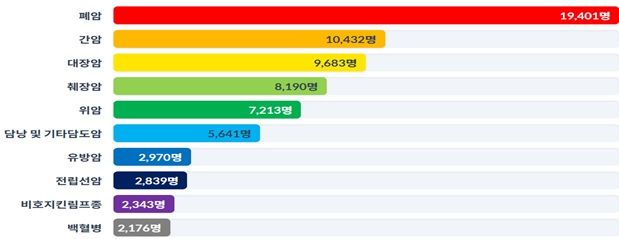
In terms of deaths, lung cancer recorded 19,401 deaths in 2024, compared with 10,432 for liver cancer and 9,683 for colorectal cancer, making lung cancer the deadliest among them.
Changes in the medical environment also support the need for reform. As 16-slice or higher computed tomography (CT) scanners have become widely available, calls are growing for the current screening institution designation standards to be reviewed in line with reality.
This structure is criticized for reducing access to screening and concentrating patients at a small number of institutions, even though lung cancer has the highest mortality rate among cancers. In particular, residents in regions with very few general hospitals that can provide screening — such as Sejong Special Self-Governing City, with one hospital, Daejeon with nine, and Ulsan Metropolitan City with nine — must travel to other areas to get screened.
As a result, proposals are being made to promote early diagnosis by allowing clinics and hospitals that meet the designation standards for staffing, facilities and equipment to apply for screening institution status. Another suggested reform is to reconsider the clause that limits eligibility for lung cancer screening institutions to general hospitals only.
An official from the Korea Association of Health Promotion said, "If improvements are made to lung cancer screening, the current screening rate of 52.7% could be raised to the level of other major cancers." The official added, "It is also expected to ease the burden on residents in regions with weak screening infrastructure, improve access and strengthen the cancer prevention safety net."
[email protected] Medical Reporter Jung Myung-jin Reporter