Esophageal Cancer Surgery Enters the Robot Era... "Survival and Recovery Both Improved" [Health Check]
- Input
- 2026-08-27 08:41:40
- Updated
- 2026-08-27 08:41:40
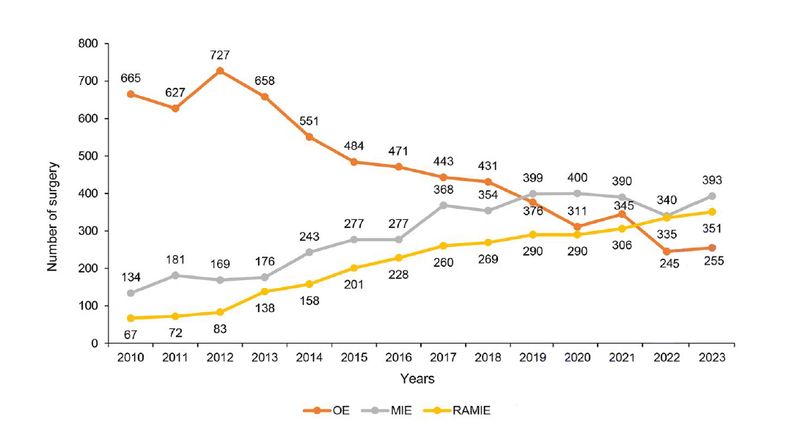
[Financial News] The 5-year survival rate for patients who underwent robotic surgery for esophageal cancer was 64%, 9 percentage points higher than the 55% seen in patients who had open-chest surgery. Robotic surgery also appears to be more advantageous not only for long-term survival but also for recovery after surgery.
A research team led by Professor Park Seong-yong of the Department of Thoracic and Esophageal Surgery at Samsung Seoul Hospital, resident physician Joon Beom Park, and Professor Kang Dan-bi of the Center for Clinical Epidemiology analyzed 13,608 patients who underwent esophagectomy for esophageal cancer from 2010 to 2023. They published the findings in Cancer Research and Treatment.
Surgery is considered a key treatment for esophageal cancer because it aims to cure the disease. In the past, esophagectomy was mainly performed through open-chest surgery, but advances in surgical techniques have expanded the use of minimally invasive procedures using thoracoscopy or robots.
Using data from the National Health Insurance Service (NHIS), the team tracked patients in South Korea who underwent esophagectomy for esophageal cancer between 2010 and 2023. The study found that during this period, 6,582 patients had open-chest surgery, 4,097 underwent thoracoscopic surgery, and 2,929 received robotic surgery.
The researchers compared differences by surgical method after accounting for patients' age, sex, comorbidities, and preoperative treatment, as well as hospital characteristics such as institution type and esophageal cancer surgery volume. As a result, the risk of bleeding was about 27% lower in patients who underwent robotic surgery than in those who had open-chest surgery.
Robotic surgery also showed better long-term survival. In the comparison of 5-year survival rates, robotic surgery recorded 64%, while open-chest surgery recorded 55%. Over a median follow-up period of three years, the overall risk of death was also 20% lower in the robotic surgery group than in the open-chest surgery group.
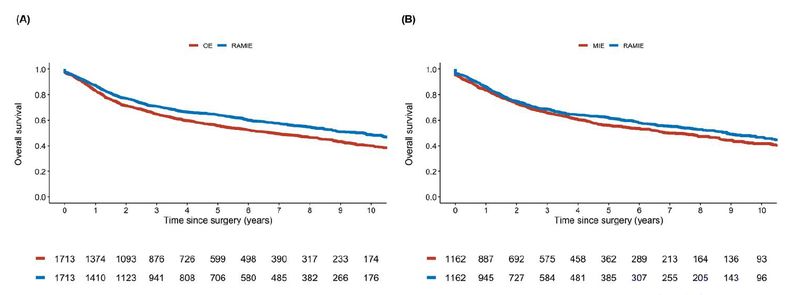
Compared with conventional minimally invasive surgery such as thoracoscopic surgery, the advantages of robotic surgery were seen mainly in the recovery period immediately after surgery. Patients who underwent robotic surgery had shorter hospital stays and shorter intensive care unit stays than those who had thoracoscopic surgery. They also had less bleeding requiring transfusion and a lower 90-day mortality rate.
The team added that although robotic esophageal cancer surgery has higher upfront costs, it was assessed as more cost-effective than open-chest surgery or conventional minimally invasive surgery when recurrence, complications, and quality of life were taken into account.
The researchers also stressed that to fully realize the benefits of robotic surgery, support is needed not only from surgical equipment but also from experienced surgical teams, systematic pre- and postoperative care, and a multidisciplinary care infrastructure.
Professor Kang Dan-bi said, "This study is meaningful because it confirmed the clinical value of robotic esophagectomy in real-world medical settings in South Korea using nationwide data," adding, "If more detailed information on cancer stage and recurrence is combined in the future, we will be able to determine more accurately what is the better option for patients."
Professor Park Seong-yong, the principal investigator, said, "Esophagectomy is a highly complex operation that involves both the chest and abdomen, so in order to improve patients' recovery and long-term outcomes, not only surgical precision but also systematic pre- and postoperative management is important." He added, "Minimally invasive surgery such as robotic surgery can deliver the best results when the experience of the medical team and the hospital's care infrastructure are supported together."
Meanwhile, the Department of Thoracic and Esophageal Surgery at Samsung Seoul Hospital continues to build its experience in robotic surgery. After introducing a dedicated da Vinci surgical robot for the department in 2023, it surpassed 1,000 cumulative robotic surgeries in 2025 and was also designated as an Epicenter, a robotic surgery training center by Intuitive Surgical.
In 2026, the hospital plans to further advance its minimally invasive surgical methods by introducing the latest robotic surgical systems, the da Vinci 5 robotic surgical system and the da Vinci SP, a single-port specialized robot, for lung and esophageal cancer surgery.
[email protected] Medical Reporter Jeong Myeong-jin Reporter