Hyundai Motor Company will not cut shareholder returns despite weaker earnings... to cancel 800 billion won in treasury shares this year
- Input
- 2026-08-27 08:08:52
- Updated
- 2026-08-27 08:08:52
[Financial News] Hyundai Motor Company will maintain its existing shareholder return policy despite external uncertainty and greater earnings volatility. The company plans to cancel about 800 billion won worth of treasury shares this year and keep its total shareholder return (TSR) above 35% through 2027. Analysts said the steady shareholder return policy should help support Hyundai Motor Company’s share price on the downside.
According to the securities industry on the 27th, Hyundai Motor Company reaffirmed at the 2026 Kia CEO Investor Day held the previous day that it would keep its existing value-up program in place.
Hyundai Motor Company is aiming for a total shareholder return of at least 35% from 2025 to 2027. It will maintain a minimum annual dividend per share (DPS) of 10,000 won and a minimum payout ratio of 25% or more. The company also plans to keep quarterly DPS at 2,500 won.
It will also continue to cancel treasury shares. Hyundai Motor Company plans to cancel 2.51 million treasury shares it holds this year. The cancellation is worth about 800 billion won. The company is using dividends and treasury share cancellations together to maintain the scale of shareholder returns.
Research analyst Lee Byung-geun of LS Securities Co., Ltd. said, "The fact that the company is maintaining its existing value-up policy despite greater earnings volatility is seen as a factor supporting downside valuation."
The company also raised its mid- to long-term growth targets. Hyundai Motor Company set a global sales target of 5.55 million units for 2030, up about 35% from 4.1 million units last year. It plans to raise its global market share from 4.7% to 6.0% and increase the share of electrified vehicles (xEV) in total sales from 23% to 60%.
Profitability targets were also raised. Based on a better product mix from expanding hybrid electric vehicle (HEV) sales and economies of scale in electrified vehicles, the company lifted its 2030 operating margin target from 8% to 9% to above 9%. In North America, it plans to build a lineup of more than 10 HEV models by 2030 and increase HEV sales to 50% of total sales.
Over the next eight months, it will launch seven key new models, including the new Elantra, the Ioniq 3, the new Tucson and Tucson Hybrid, and the Santa Fe EREV. By 2030, it plans to introduce more than 100 new models, including full redesigns, product upgrades, and new powertrains.
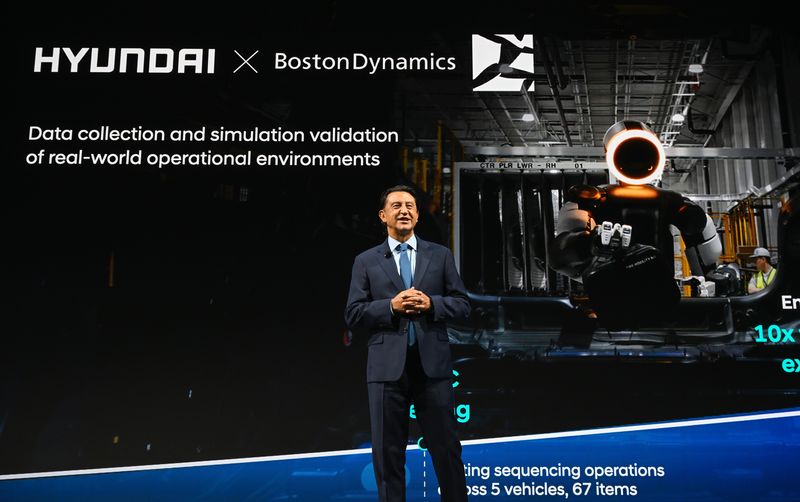
Robotics will also be developed as a new growth engine. Hyundai Motor Group plans to begin annual production of 30,000 commercial robots in the United States in 2028. The group will secure an initial batch of 25,000 units, easing the burden of early mass production before expanding sales to external customers in logistics and industrial sectors.
The analyst said of Boston Dynamics, "It is expected to shift from a simple research and development asset to a business that will drive both manufacturing innovation within the group and external sales."
[email protected] Choi Du-seon Reporter