Kim Jong-ho: "A statutory organization means responsibility, not power. We will strengthen self-regulation"
- Input
- 2026-08-27 09:00:00
- Updated
- 2026-08-27 09:00:00
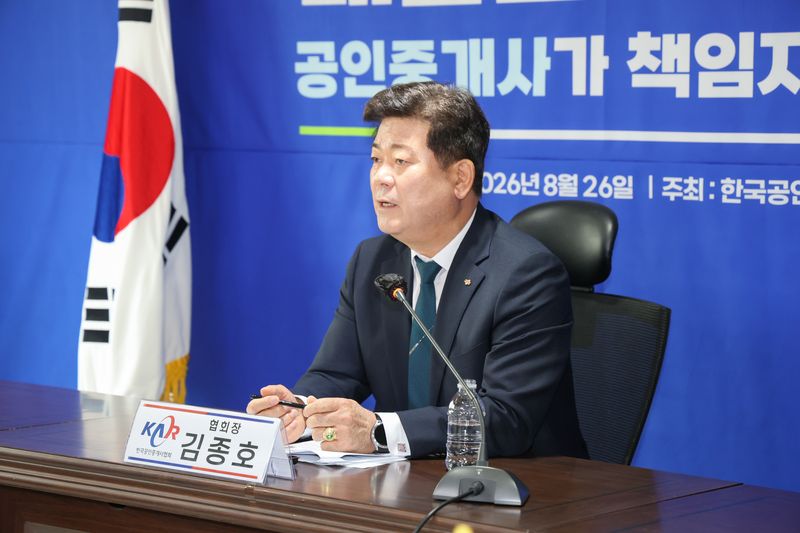
The association was launched as a statutory organization in 1986 but became a voluntary group in 1999. The revised Licensed Real Estate Agents Act designates the association as the sole statutory organization and requires it to establish a general assembly and carry out public-interest activities. Its ethics code must be approved by the Minister of Land, Infrastructure and Transport.
However, mandatory membership, authority to guide and discipline members, and the right to impose self-regulatory sanctions were left out. As of July 31, the association had 104,123 members out of 107,576 licensed real estate agents in business, or 97 percent. Kim argued that mandatory membership is necessary to protect consumers.
To make up for the lack of authority to guide and discipline members, Kim outlined a plan to operate a monitoring center where local members can share information on conduct that disrupts market order and on illegal brokerage by unregistered agents. Cases that cannot be directly sanctioned will be reported to the supervisory authorities for punishment. He also proposed lowering fines for mistakes that do not harm consumers while strengthening penalties for false conduct that causes damage.
When asked about a full investigation into whether more than 300 brokerage-related groups, including social clubs, were acting as cartels, he said, "Private gatherings have declined significantly," but did not disclose the progress of the review or the number of cases referred for detection or investigation.■ Burden of a real estate oversight agency: need for a fixed-rate brokerage fee systemAs bills related to a real estate oversight agency remain pending before the National Policy Committee, Kim said, "If a supervisory agency is created, it cannot be good for members," expressing opposition to the proposed new body. He argued that brokers are already subject to oversight by MOLIT and local governments, and that self-regulation among members is more effective than post hoc government supervision in preventing accidents.
He also called for deregulation to ease the slump in property transactions. According to the association, the annual average number of apartment transactions nationwide fell from 665,000 between 2017 and 2021 to 443,000 between 2022 and 2025. Kim criticized the permanent application of the Land Transaction Permit System and lending regulations, saying, "The fundamental solution is supply." He explained that a predictable supply roadmap is needed.
He also called for cuts in capital gains tax and Acquisition Tax, as well as a postponement of the third-stage stress DSR application for end users. He identified the rise in direct transactions and the closure of brokerage offices due to excessive numbers of agents as key issues, and said the association will maintain regular communication with the government.
Kim said, "Brokerage fees must clearly change," arguing that the current system, in which fees are negotiated within legal caps, should be replaced with a fixed-rate model. He said disputes arise when fees agreed upon at the time of contract are later reduced at the final payment stage, and that price competition lowers service quality. The association plans to discuss the gap in fees between monthly and jeonse leases with the government.
He did not withdraw his campaign promise to introduce a 'basic fee system for property viewings.' Kim said, "The goal is not to charge a viewing fee," adding that the association first wants to improve service quality by providing property reports and explaining ownership and rights issues.
The association will also upgrade its real estate information network, 'Hanbang,' to improve services. About 70 percent of contracts are written through Hanbang, but advertising use remains low because visibility is limited. The association plans to gather member listings on Hanbang to increase exposure, filter out false listings, and handle electronic contracts and transaction reporting. It is also considering limits on duplicate postings for the same property.
In closing, Kim said the association will fulfill its public responsibilities as a statutory organization and stated, "Going forward, the association will serve as a trusted guardian for the public and protect people's property rights."
[email protected] Jang In-seo Reporter