Lee Chang-heum deemed 'suitable' for Jeju's vice governor for climate and economy post... martial law response and economic experience remain questions
- Input
- 2026-08-26 21:07:47
- Updated
- 2026-08-26 21:07:47
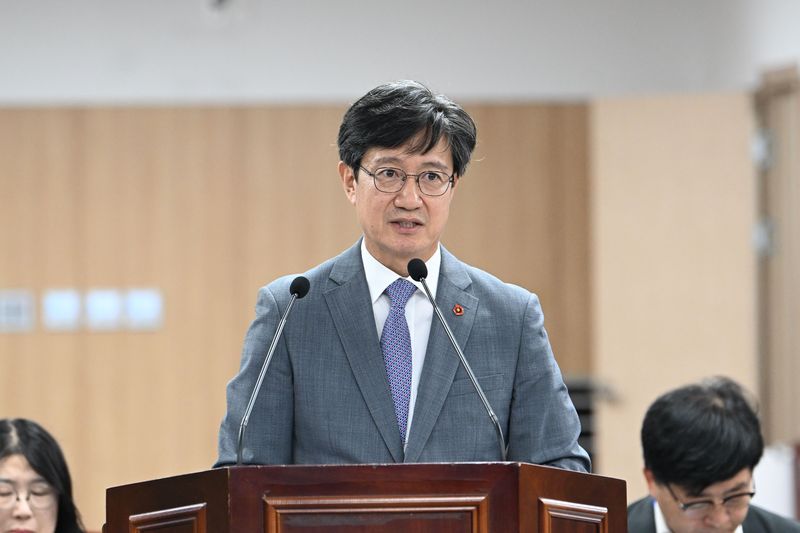
[Financial News, Jeju = Reporter Jung Yong-bok] Lee Chang-heum, former secretary for climate and environment at the Presidential Office and the first candidate for vice governor for climate and economy under Jeju's ninth popularly elected administration, has cleared the Jeju Special Self-Governing Provincial Council's confirmation hearing. The council gave a 'suitable' opinion, praising nearly 30 years of expertise in climate and environment and experience working with the central government. However, it also left room for improvement in his passive response during the December 3 Martial Law declaration, his lack of experience in energy and economic affairs, and his understanding of major Jeju issues.
According to the special committee on the confirmation hearing for the candidate for vice governor for climate and economy of the Jeju Special Self-Governing Provincial Council, the committee adopted a hearing report containing those findings after wrapping up the hearing for Lee on the 26th.
The committee positively assessed Lee's roughly 30 years of work on climate and environmental policy at the Ministry of Climate, Energy and Environment, the Wonju Regional Environment Office, and the Presidential Office, saying he had built up expertise and policy experience in carbon neutrality, the environmental industry, resource circulation, and environmental conflict mediation.
His ability to coordinate policy and work with central ministries was also cited as a reason for the favorable judgment. The committee said he could contribute to securing state funding, improving laws and systems, reflecting Jeju's interests in national plans, and fostering future industries by leveraging the network he built in the central government.
On the other hand, questions were raised about his responsibility as a senior public official and his potential to broaden his duties.
Lee was serving as secretary for climate and environment at the Presidential Office during the December 3 Martial Law declaration in 2024. At the hearing, he said he believed the declaration did not meet constitutional requirements, but admitted that he did not formally voice opposition or take specific action.
The committee pointed out that, even though he recognized the problem, he failed to act, and said a senior public official must demonstrate conviction and a responsible sense of public service through actual behavior.
When asked what he would do if the governor's judgment later conflicted with public service principles or his own professional assessment, Lee said, "I will put the interests of Jeju residents first and act at the risk of my position."
Energy, the economy, and future industries such as space and mobility, areas in which Lee has relatively little direct experience, were also subject to review among the responsibilities the vice governor for climate and economy will handle.
Lee acknowledged that he lacked expertise outside the environmental field and said he would study the relevant areas and work with experts, the provincial council, and local residents to make up for the shortcomings.
The exchange-traded fund (ETF) investments made by the candidate and his spouse also came under scrutiny. During the hearing, it was noted that they had invested a significant amount in multiple ETFs and had bought more during the preparation period. Lee explained that the money came from his retirement benefits and said he would consider disposing of the holdings later so they would not affect his duties.
Questions were also raised about a lack of volunteer work and donations. The committee said more effort was needed in terms of the social responsibility expected of senior public officials, and Lee said he would take part in volunteer and social contribution activities in the future.
The Second Airport, one of Jeju's most contentious issues, focused attention on what stance he would take between his judgment as an environmental expert and the policy judgment of the provincial government.
Lee said that environmental impact assessments go through review by expert institutions and a deliberation committee, so their results should be respected even if they differ from the governor's policy judgment. On whether he supports or opposes the Second Airport, he said he would manage the process by objectively verifying and disclosing the issues so that residents can reach a conclusion they can accept, rather than putting forward his personal view.
For Chuja Offshore Wind Power, the key issue was how to secure both linkage to the national power grid and a return of benefits to Jeju. Lee said he would seek a plan that brings benefits to Jeju and its residents by consulting with the government while considering public interest, business viability, and local acceptance together.
As the direction of climate and economy policy, he proposed a structure that returns Jeju's renewable energy gains to residents. He said he would connect the energy transition and carbon reduction to industry, jobs, and resident income, and create a structure in which future industries such as AI, energy, space, and biotech do not remain limited to demonstration projects but produce results for Jeju companies and the local economy.
The committee recommended that, if he is ultimately appointed, he should transparently disclose major policy implementation processes to the provincial council and local residents, and strike a balance among environmental protection, future industry development, and the interests of residents.
The hearing report adopted that day by the special committee on personnel hearings of the Jeju Special Self-Governing Provincial Council will be sent to Jeju Island via the chair of the provincial council. Governor Wi Seong-gon will review the report and decide whether to make Lee's appointment final.
Lee, who is from Sinrye-ri, Namwon-eup, Seogwipo-si, passed the 40th Higher Civil Service Examination and entered public service in 1997. He has served as secretary to the environment minister, Policy Planning Officer, head of the Wonju Regional Environment Office, head of the Climate and Carbon Policy Bureau, and secretary for climate and environment at the Presidential Office. He is the first Jeju-born environmental official to rise to senior-level official at the Ministry of Climate, Energy and Environment.
[email protected] Jung Yong-bok Reporter