Key Switch Found to Break Alzheimer’s Vicious Cycle
- Input
- 2026-08-27 00:00:00
- Updated
- 2026-08-27 00:00:00
[Financial News] A key factor that accelerates the vicious cycle of Alzheimer's disease (AD) has been identified. The finding opens the door to a new treatment strategy that could ease multiple pathological changes at once by targeting a single molecule.
The Ministry of Science and ICT announced on the 27th that a research team led by Won-Suk Chung, deputy director of the Center for Vascular Research at the Institute for Basic Science (IBS) and associate professor in the Department of Biological Sciences at Korea Advanced Institute of Science and Technology (KAIST), has identified a key regulatory factor that disrupts the balance between neural circuits and synapses in Alzheimer's disease and drives the disease forward in a chain reaction.
The study was carried out through the Ministry of Science and ICT's IBS basic science research center support program and was published at 12:00 a.m. KST on August 27 in the world-renowned journal Nature.
The researchers focused on the imbalance in neural circuits and synapses that appears from the early stages of the disease. In the hippocampus of an AD model mouse, they found that excitatory neurons, which stimulate brain circuits, were overactivated, while inhibitory neurons, which suppress them, showed a sharp decline in activity. In addition, non-neuronal astrocytes and microglia excessively eliminated excitatory synapses, while removing fewer inhibitory synapses, further deepening the imbalance in neural circuits.
The team found that the root cause of this uneven synapse loss was ultimately the abnormal activation state of neurons. When neuronal activity was artificially increased, glial cells removed more synapses. When activity was reduced, they removed fewer.
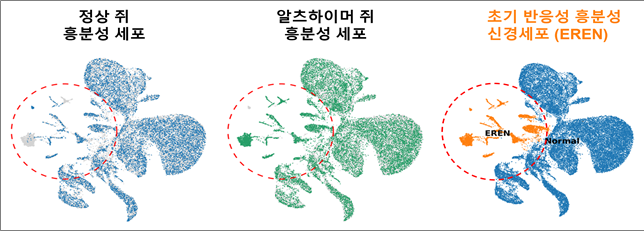
Based on this, the researchers traced the molecular cause and found that the ERBB4 receptor, which is present in inhibitory neurons in the healthy brain, was markedly increased in a specific group of excitatory neurons. They named these cells early responsive excitatory neurons (EREN) and identified ERBB4 as the key factor triggering circuit abnormalities. ERBB4, or erb-b2 receptor tyrosine kinase 4, is a receptor protein that senses external signals at the cell membrane and regulates cell growth, differentiation, and neuronal function.
The researchers then used gene-editing technology to selectively remove ERBB4 only from excitatory neurons in AD model mice. As a result, the excessive activity of excitatory neurons decreased, and the reduced activity of some inhibitory neurons was restored. Abnormal synapse removal by glial cells and inflammatory responses were also eased, while the area and number of amyloid plaques fell by more than 50%. Memory and spatial cognition also improved significantly.
Conversely, when ERBB4 was expressed in excitatory neurons of normal mice, AD-like pathological changes appeared even in the complete absence of amyloid plaques, including hyperactivity in neural circuits, synaptic imbalance, and inflammatory responses in glial cells.
The team also demonstrated the mechanism by which increased ERBB4 activates the mTOR signaling pathway, which regulates cell growth and metabolism, causing pathology to spread to surrounding regions. In an analysis of brain tissue from 446 people, ERBB4 expression in excitatory neurons from patients with AD was significantly higher, and higher expression levels were associated with greater amyloid plaque accumulation and more severe cognitive decline. mTOR is an intracellular signaling protein that regulates a wide range of biological processes, including cell growth, metabolism, and protein synthesis.
This confirms that changes in ERBB4 are not merely a phenomenon accompanying Alzheimer's disease, but a key regulatory factor that drives the chain progression of multiple pathological changes.
Won-Suk Chung, deputy director of the IBS Center for Vascular Research, said, "We expect this to contribute to the development of a new therapeutic strategy that targets the core link in the disease's vicious cycle and simultaneously alleviates complex and diverse pathologies."
[email protected] Youn Ji-an Reporter