Governor Wi Seong-gon Proposes 40MW Data Center to Government, Says Jeju Should Become an AI Testbed City
- Input
- 2026-08-26 18:20:29
- Updated
- 2026-08-26 18:20:29
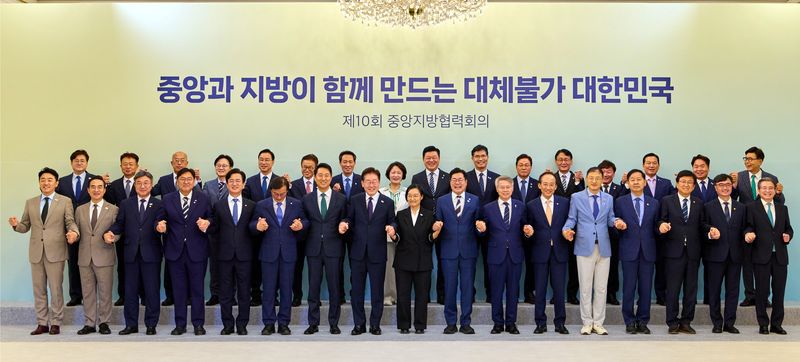
[Financial News, Jeju = Reporter Jung Yong-bok] Jeju Province has proposed to the government a strategy to grow into an "AI testbed city" that would be the first in South Korea to trial new technologies, by combining a 40MW artificial intelligence data center powered by renewable energy with a joint campus linking the four science and technology institutes. The plan envisions bringing companies, researchers, and new industries to Jeju by integrating AI with energy, space and aviation, biotech, and mobility, while also adding regulatory exemptions.
According to Jeju Special Self-Governing Province on the 26th, Governor Wi Seong-gon attended the 10th Central-Local Cooperation Meeting at Cheong Wa Dae, chaired by President Lee Jae-myung, and presented "Jeju-region AI transformation" and a "joint campus linking the four science and technology institutes with Jeju Province" as local-led growth strategies.
AI transformation refers to the shift of existing industries, administration, and services toward an AI-centered model. Jeju Province has focused its policy on linking the region's renewable energy and future-industry base with AI infrastructure.
The core infrastructure is a 40MW green AI data center operated entirely on renewable energy. The plan is to supply the large-scale power needed for AI computing with clean energy produced in Jeju Province, and to use the data center as a base for testing and R&D by companies and research institutions.
Rather than building the data center as a stand-alone facility, Jeju Province intends to connect it to the AI transformation of local industries. The idea is to apply AI to strategic sectors that Jeju Province is nurturing, including energy, space and aviation, biotech, and mobility, and to test and commercialize new technologies and services in real-world settings.
The province also proposed a reform of the regulatory system. It wants to create an environment where companies can quickly test new technologies in Jeju Province by adopting a negative-list approach, which allows new technologies and services unless they are explicitly restricted, along with a Jeju-style regulatory free zone.
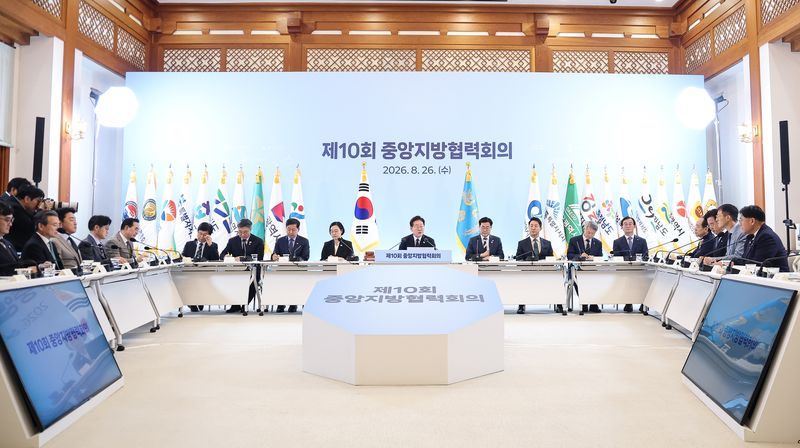
Governor Wi said, "We will create a model in which innovative technologies and services are first demonstrated in Jeju Province and then expanded nationwide," adding, "I ask the government to help make Jeju Province the country’s first testbed city where people encounter the future of South Korea first."
Jeju Province also outlined a strategy to secure talent for AI and future industries. It is promoting a "joint campus linking the four science and technology institutes with Jeju Province" to connect the educational and research capabilities of KAIST, GIST, DGIST, and UNIST with Jeju Province’s future industries.
At the joint campus, students and researchers in clean energy, space, biotech, and mobility would work with companies and research institutions in Jeju Province to study real industrial problems. The goal is to link research outcomes to technology commercialization and startups, while building an industrial and research ecosystem that can keep talented people in Jeju Province.
Governor Wi said, "Regional industries can grow only when talented people can develop and stay in the region," adding, "We will develop the joint campus into a new model for national talent development and regional innovation."
The proposal comes as the government moves to strengthen local government-led growth strategies as one pillar of its balanced national development policy.
At the meeting, President Lee Jae-myung described strong balanced development across the country as an essential strategy for South Korea’s sustainable growth and stressed cooperation between the central and local governments. The meeting also discussed local-led growth measures, regional growth engines linked to the three major megaprojects, and directions for fiscal investment to promote balanced regional growth.
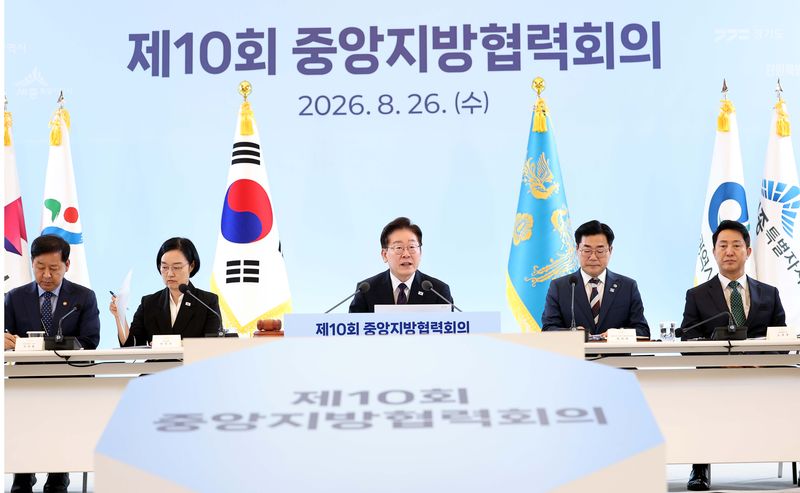
Along with its future-industry strategy, Jeju Province also raised the issue of air access with the government. Governor Wi explained the recent decline in domestic seat supply to Jeju Province and requested expanded slots at Jeju International Airport and more domestic flights. In Jeju Province, where tourism and the movement of companies and workers depend heavily on air travel, accessibility is seen as directly tied to tourism and industrial competitiveness.
Jeju Province emphasized that expanding domestic flight supply could also help the government reach its goal of attracting 30 million foreign visitors to South Korea.
In the energy sector, the province also submitted a written request to the government for a plan to connect the Chuja offshore wind power project to the mainland grid and to develop floating offshore wind power in Jeju Province as a national demonstration hub.
The request calls for the Chuja offshore wind power project’s connection to the national grid to be reflected in the 12th Basic Plan for Electricity Supply and Demand and in the national power grid plan, so that electricity generated by offshore wind in Jeju Province can be supplied to advanced industries such as semiconductors and AI data centers in the Honam region.
The province also proposed creating a national demonstration hub so that floating offshore wind power and next-generation power grid technologies can be tested in Jeju Province’s waters.
Jeju Province plans to continue consultations with relevant ministries to link Jeju Province’s AI transformation, the joint campus connecting the four science and technology institutes with Jeju Province, and the national grid connection for offshore wind power to government policy and national fiscal projects.
[email protected] Jung Yong-bok Reporter