How Far Should AI Be Trusted to Make Decisions in Space Exploration? 300 People from 17 Countries Gather in Jeju
- Input
- 2026-08-26 17:47:54
- Updated
- 2026-08-26 17:47:54
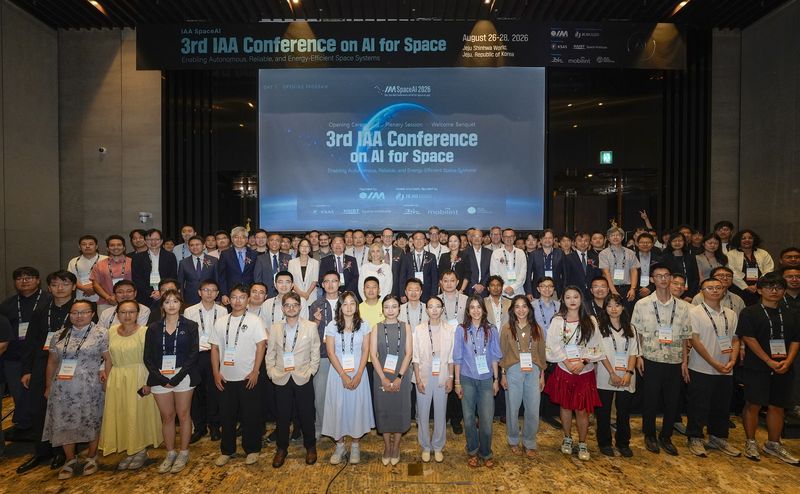
[Financial News, Jeju = Reporter Jongyongbok] How much of a spacecraft's core decision-making can be entrusted to artificial intelligence (AI) on the Moon and Mars, where real-time communication with Earth is difficult? More than 300 space and AI experts from 17 countries are gathering in Jeju to closely examine the autonomy, reliability and safety of space systems.
According to Jeju National University (JNU) and the International Academy of Astronautics (IAA) on the 26th, the 3rd IAA Conference on AI for Space (IAA SpaceAI 2026) opened that day at Jeju Shinhwa World. The event runs for three days through the 28th, with more than 170 research papers to be presented.
This year's theme is "Building autonomous, trustworthy and energy-efficient space systems." Moving beyond the question of whether AI can be applied to space missions, the key issue is how much autonomy should be allowed when actual spacecraft and satellites make decisions and act on their own, and how that autonomy should be verified.
AI cannot be used in space in the same way it is used on the ground. The farther a mission moves from Earth, as in the case of the Moon or Mars, the longer the communication delay becomes, and the power and computing resources available to spacecraft are also limited. That is why the ability to change mission sequences or determine travel routes independently, without waiting for commands from Earth when unexpected situations arise, is becoming increasingly important.
At the same time, a wrong decision could lead to the loss of a spacecraft worth hundreds of billions of won or the failure of an entire mission. That makes it essential to verify how far AI decisions can be trusted.
According to the IAA, major research areas include autonomous spacecraft operations, deep-space autonomy, space robotics, onboard AI for satellites, high-efficiency AI semiconductors, hardware reliability in space environments, and AI safety, accountability and standards.
From the first day of the conference, studies applying AI to real space missions were presented in depth. Dario Izzo of the European Space Agency (ESA) presented research combining AI and astrodynamics to solve spacecraft guidance, control and orbital problems. Professor Jung Hong Ju of York University discussed motion planning for free-flying space robots using reinforcement learning.
Steve Chien of NASA's Jet Propulsion Laboratory (JPL) and the California Institute of Technology (Caltech) presented real-world examples of how much AI can be trusted in Mars exploration. A key topic was autonomous planning technology that allows the Perseverance rover on Mars to carry out its mission by adjusting its own schedule rather than relying only on detailed commands from Earth.
Professor Simone D'Amico of Stanford University discussed the autonomous operation of formation-flying and swarm satellites, in which multiple satellites cooperate with one another. Professor Hyochoong Bang of KAIST introduced technology that allows onboard AI to process vast amounts of hyperspectral imagery captured by satellites directly in space, without sending all of it back to Earth.
The conference will feature research on applying AI across the full range of space missions, including guidance, navigation and control of spacecraft, rendezvous and docking, lunar and planetary exploration, Earth observation, space domain awareness and satellite-constellation operations.
It will also discuss how recent AI technologies such as reinforcement learning, large language models (LLM), AI agents and digital twin systems can play a role in space systems. Research will also focus on semiconductors and computing technologies for running AI with limited power, as well as technologies that ensure stable operation in harsh space environments such as radiation and extreme temperatures.
In particular, a special panel discussion will be held on the 27th under the theme, "Will AI become a core technology for space exploration, or are there still greater barriers to overcome?"
The session will be moderated by Hyojung Ahn, professor in the Department of Artificial Intelligence at Jeju National University. Participants include Professor Jae-Hung Han of KAIST, Jean-Michel Contant, secretary-general of the IAA, Professor Jung Hong Ju of York University, Professor Pan Binfeng of Northwestern Polytechnical University in China, Dario Izzo of ESA, and Steve Chien of JPL.
They are expected to discuss how to prove the reliability of AI decisions, what verification should be carried out through actual spaceflight, and how responsibility should be determined if an accident occurs.
The IAA Conference on AI for Space is being held in Jeju for the third time this year, following the first event in the United Kingdom in 2024 and last year's conference in Suzhou, China.
The event is hosted by the International Academy of Astronautics (IAA), with Jeju National University (JNU) serving as the local organizer and overall host. It is co-hosted by the Korean Society for Aeronautical and Space Sciences and the KAIST Space Institute, and supported by Jeju Special Self-Governing Province, the Jeju Tourism Organization and Mobilint.
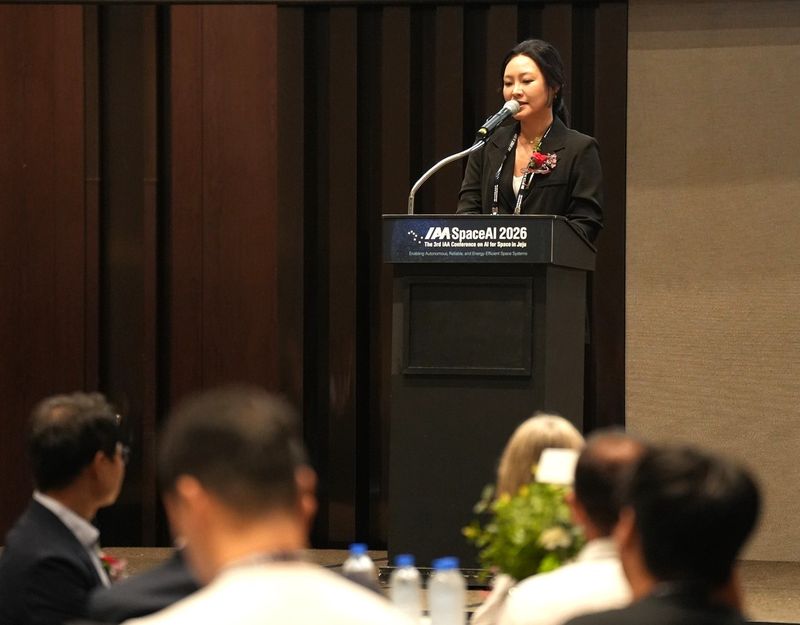
Hyojung Ahn, chair of IAA SpaceAI 2026, said, "The question about AI in the space sector is shifting from 'Can we use it?' to 'How far can we entrust it with mission-critical decisions, and what must be verified for it to be trustworthy?'" She added, "I hope the Jeju conference will become an opportunity to expand cooperation between domestic researchers and global research teams."
The 2026 Jeju Global Future Aerospace Confesta will also be held at Jeju Shinhwa World on the 27th and 28th. It will connect the space AI research discussed at the international conference with domestic aerospace companies and policy officials, while exploring the potential for industrial application of the research results.
[email protected] Jongyongbok Reporter