Acquisition tax on a 12.1 billion won apartment to jump from 360 million won to 1.33 billion won... Government to curb 'common-area loopholes'
- Input
- 2026-08-26 17:46:35
- Updated
- 2026-08-26 17:46:35
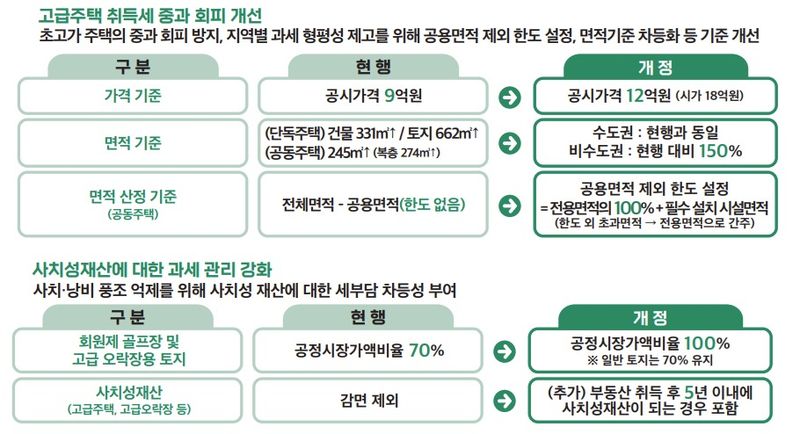
[Financial News] The government will block a loophole that has allowed ultra-expensive apartment complexes to avoid higher acquisition tax rates by reducing their exclusive floor area below the luxury-home threshold and expanding common areas such as storage rooms and parking spaces that are effectively used by a single household.
According to the 2026 local tax reform plan announced on the 26th by the Ministry of the Interior and Safety (MOIS), apartment complexes are currently classified as luxury homes if they meet certain criteria, including price and floor area, and are then subject to a higher acquisition tax rate than ordinary homes. The floor-area threshold for apartment complexes is an exclusive floor area of more than 245 square meters. As a result, critics have pointed out that developers can design exclusive floor space just below the threshold and widen common areas such as storage rooms or parking spaces that are effectively used only by the household, thereby avoiding the higher tax rate.
In one case, an apartment in Seoul that sold for 12.1 billion won last year had an officially assessed value of 8.5 billion won, but its exclusive floor area was 244.34 square meters, just 0.66 square meters below the current 245-square-meter standard. By contrast, its common area was 402.58 square meters, about 1.6 times the size of the exclusive area. Under the current rules, the apartment was taxed at 3%, resulting in an acquisition tax of 363 million won.
Under the revised plan, common areas exceeding 100% of the exclusive floor area will be added to the exclusive floor area, causing the property to be classified as a luxury home. As a result, the acquisition tax rate will rise to 11%, and the tax bill will increase to 1.331 billion won. That is 968 million won more than under the current system.
To implement this, the government will count common areas that exceed 100% of the exclusive floor area as part of the exclusive floor area. However, essential shared facilities used collectively by residents, such as management offices, daycare centers and playgrounds, will be excluded from the calculation.
The price threshold for luxury homes will also be raised from the current 900 million won in officially assessed value to 1.2 billion won, reflecting the rise in housing prices. MOIS explained that an officially assessed value of 1.2 billion won is roughly equivalent to a market transaction price of 1.8 billion won. The floor-area standard will be applied differently in the Capital Region and Non-metropolitan areas. The current standard will remain in place in the Capital Region, while the threshold in Non-metropolitan areas will be expanded to 150% of the Capital Region standard. The move reflects housing market conditions outside the Capital Region, where homes tend to be larger but cheaper. Separately, standards such as elevators and swimming pools, which had previously been used to determine luxury homes, were already abolished on Jan. 1 after criticism that they no longer reflected reality.
MOIS plans to announce the bill in November and implement it on Jan. 1, 2027. The new standards will apply to homes acquired on or after that date.
Taxation on luxury assets will also be tightened. The fair market value ratio for property tax on private golf courses and land used for upscale entertainment venues will be raised from the current 70% to 100%. In addition, penalties for taxpayers who refuse local tax audits or avoid submitting documents will be strengthened. Fines will rise from the current 2 million won for the first offense, 3 million won for the second, and 5 million won for the third and beyond, to 20 million won, 30 million won and 50 million won, respectively. If a taxpayer continues to refuse to submit books or records, the government also plans to impose a coercive daily fine of 1 million to 3 million won, depending on total assets or sales.
[email protected] Lee Bo-mi Reporter