Industrial electricity rates outside the capital area to fall by up to 10%, but Jeju is left out
- Input
- 2026-08-26 17:24:47
- Updated
- 2026-08-26 17:24:47
[Financial News, Jeju = Jung Yong-bok] The government will introduce a regional tiered electricity pricing system within this year to encourage companies to relocate to the provinces and expand investment, lowering industrial power rates outside the capital area by as much as 10%. Jeju Province, however, has been left out because of its island status and unique power supply conditions, giving it a new pricing disadvantage as it competes with other non-capital regions to attract companies and industrial projects.
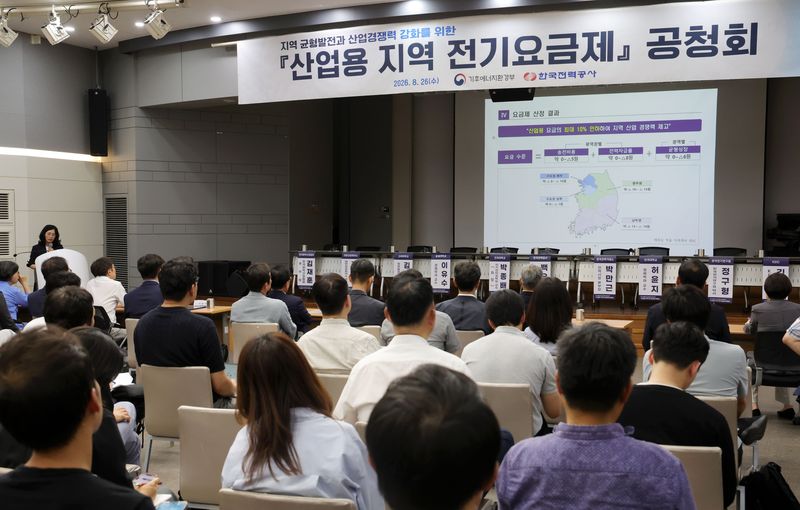
According to the Ministry of Climate, Energy and Environment and KEPCO on the 26th, they held a public hearing on the "regional industrial electricity rate system" at KEPCO's Namsan Seoul headquarters in Yeongdeungpo District and unveiled the draft design for differentiated regional tariffs for the first time.
A detailed pricing framework was presented two years and two months after the Special Act on Activation of Distributed Energy took effect in June 2024.
The key is to add a new "regional adjustment charge" to industrial electricity rates, which have so far been applied uniformly nationwide. The current tariff structure consists of a basic charge, an energy charge, a climate and environment charge, and a fuel cost adjustment charge. The new regional adjustment charge will be added to set different rates depending on where electricity is generated and consumed.
The system will apply to all industrial power users. As of last year, industrial electricity accounted for 51% of KEPCO's total sales volume. The government believes that if companies with high electricity demand choose factory and business locations based on power cost differences, electricity demand concentrated in the capital area can be dispersed to non-capital regions.
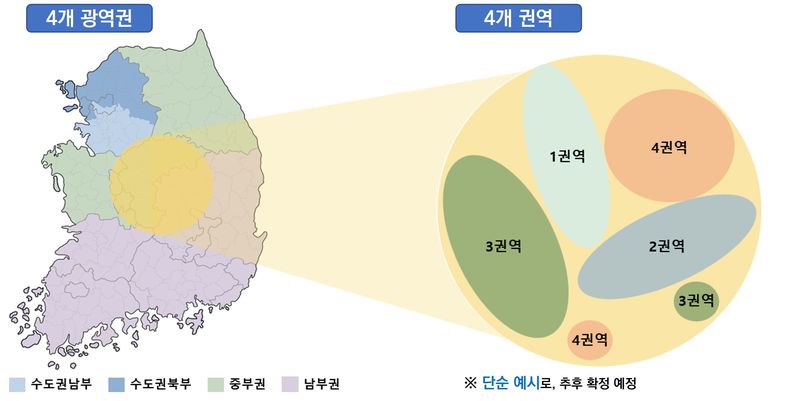
The regions will be divided into 11 areas by combining two criteria: the power grid and balanced regional development.
Based on the power grid, four broad zones will be set: the southern Seoul metropolitan area, the northern Seoul metropolitan area, the Central Region, and the southern region. The southern Seoul metropolitan area includes Seoul and southern Gyeonggi Province, while the northern Seoul metropolitan area covers Seoul, northern Gyeonggi region, and Incheon. The Central Region includes Gangwon State and the Chungcheong region, and the southern region includes the Gyeongsang region and the Jeolla region. These are then further divided into 11 final areas by applying four additional zones that reflect balanced development factors such as the local preference index and industrial crisis areas.
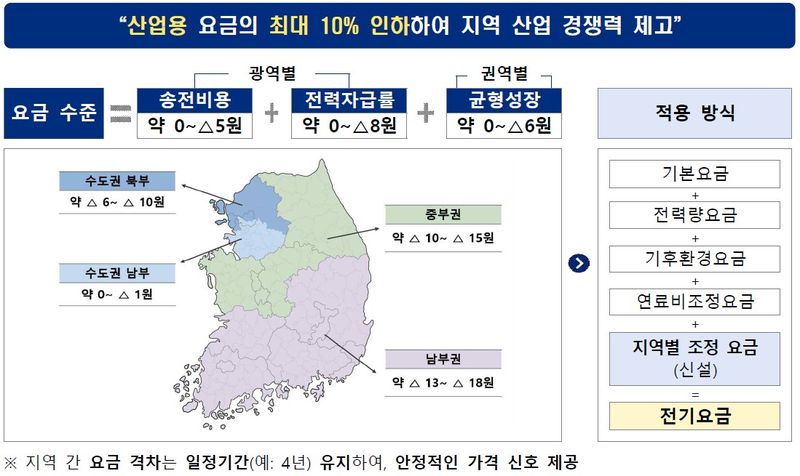
Rates will be determined by three factors: transmission costs, self-sufficiency in power generation, and balanced growth. The lower the grid usage cost, the greater the local generation capacity, and the stronger the need for balanced regional development, the lower the electricity rate will be.
Under the calculation plan released by the government, the southern Seoul metropolitan area will see rates remain unchanged or fall by about 1 won. The northern Seoul metropolitan area will see cuts of 6 to 10 won, the Central Region 10 to 15 won, and the southern region 13 to 18 won.
The cheapest southern region, one of the four balanced-growth zones, would see rates cut by as much as 18 won, or about 10% of last year's average industrial electricity sales price of 181.9 won.
Jeju Province, however, will not be subject to the regional adjustment charge.
The government and KEPCO stated in the draft plan that "Jeju Province will be excluded from application in consideration of its island status and special power supply conditions." Jeju was also not included as a separate region in the nationwide tariff calculation.
The exclusion of Jeju is significant, given that the new system is directly tied to regional industrial policy.
The government plans to use lower electricity rates outside the capital area as a price signal to encourage investment and corporate relocation by power-intensive advanced industries. It also expects existing local companies to reduce production costs and improve both cost competitiveness and export competitiveness.
While other non-capital regions may use industrial electricity cuts of up to 10% as a new tool to attract companies, Jeju Province will not receive the same benefit. In future competition to secure investment from manufacturing and other power-intensive industries, electricity price differences could become a key factor in location decisions.
The government estimates that the new system will reduce the industrial sector's electricity burden by about 2.8 trillion won. The final amount may vary depending on how the detailed regional zones are finalized.
Funding will be secured through improvements to the electricity market system and more detailed regional transmission cost calculations. A regional wholesale pricing system, which applies different wholesale electricity trading prices depending on supply and demand conditions in the capital area and non-capital regions, will also be introduced in parallel.
KEPCO will also reflect regional differences in transmission costs in tariffs and absorb part of the burden itself. The government plans to provide financial support as well, easing KEPCO's financial strain.
The ministry and KEPCO plan to finalize the detailed regional zones by reflecting opinions raised at the public hearing, then complete follow-up procedures such as revising related notices and electricity tariff terms before implementing the system within this year.
[email protected] Jung Yong-bok Reporter